
Almost every preparedness guide is written for a house. Store water in the garage, put the generator outside, keep a month of food in the basement — none of which exists in a fourth-floor one-bedroom.
Apartment living isn't worse for preparedness, it's different. Some things get easier, like heat retention and having sixty neighbours nearby. Some get harder, and those are worth planning around properly rather than pretending a house checklist will stretch. Everything else in standard household preparedness applies as written.
Getting Out of a Building, Not a House
In a house, evacuation means the front door. In a building it means a specific stairwell, in the dark, possibly with other people coming down behind you.
Walk both stairwells once, all the way down, before you need to. Count the floors by feel, note which doors are locked from the inside, and find out where each one actually exits — buildings have a habit of putting one stairwell out into a service yard behind a gate. Then decide which one is your default and write it on the plan.
Two more things belong on that plan. The elevator is out of the picture entirely, which changes the calculation for anyone who can't manage stairs — that needs naming and solving in advance, not improvising. And the meeting point is not "outside," it's a named corner or a specific storefront across the street, far enough that a fire service response has room to work.
If you're in a high-rise
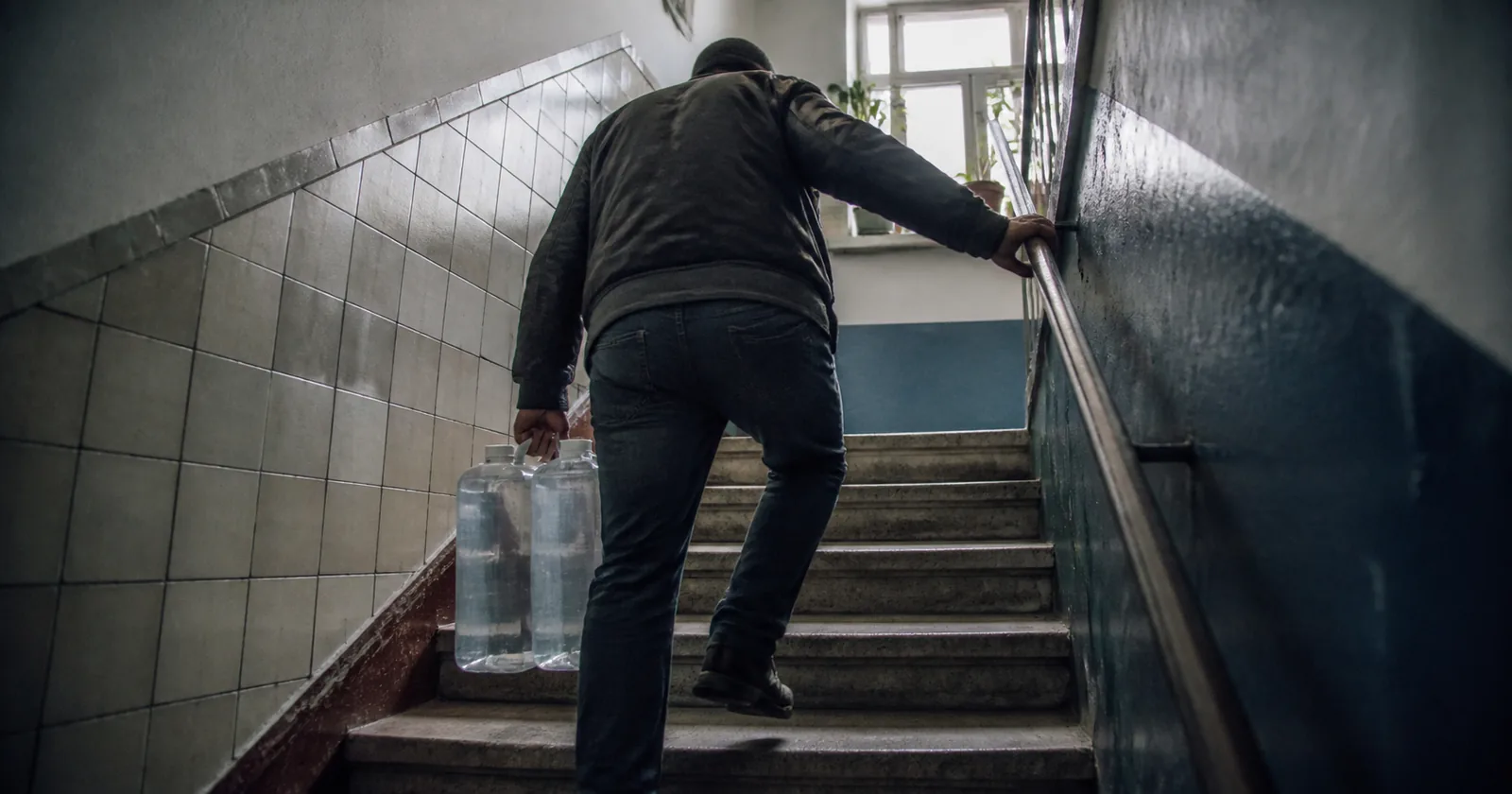
In many multi-storey buildings, upper-floor water service depends on pumps, so taps higher up can go dry during a power cut while the ground floor still runs. Where the cut-off sits depends entirely on the building — worth asking rather than assuming. Stair descent with anything heavy also becomes a real physical event, which changes what's worth packing.
New York requires many residential buildings to have a written emergency preparedness and evacuation plan and to make it available to residents. Rules elsewhere vary, so ask your management either way — the plan will tell you whether your building's policy is evacuate or shelter in place, and those are opposite instructions.
Water and Food Without a Basement
Water is the hard one, because it's heavy and there's nowhere to put it. A gallon a day per person is the standard figure, and three days of that for two people is roughly fifty pounds of stuff in an apartment that has no obvious empty corner.
Two things make it workable. Store it in containers a person can actually move — several small ones rather than one large, because a full five-gallon jug weighs over forty pounds and that's a genuine problem for anyone with a bad shoulder or a bad back. And use the dead space: under the bed, the bottom of a wardrobe, behind the sofa, the gap above the kitchen cabinets. Flat stackable containers exist precisely for this and are worth the small premium. Water storage covers the container types in detail.
Food is easier than people expect. Skip the bucket of freeze-dried meals and buy more of what's already in the cupboard — the tinned things and dry things you eat anyway, rotated normally. It costs less, it takes no learning, and nothing expires unnoticed in a corner.
Heat and Cooking When the Power Goes
This is where apartment advice diverges most sharply from house advice, and it's the section that matters most, because getting it wrong kills people every winter.
Nothing that burns fuel goes on indoors. Not a camping stove, not charcoal, not a patio heater, not a generator on a balcony, not the gas oven left open for warmth. There is no version of this that is safe in a sealed apartment, and a balcony or a cracked window does not make it safe.
What works instead: layers, sleeping bags, and closing off one room. A small apartment holds heat well, and a single room with the door shut and a blanket over the window stays liveable far longer than most people expect. Cold food for a couple of days is unpleasant and entirely survivable.
For light, battery lanterns only — no candles in a small space with a cat, a curtain and no smoke detector you control. And power banks matter more here than in a house, because there's no car in a driveway to charge from.
Your Building Is Part of the Plan
Renters tend to treat the building as someone else's problem, which is understandable and also the thing that leaves you short on information. Three questions to the management office are worth an afternoon of reading:
- Is there a building emergency plan, and does it say evacuate or shelter in place?
- Is there any backup power, and does it cover the water pumps, the lifts, the hallway lights, or only the fire systems?
- Where are the main shutoffs, and who is on call outside office hours?
Then meet two neighbours properly. Not a plan, just names and numbers — one on your floor, one somewhere else in the building. Everything about apartment emergencies works better when the person banging on the door already knows who lives behind it.
Walk your stairwells this week, then ask the building for its emergency plan. Those two answers change more of your plan than anything you can buy.
FAQ: Apartment Emergency Preparedness
How do I store water in a small apartment?
In several small containers rather than one big one, tucked into dead space — under the bed, the bottom of a wardrobe, above the kitchen cabinets. Flat stackable containers are designed for this. Weight is the real constraint, not volume.
Can I use a camping stove or a small heater indoors during an outage?
No. Nothing that burns fuel, ever, including on a balcony or beside an open window. Carbon monoxide poisoning is a recognised cause of death during winter outages, and it gives no warning.
What about NYC apartment building emergency preparedness specifically?
New York requires many residential buildings to maintain an emergency and evacuation plan and to share it with residents. Ask the management for yours — it will tell you whether the building's policy is evacuate or shelter in place, and where the assembly point is.
Should I keep a go bag if I live on a high floor?
Yes, and keep it lighter than a house go bag. Everything in it may have to come down eight flights on foot, and a bag that's too heavy to carry down stairs gets left behind.
Is a winter preparedness checklist different for an apartment?
Mainly in one way: heating is not yours to control and combustion is off the table. The plan becomes layers, closing off one room, and knowing whether the building has backup power.
What if I can't use the stairs?
Raise it with building management now and get it into the building's plan, and register with your local emergency management office if they run an assistance list. This is arranged in advance, never on the day.
Sources
- Ready.gov — Make a Plan, Home Fires
- CDC — carbon monoxide poisoning prevention
- FEMA — sheltering guidance
- NYC Emergency Management — residential building emergency planning
- Local fire departments and building management
When a warning is active, follow local authorities and official emergency instructions before any general guidance. See our Editorial Policy and Sources & Fact-Checking.