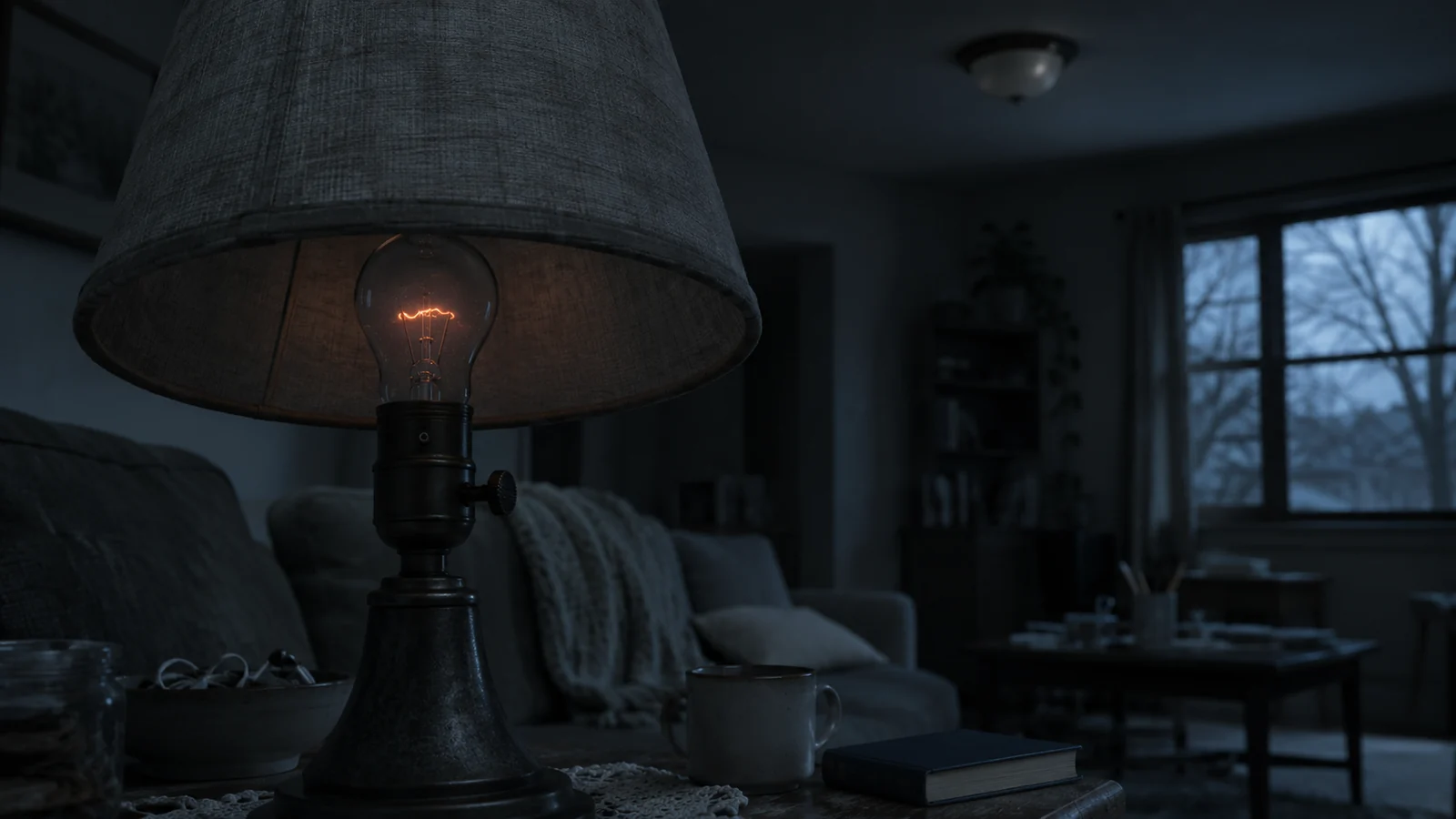

The words get used interchangeably in news reports and they describe genuinely different electrical events. One is the absence of power. The other is power that is still arriving, at a voltage too low to be useful, which is in some ways the more damaging of the two.
Here is blackout vs brownout in one line each, then what each does to the equipment in your house and why utilities sometimes choose one deliberately.
The Two Words, Precisely
A blackout is the complete loss of electrical supply to an area. Nothing arrives at the meter. It can be a fault — a storm, a fallen tree, a failed transformer, a substation fire — or it can be intentional, as with a public safety power shutoff ahead of extreme fire weather. From inside the house the experience is binary: everything stops at once.
A brownout is a drop in voltage rather than a loss of it. The supply continues, below its nominal level, either because demand is outstripping what the system can deliver or because the utility has reduced voltage deliberately to shed load and keep the grid intact. The name comes from what incandescent lamps used to do when it happened: dim to a brownish glow rather than switch off.
The brownout experience is less obvious and more confusing. Lights dim or flicker without going out, a motor labours or hums, a fan runs slow, the television picture shrinks or the set reboots, a computer behaves oddly. Nothing has clearly failed, which is precisely why people do not react.
The useful distinction behind blackout vs brownout meaning is therefore not severity but kind: a blackout is an absence you cannot miss, a brownout is a degradation you easily can.
Rolling Blackouts Are a Third Thing
A rolling blackout is a controlled, rotating interruption. When demand threatens to exceed supply — a heat wave with every air conditioner running, a deep freeze with every heater on, a generation shortfall — the operator cuts power to one area for a defined period, restores it, and moves to the next. Each neighbourhood goes dark for a while so that none of them go dark for a long time.
The reason this exists is unglamorous and important. If demand exceeds supply and nothing is shed, protective equipment begins tripping automatically, and an uncontrolled cascade can take down a whole interconnection. Restarting a collapsed grid takes days rather than hours. A rolling blackout is the cheap version of that problem.
In practice, rolling blackouts and voltage reduction are tools from the same toolbox, and the published procedures use them in order: public appeals for conservation, then voltage reduction, then interrupting customers who are contracted to be interruptible, then shedding firm load in rotation. Hospitals, water treatment and other critical circuits are normally excluded, which is also why some streets appear to be spared.
So the answer to what is a rolling blackout vs brownout is that both are deliberate load-shedding measures, but one removes supply from a rotating selection of customers while the other reduces the voltage delivered to everybody.
What Each One Does to the Things You Own
This is where blackout vs brownout stops being vocabulary and starts costing money, and it is counter-intuitive. It matters to anyone with a well pump, a refrigerator or an air conditioner.
A clean blackout is relatively kind to equipment. Things stop. The risk arrives at the other end, when restoration brings a surge and everything in the house tries to start at the same moment — which is why unplugging sensitive electronics during an outage, and leaving them unplugged until the supply has settled, is a real precaution rather than folklore.
A brownout is harder on anything with a motor. Induction motors — in fridges, freezers, pumps, compressors, air conditioners — draw more current at reduced voltage to deliver the same work. More current means more heat in the windings, and sustained undervoltage can cook a compressor or trip its thermal overload repeatedly until something gives. The failure often shows up weeks later and gets blamed on age.
Electronics with switching power supplies, which is most modern equipment, tolerate a wide voltage range and generally cope. The things to worry about are the ones that hum: the fridge, the freezer, the well pump, the air handler.
What to do during a brownout is therefore the opposite of waiting it out. Switch off motor-driven appliances you can live without until normal supply returns, leave the fridge and freezer closed rather than cycling them, avoid starting anything large, and report it to the utility — a persistent voltage sag on one property can be a fault on your own service rather than a grid-wide event. If you keep seeing dimming lights with no announced grid problem, that is worth an electrician's attention.
Either way, the household preparation is the same, and it is set out at Power Outage Preparedness: food safety, water, medication, light, and the carbon monoxide rules that apply the moment anyone reaches for a generator.
FAQ: Blackout vs Brownout
What is the difference between a blackout and a brownout?
A blackout is a total loss of electrical supply. A brownout is a reduction in voltage while supply continues, so lights dim and motors labour without anything switching off completely.
Is a brownout worse than a blackout?
For your appliances it often is. Motors in fridges, freezers, pumps and air conditioners draw extra current at low voltage, overheat, and can fail. A clean blackout simply stops them; the risk there comes at restoration, as a surge.
What is a rolling blackout?
A deliberate, rotating interruption. The grid operator cuts power to one area at a time for a limited period to reduce demand, then restores it and moves on, rather than letting an uncontrolled failure cascade across the whole system.
Blackout vs brownout vs power outage — are they all the same?
"Power outage" is the general term for any loss or interruption of supply, and a blackout is its total form. A brownout is not strictly an outage at all, because the power is still being delivered, just at reduced voltage.
What should I unplug during a brownout?
Anything with a motor or compressor that you can do without — the air conditioner, the tumble dryer, a pool pump, power tools. Leave the fridge and freezer shut rather than switching them on and off, and avoid starting large loads until the voltage is back to normal.
Why do my lights dim when nothing has been announced?
It may not be a grid event. A persistent voltage sag at one address can indicate a loose connection, an overloaded circuit or a fault on your own service. Report it to the utility, and if they find nothing on their side, have an electrician look at it.
Sources
- US Department of Energy and Energy Information Administration — electricity reliability and load shedding
- North American Electric Reliability Corporation — emergency operations and energy emergency alert levels
- Regional grid operators (PJM, MISO) — published capacity emergency and voltage reduction procedures
- CPSC — surge protection and appliance safety
- Ready.gov — power outages
Load-shedding procedures, voltage reduction practice and critical-circuit exclusions differ between grid operators and utilities; check your own provider's published procedure. For current conditions see the Live Emergency Map. See our Editorial Policy and Sources & Fact-Checking.