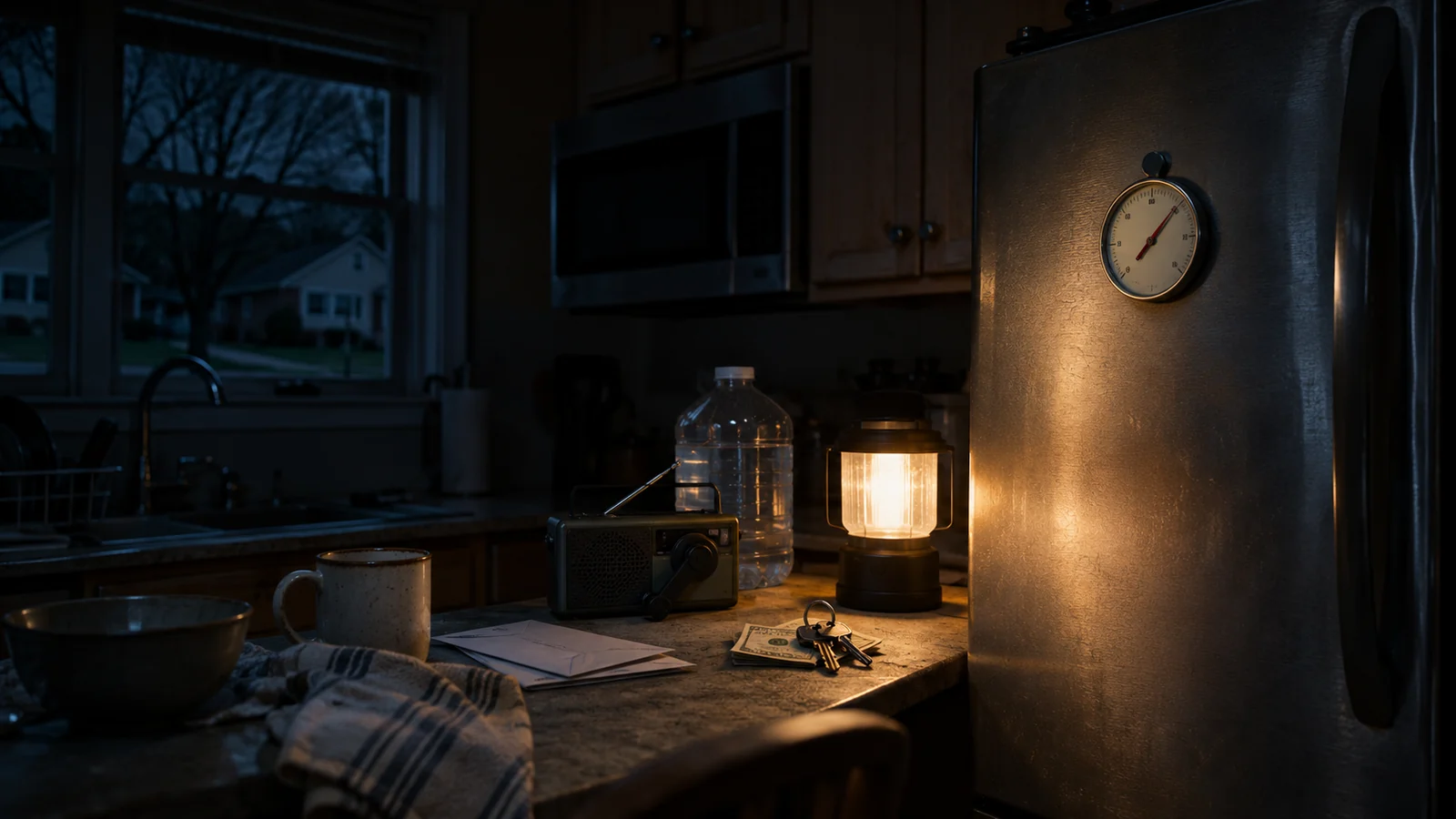

Most outages last under two hours and cost you a reset clock. The ones worth preparing for are the other kind — the ice storm, the heat wave, the hurricane that takes a substation — where the lights stay off for days and everything that mattered turns out to have been plugged in.
Useful power outage preparedness is therefore not a shopping list. It is a short set of decisions about food, medication, water and heat, made while you can still see.
The First Ten Minutes
Before assuming the grid is down, check whether it is just you. Look at the breaker panel, then out of the window at the neighbours — a tripped main on your side of the meter is a different problem with a faster fix.
If it is the grid, the sequence is short:
- Report it. Utilities route crews by call volume, and an unreported street is restored last.
- Light the house without flame. Battery lanterns, not candles — the post-outage house fire is usually a candle (Emergency Lighting & Lanterns).
- Unplug sensitive electronics. Restoration arrives as a surge; the damage often happens when the power comes back.
- Leave one lamp switched on so you know when it returns.
- Get information from a battery or crank radio (NOAA Weather Radios), and ration the handset: brightness down, data off.
Food: The Four-Hour Rule and the Discard Line
This is the part people get wrong in both directions — some bin a full fridge after ninety minutes, others eat chicken that sat out overnight.
The federal guidance is specific. An unopened refrigerator keeps food safe for roughly four hours. A full freezer holds for about two days, a half-full one for about one. Those numbers assume the door stays shut, so decide what you need before opening it.
Afterwards the deciding question is temperature, not elapsed time. Keep an appliance thermometer in each. At or below 40°F when power returns, the contents are fine, and frozen food still holding ice crystals can be refrozen — the texture suffers and the safety does not.
Discard without agonising: meat, poultry, fish, eggs, soft cheese, cut fruit, leftovers and anything with milk or cream, once above 40°F for more than two hours. Hard cheese, butter, whole fruit and most condiments survive. Smell decides nothing: the organisms that make you ill do not announce themselves.
Two moves worth making now, and the cheapest part of any power outage preparedness plan: freeze bottles of water as cold mass, and hold a few days of food that can be eaten cold.
The People and Animals Who Cannot Simply Wait
Powered medical equipment. Oxygen concentrators, ventilators, CPAP machines, nebulisers, powered wheelchairs. Most utilities keep a medical priority register and joining it is free — it guarantees no restoration time, but it means you are known. Ask the supplier about the manual or battery fallback, and practise it once while the lights are on.
Refrigerated medication. Insulin and several other drugs have published tolerances for time out of refrigeration, specific to the product. Get the number from the pharmacist or the leaflet rather than guessing, and keep a cool bag and gel packs findable.
Older adults. Heat and cold both become dangerous faster with age and with several common medications. Power outage preparedness for seniors is three things: somebody who checks in daily, a plan for reaching a heated or cooled building, and a torch and phone within reach rather than in a drawer downstairs (Senior Emergency Preparedness).
Animals. Power outage preparedness for pets is mostly water and temperature. Aquariums and reptile enclosures lose heaters, filters and pumps, and fish tolerate that for less time than their owners expect (Pet Emergency Kits). In winter the problem becomes heat: see Winter Storm & Blizzard Preparedness.
Water, and the Outage That Outlasts Your Plan
A detail that catches people: if you draw from a private well, the pump is electric and the water stops when the power does. The same applies in tall buildings, where the pumps lifting water above the first few floors stop too. A long regional outage can also bring a boil-water notice.
So store the ordinary gallon per person per day, fill the bathtub when an outage is forecast, and keep the means to flush — a bucket poured fast into the bowl does it (Emergency & Survival Kits).
Then cash. Card readers, ATMs and petrol pumps all need power, and a regional outage takes them out together. A modest amount in small notes is the most boring item on any blackout preparedness checklist and one of the few that cannot be improvised. Keep the tank above half for the same reason. Why some outages are announced and others simply happen: Blackout vs Brownout.
FAQ: Power Outage Preparedness
How do I prepare for a power outage?
Charge a power bank, keep torches and a battery radio accessible, hold a few days of no-cook food and stored water, freeze bottles as cold mass, keep some cash, and register anyone on powered medical equipment with the utility in advance.
How long does food stay safe without power?
About four hours in an unopened refrigerator, two days in a full freezer and one in a half-full one. Judge by an appliance thermometer rather than the clock: at or below 40°F is safe.
Is there a power outage preparedness food list?
The discard list above is the practical one: thermometers in both appliances, doors shut, perishables out after two hours above 40°F. The rest of a power outage preparedness checklist is light, water, cash, medication.
What if someone at home uses powered medical equipment?
Ask the utility to add the address to its medical register now, confirm the battery or manual fallback with the supplier, practise it once, and decide in advance which nearby facility you could reach.
Is it safe to run a generator in the garage with the door open?
No. An open door is not enough ventilation, and carbon monoxide accumulates in attached garages and seeps into the house. Generators run outdoors only, well clear of the building, exhaust away from any opening.
Sources
- FoodSafety.gov, USDA Food Safety and Inspection Service and CDC — food safety during a power outage
- Ready.gov — power outages
- CPSC and CDC — carbon monoxide and portable generator safety
- FDA — storage of refrigerated medicines during an interruption
Utility medical registers, restoration priorities and boil-water procedures are set locally; check with your own provider. This page is general information and not medical advice — follow your clinician and the product leaflet on medication storage. For current conditions see the Live Emergency Map. See our Editorial Policy, Sources & Fact-Checking and Emergency Medical Disclaimer.