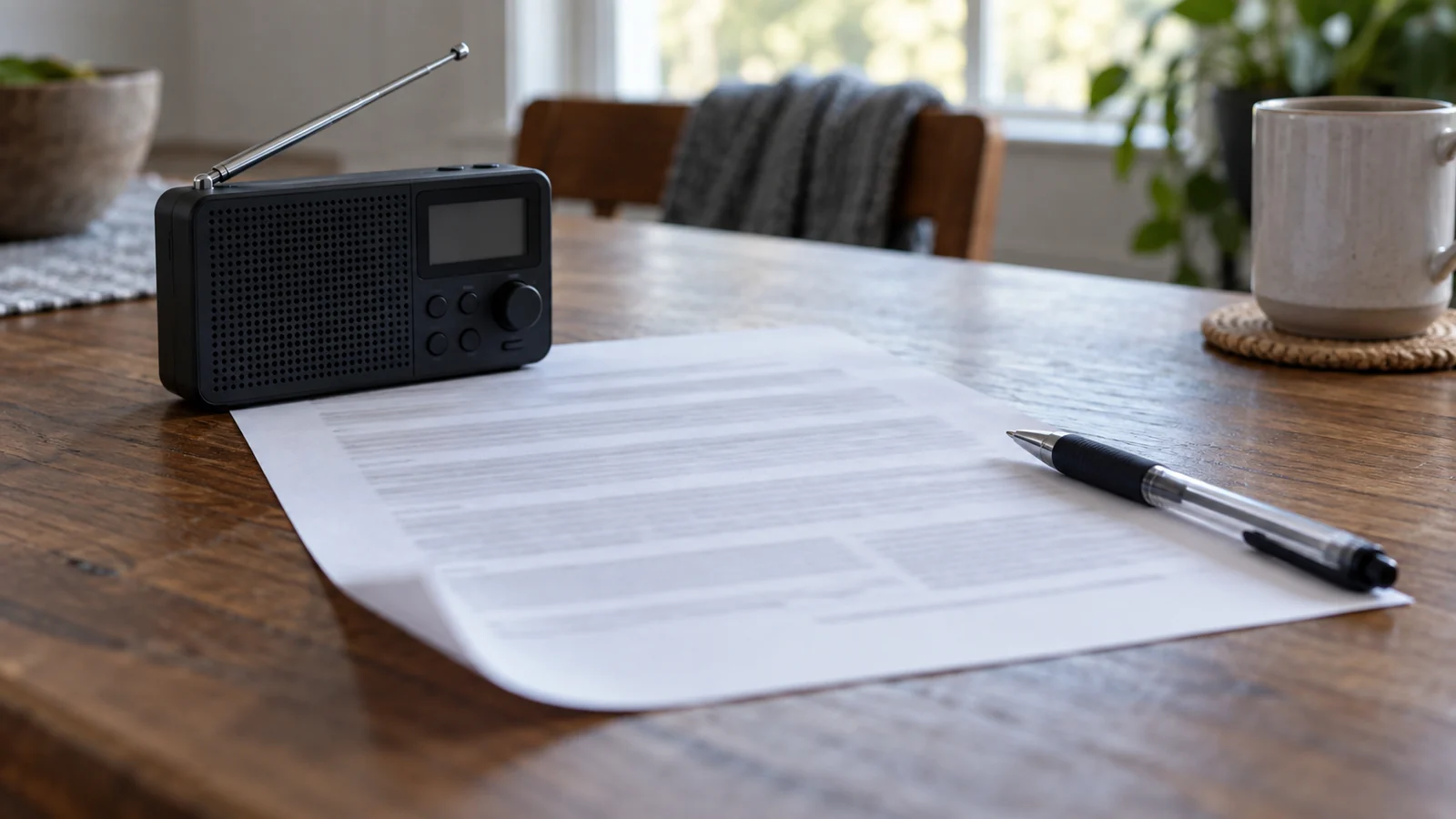

Most lists of emergency radio frequencies online are copied from each other, mix countries together, and quietly include bands you are not allowed to transmit on. This one is sized to fit on a single sheet and says which side of the line each entry sits on.
Listening is almost always legal. Transmitting usually isn't, and the difference is the most important thing on the page.
The Weather Channels
NOAA Weather Radio broadcasts on seven VHF frequencies, universally labelled WX1 to WX7 on receivers, though the numbering order varies by manufacturer.
| Channel | Frequency | Notes |
|---|---|---|
| WX1 | 162.400 MHz | Receive only. No licence, no cost, no network needed |
| WX2 | 162.425 MHz | Adjacent transmitters use different channels to avoid overlap |
| WX3 | 162.450 MHz | — |
| WX4 | 162.475 MHz | — |
| WX5 | 162.500 MHz | — |
| WX6 | 162.525 MHz | — |
| WX7 | 162.550 MHz | Often the strongest in a given area — scan all seven |
Finding your noaa weather radio stations is a matter of scanning all seven and keeping whichever comes in cleanest, then writing it on the chart. The National Weather Service publishes transmitter locations and coverage maps by state, which is worth checking if reception is poor — terrain creates real gaps.
Programming the county codes that go with it is covered in NOAA Weather Radios.
The Rest of the Chart
An emergency radio frequencies chart is only useful if it distinguishes what you may transmit on from what you may only hear.
| Service | Where | May you transmit? |
|---|---|---|
| FRS — family radios | 22 channels, 462 and 467 MHz | Yes. No licence, low power, fixed antenna |
| GMRS | Same channel plan, higher power, repeaters | Licence required — FCC, no exam |
| MURS | Five channels, 151 and 154 MHz | Yes. No licence. Rarely used, so often quiet |
| CB channel 9 | 27.065 MHz | Yes. Traditional emergency channel, lightly monitored now |
| CB channel 19 | 27.185 MHz | Yes. Highway and road conditions |
| Marine VHF channel 16 | 156.800 MHz | Distress only. Monitored by the Coast Guard |
| Aviation emergency | 121.500 MHz | Distress only. Listening is legal |
| Amateur 2 m calling | 146.520 MHz | Amateur licence required |
| Distress beacons | 406 MHz | Registered PLB or EPIRB only |
Local police, fire and EMS are deliberately absent from this chart. Those allocations are assigned county by county, many are encrypted, and a national list would be wrong almost everywhere. Your state's frequency coordination body publishes the accurate version.
Why Paper, and What to Write on It
An emergency radio frequencies pdf on a phone is a frequency list you cannot read while the phone is being used for something else, and cannot read at all once it's flat.
Print it and put it with the radio. Then add the three things no national chart can know: your local NOAA channel, found by scanning; your county SAME code; and the FRS or GMRS channel your household agrees to use, which is worth deciding in advance rather than shouting about later.
That last one belongs in the wider household plan rather than taped to a radio on its own — Emergency Communication Plans covers who calls whom and what the fallback is when nobody has signal.
What the family radio channels are actually good for, and what the range claims on the packaging are worth, is in Two-Way Radios & Walkie-Talkies.
Print the sheet, scan for your weather channel tonight, and write it in the blank. That's the part a chart can't do for you.
FAQ: Emergency Radio Frequencies
What are the NOAA weather radio frequencies?
Seven VHF channels between 162.400 and 162.550 MHz, spaced 25 kHz apart and labelled WX1 to WX7 on receivers. Scan all seven and keep whichever is clearest where you live.
Is it legal to listen to emergency frequencies?
Receiving is legal in the US for these allocations. Transmitting is what's restricted, and on marine, aviation and amateur frequencies it requires either a licence or a genuine distress situation.
Can I use a radio to call for help in an emergency?
US rules permit any means of radio communication in a real life-threatening emergency when nothing else is available. That's a narrow exception for actual distress, not general permission.
Why aren't local police and fire frequencies listed?
They're assigned locally, they change, and many are encrypted. A national list would be wrong in most places. Your state's frequency coordination body publishes the current local allocations.
Which channel should my family agree on?
Any FRS channel, chosen in advance and written down. The specific number matters far less than everyone knowing it before they need it.
Is the printable chart free?
Yes. No email address, no account, nothing bundled. Every printable on this site works the same way.
Sources
- NOAA / National Weather Service — NOAA Weather Radio All Hazards frequencies, transmitter coverage and SAME codes
- FCC — Family Radio Service, General Mobile Radio Service and MURS rules
- FCC — emergency communication provisions and licensing requirements
- US Coast Guard — VHF channel 16 distress and calling
Allocations and rules change; verify against current FCC and NOAA publications before relying on any chart. This page is general information. When an emergency is underway, follow emergency services and local authorities before any general guidance. See our Editorial Policy and Sources & Fact-Checking.