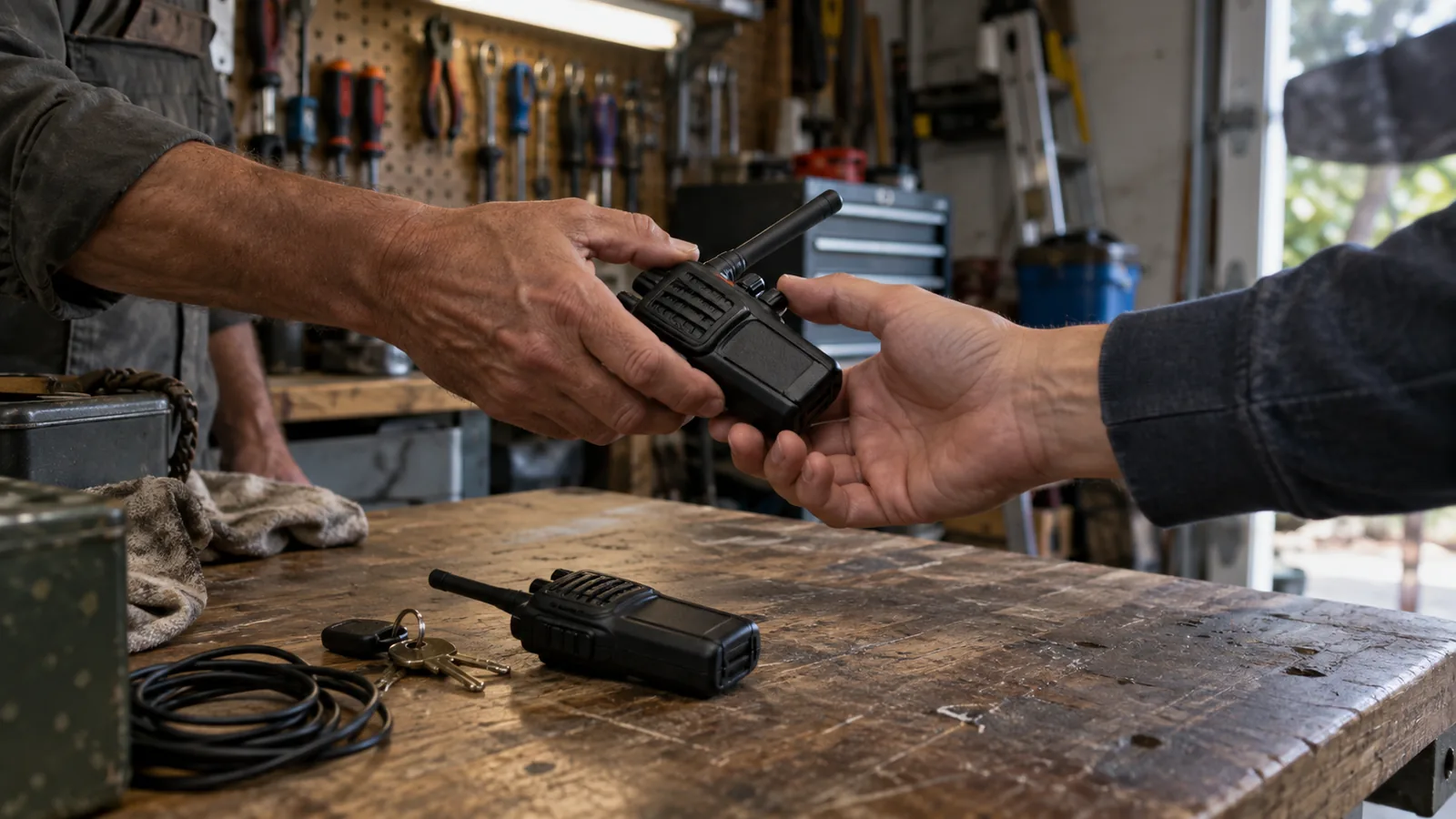

The number on the front of the packaging is the first thing to ignore. A two way radio advertised at thirty-five miles will, in a neighbourhood with houses and trees in it, reach the end of the street and a bit further.
That isn't a scandal, it's physics — and once you stop expecting the box number, these become genuinely useful for the one job phones are worst at: talking to people nearby when the network is gone.
What They're Actually For
Two way radio communication solves a narrow problem well. Everybody in a group can hear one transmission at once, there's no network in between, and it keeps working when towers are congested or down — the situation where a phone is least useful and feels most essential.
The realistic uses are close-range and specific: keeping a household in contact while clearing a property after a storm, coordinating two cars in a convoy, a group spread across a campsite, or reaching the neighbour whose phone has no signal either.
The unrealistic use is talking to someone across a city. That is what the packaging implies, and it is not what these do.
What they are not, in any configuration, is a way to call for help. There is no emergency service listening on a walkie talkie channel. If you need 911 and have no signal, the answer is a phone in a place with coverage, or a satellite device — see Satellite Messengers.
Why the Range Number Is Fiction
These are VHF and UHF radios, and their signals travel essentially in straight lines. The advertised figure describes ideal conditions — one hilltop to another, nothing between.
Put a house in the way and it drops. A hill, and it stops. In a built-up area, a licence-free handheld covering a mile is doing well; through a few floors of a building it may not manage that. This is the single largest gap between expectation and reality in the whole category, and it is the reason so many of these end up in a drawer.
Two things genuinely extend range, and neither is a bigger number on the box. Height helps enormously — the same radios that fail across a valley work fine ridge to ridge. And on GMRS, repeaters re-transmit your signal from a high site, which is the real answer for wider coverage, where one exists and you're licensed to use it.
FRS, GMRS and the Licence Question
Both services share the same 22-channel plan around 462 and 467 MHz, which is why a pair of radios can look identical and be legally different.
FRS is licence-free. Power is limited, the antenna is fixed, and that combination is what keeps it open to everyone. For a household staying within a few hundred metres of each other, it is entirely sufficient.
GMRS allows much higher power, detachable antennas and repeater access. It requires an FCC licence, which costs $35, lasts ten years, and involves no exam — it's an application, not a test. One licence covers your immediate family, which makes it unusually good value for a household that wants the extra range.
The trap is buying a GMRS-capable radio and using the high-power channels without the licence, which happens constantly and is not legal. If you want the capability, the application is straightforward and the fee is modest.
The exact channel allocations, alongside weather and distress frequencies, are on the printable chart in NOAA & Emergency Radio Frequencies.
Making Them Work Before You Need Them
Pick a channel and record it where the household will find it. Emergency Communication Plans is where that decision belongs, alongside who calls whom and what happens when nobody has signal.
Then test at real distance. Not across the garden — from the house to wherever the other person would actually be. That's the number that matters, and it will be nothing like the box.
Sort out power. Rechargeable packs die in storage exactly like the ones in crank radios, and radios that also take AA cells are more likely to work after two years in a cupboard, for the same reason described in Hand-Crank & Solar Emergency Radios.
And keep the conversations short. Only one person can talk at a time, batteries drain while transmitting, and a group that has never practised will talk over each other for the first five minutes.
Agree the channel tonight, then walk to the far end of the street and press the button. Ten minutes, and you'll know what you actually own.
FAQ: Two-Way Radios & Walkie-Talkies
How far does a two way radio really reach?
Far less than the box says. Advertised figures are line-of-sight with nothing in the way. In a built-up area a licence-free handheld covering about a mile is doing well.
Do I need a licence?
Not for FRS. GMRS requires an FCC licence — $35, no exam, valid ten years, and it covers your immediate family.
Can I call 911 on a walkie talkie?
No. No emergency service monitors these channels. If you have no phone signal, you need coverage or a satellite device, not a two-way radio.
What's the difference between FRS and GMRS?
They share the same channel plan. FRS is low power with a fixed antenna and no licence. GMRS allows higher power, detachable antennas and repeaters, and requires a licence.
Which channel should we use?
Any FRS channel, agreed in advance and written down. The number matters far less than everyone knowing it before they need it.
Do you test these radios?
No, and we don't publish range measurements we haven't taken. This page works from FCC service rules and the physics of the bands, and points you at the only test that counts: walking the distance yourself.
Sources
- FCC — Family Radio Service and General Mobile Radio Service rules, licensing and fees
- FCC — GMRS licence term, application process and family coverage
- Manufacturer channel and power specifications, checked September 2026
Licence requirements and fees change; verify with the FCC before applying. This page is general information. When an emergency is underway, follow emergency services and local authorities before any general guidance. See our Editorial Policy and Sources & Fact-Checking.