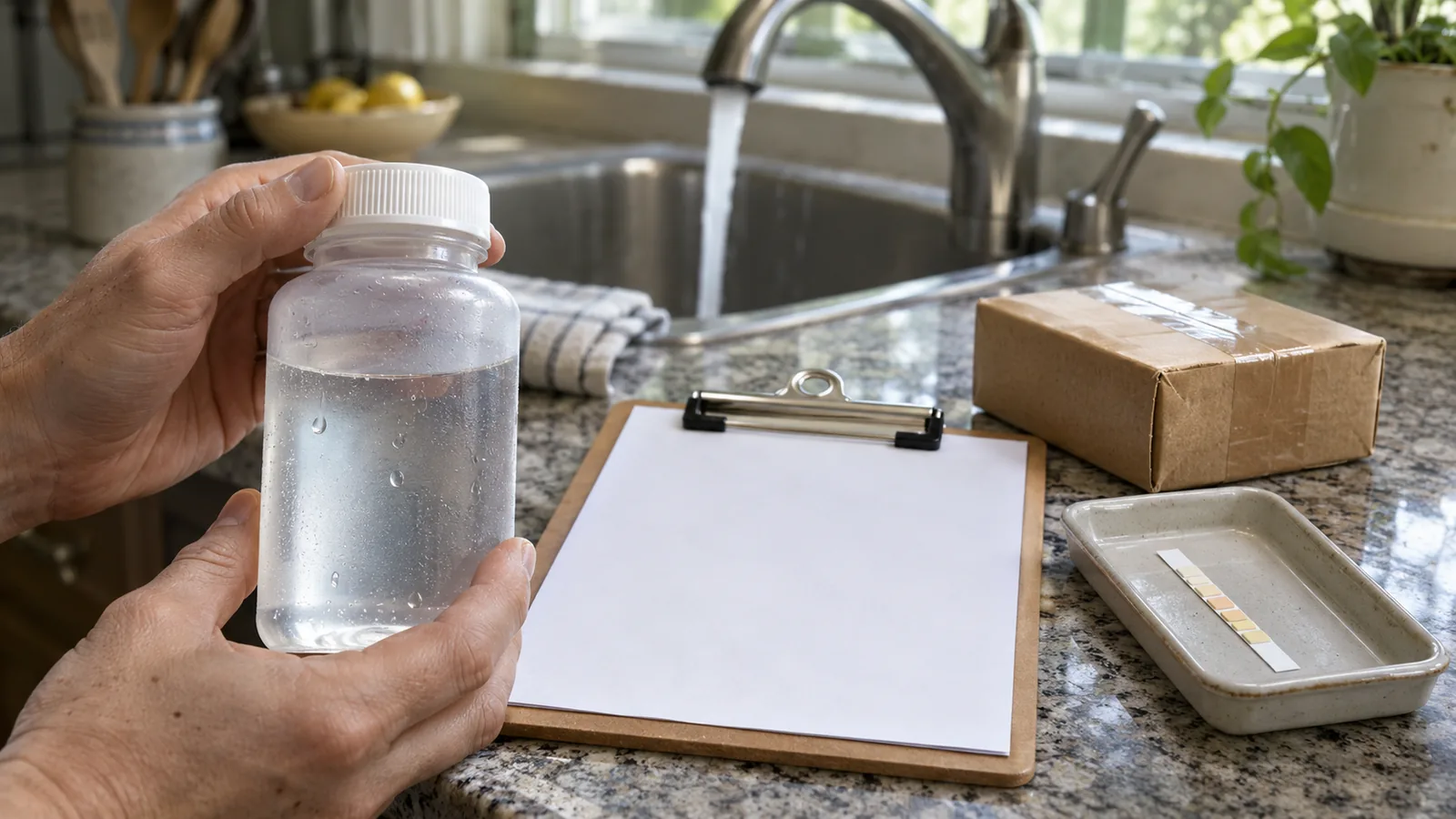

Choosing a well water test kit for drinking water means first deciding what the test is for. A strip you dip in a glass and a sample you mail to an accredited laboratory are both called a water test, and they answer completely different questions. One tells you whether something changed. The other produces a result you can act on, show a buyer, or hand to whoever specifies treatment.
Both have a place. This page covers what each one is good for, what a private well should be tested for and how often, and the part that gets left out of most buying advice: in a great many places, the test you need is available free.
Start With the Free Option
Before buying anything, check what is already available to you. Many state and county health departments run well-water programmes that provide sample bottles and laboratory analysis at no cost or at a fraction of commercial prices, particularly for bacteria and nitrate. Some offer it to every private well owner; others target households with infants, pregnant residents, or wells in areas with known contamination.
These programmes exist because private wells fall outside drinking water regulation, and under-testing is a public health problem rather than a consumer one. Using them is not a loophole — it is the intended route.
So the first call is to your county or state health department, or your agricultural extension service, which often coordinates testing and knows the local contaminants. If they cannot help, they will usually name the accredited laboratories that can, which is more reliable than searching for one yourself.
DIY Kit or Laboratory: What Each One Is For
A home well water test kit is a set of reagent strips or colour-change tests you read yourself — the same thing people search for as a water testing kit for well water. A laboratory test is a sample you collect under instructions and ship, analysed with calibrated instruments by people whose results carry legal weight.
| DIY kit | Accredited laboratory | |
|---|---|---|
| Answers | Roughly, for a handful of parameters | Precisely, with a number and a detection limit |
| Good for | Hardness, pH, chlorine, rough iron; spotting change | Bacteria, nitrate, arsenic, lead, metals, radon |
| Turnaround | Minutes | Days, with a written report |
| Accepted as evidence | No | Yes — sales, lenders, treatment design, health advice |
| Main weakness | Cannot detect the contaminants that matter most | Costs more, and you must follow the sampling instructions exactly |
The trap is a kit that lists twelve or fifteen parameters and implies it covers everything. Bacteria need incubation, arsenic and lead need instrumentation, and no strip detects them at the levels that affect health. A kit that claims otherwise is the one to avoid.
Used properly, though, a DIY kit is genuinely useful: test after a heavy rain, after the taste changes, after a pump repair. If a reading moves, that is your trigger to send a real sample. Monitoring between laboratory tests is the job it does well.
What to Test For, and How Often
A sensible baseline for any private well, and the reason behind each one:
- Total coliform and E. coli — annually. The indicator that surface water or sewage is reaching your water. The single most important test.
- Nitrate — annually. Comes from fertiliser and septic systems, is dangerous to infants, and has no taste.
- pH and total dissolved solids — annually. Cheap, and they explain corrosion, staining and taste complaints.
- Arsenic, lead, uranium, radon, fluoride — at least once, then as local guidance suggests. These are geological and regional; your health department knows which apply.
- Pesticides or industrial solvents — if land use warrants it. Nearby agriculture, fuel storage or industry changes the question.
Test again, regardless of schedule, after flooding or any time the well is submerged, after work on the well or pump, when the taste, smell or colour changes, if anyone in the house is pregnant or there is a new baby, or if a neighbour's well shows a problem.
When You Need Professional Testing Instead
Four situations call for professional well water testing rather than a mail-in kit, because the sampling itself is part of the result.
A property sale. Buyers, lenders and sometimes local rules require a recent test from an accredited laboratory, often with a flow-rate measurement as well. A DIY result will not be accepted.
A contamination event. After flooding, or a confirmed bacterial result, the sampling location and technique affect the answer, and so does knowing where to look next.
Specifying treatment. Equipment is sized against measured concentrations. A number without a detection limit is not a specification — see water treatment systems for home.
A dispute or a health concern. If a result might be challenged, or a doctor is asking, chain of custody matters.
When comparing well water testing services, ask whether the laboratory is state-certified for drinking water, which specific analytes are included, whether they supply bottles and preservatives, and what the holding time is — bacterial samples are typically invalid after a day or so, which is why mailing one on a Friday wastes the test. Accreditation and sampling discipline matter more than who collects the sample.
A well water testing cost varies with the panel and the laboratory rather than with the brand of anything, which is the useful thing to know when a quote arrives: a bacteria-and-nitrate screen and a full metals panel are different orders of work. We publish no figures, recommend no laboratories or companies, and receive no referral fees. Your health department's list is a better starting point than any directory.
And ask what happens afterwards. A report is a column of numbers next to limits, and well water testing results only become useful when someone explains which exceedance matters, which is borderline, and which is a nuisance. A laboratory that will talk you through the sheet is worth more than one that is slightly cheaper.
Common Questions
Is there really a free well water test kit?
In many areas, yes — through county or state health departments, or agricultural extension programmes, usually covering bacteria and nitrate. Coverage and eligibility vary widely, so ask locally rather than assuming either way. Offers of a "free water test" from a company selling treatment are a different thing: a sales tool, not an independent result.
Can a home kit detect bacteria?
Some include a presence/absence bacterial test, which is better than nothing and genuinely useful as a trigger. It tells you something may be wrong, not how much or which organism, and a positive result should always be confirmed by a laboratory before you act on it.
How much water do I need to collect?
Follow the laboratory's instructions exactly, because they differ by analyte. Bacterial samples use a sterile bottle that must not be rinsed or touched inside; some tests need a preservative already in the bottle; others specify running the tap for a set time first, or sampling first thing in the morning for lead. Deviating invalidates the result.
My water has always been fine. Do I still need to test?
Yes. Nitrate, arsenic and bacteria are all tasteless and odourless at harmful concentrations, and well chemistry changes with rainfall, drought, land use and the ageing of the well itself. "Always been fine" describes the water you can perceive.
What does a bad result mean I have to do?
It depends entirely on which result. Bacteria usually means finding and fixing a contamination route — a cracked cap, a failed seal, surface water ingress — then disinfecting and retesting, rather than filtering indefinitely. A chemical result like arsenic or nitrate generally means treatment, because the source cannot be removed.
Sources
- U.S. Environmental Protection Agency — private drinking water wells: what to test for, testing frequency, and state certification of laboratories
- Centers for Disease Control and Prevention — well water testing, sampling guidance and interpretation of bacterial results
- U.S. Environmental Protection Agency — National Primary Drinking Water Regulations: maximum contaminant levels for nitrate, arsenic and lead
- National Ground Water Association — well inspection, maintenance, and contamination routes through well construction
- U.S. Geological Survey — regional occurrence of arsenic, uranium and radon in groundwater
Testing programmes, eligibility, laboratory certification and recommended analyte panels are set locally and vary widely; so does groundwater chemistry. This page is general information, not a testing plan for a specific well — contact your county or state health department and use a state-certified laboratory. We recommend no laboratories or companies and receive no referral fees. See our Editorial Policy, Sources & Fact-Checking and Affiliate Disclosure.