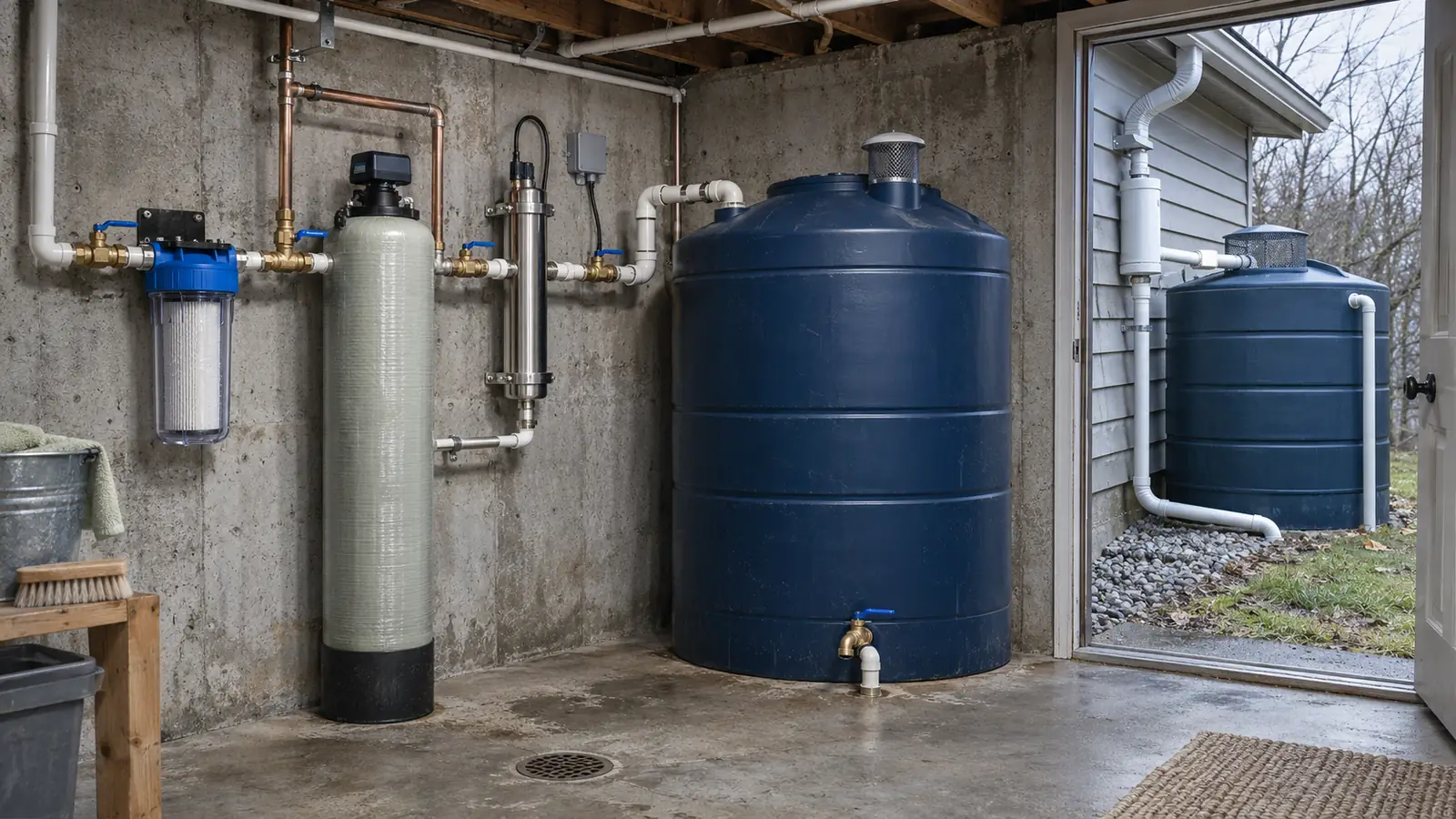

Water is the supply that fails first and matters most. A house can be cold and dark for a week and still be habitable; without water it is uninhabitable in a day. And unlike electricity, water has two separate failure modes — it can stop arriving, or it can keep arriving and no longer be safe to drink.
Those are different problems with different answers, and most advice blurs them. This pillar separates them: storage and collection for when the supply stops, filtration and treatment for when the supply is suspect, and testing underneath both, because on a private well you have no opinion about your water until a laboratory gives you one.
When the Supply Stops
The most common water emergency is not contamination, it is absence — a main break, a frozen pipe, a boil-water notice, or, if you are on a well, simply a power cut. That last one catches people out: a well pump is an electrical appliance, so the moment the lights go off, the taps do too.
Stored water is the answer that needs nothing from you at the moment it is needed. The calculation is simple and the result is usually larger than people expect — about four litres per person per day, for two weeks rather than three days, with pets, heat and medical needs on top. Rainwater collection extends that, though only meaningfully if the end use is decided honestly at the start: a barrel for the garden and a potable catchment are different projects separated by a treatment train and, in many places, a permit.
When the Water Is Suspect
The second failure mode is harder, because it is invisible. The contaminants with the clearest health consequences — bacteria, nitrate, arsenic, lead — have no taste, colour or smell at the concentrations that matter. Taste tells you about chlorine, sulphur and iron, which are mostly nuisances. So the instinct to judge water by drinking it is exactly backwards.
Which means treatment cannot be chosen from a symptom. It is specified from a water report, and the sequence of stages is the design: sediment first, because grit destroys everything downstream, and disinfection last, because ultraviolet light cannot reach organisms through cloudy water. Anyone offering a single box that solves everything is skipping the diagnosis.
Water You Can Carry
Away from the house the problem changes shape. Portable filtration is about organisms: the bacteria and protozoa in a stream, and sometimes the viruses that indicate human sewage. It is almost never about chemicals, and that distinction decides whether a given filter suits a given source.
It also sets a hard limit worth stating plainly. No portable filter makes floodwater drinkable. Floodwater should be assumed to carry sewage, fuel and agricultural chemicals together, and none of those are removed by straining. This is the one place where the honest answer is that the equipment does not help.
FILTER
Strains out bacteria, protozoa and cysts. Adequate for most backcountry water in North America and Europe. Does nothing to viruses or dissolved chemicals.
PURIFIER
Also handles viruses, which indicate human sewage. The right choice where sanitation is unreliable. Usually achieved chemically or with UV, not with a finer membrane.
Well or Municipal: The Choice Underneath
Every page here reads differently depending on where your water comes from, because the real difference between a private well and a municipal main is not quality — it is who carries the responsibility. A utility treats, tests and monitors continuously and sends you a bill. A well sends no bill and hands you the testing, the treatment, the pump and the repairs.
Neither is inherently safer. Municipal water is reliably adequate and vulnerable to distribution failures; well water can be better than anything a utility delivers or genuinely unsafe, and only a test distinguishes the two.
One thread runs through all of it. If your water comes from a well, your water supply is an electrical appliance, and planning for one without the other leaves a gap you will find at the worst moment — see backup power and energy. And when the problem is water arriving rather than water stopping, start with flood preparedness.
Sources
- U.S. Environmental Protection Agency — private drinking water wells, National Primary Drinking Water Regulations, and emergency disinfection of drinking water
- Centers for Disease Control and Prevention — household water treatment, emergency water supply, and well water testing guidance
- Ready.gov (U.S. Department of Homeland Security) — emergency water storage quantities and supply planning
- World Health Organization — household water treatment and safe storage
- National Ground Water Association — well construction, maintenance and service life
Water chemistry, testing programmes, permit requirements and rainwater harvesting law are all local and subject to change. These guides are general information rather than advice for a specific property; have water tested by an accredited laboratory and confirm requirements with your local health, building or water authority. We recommend no companies or laboratories and receive no referral fees. See our Editorial Policy, Sources & Fact-Checking and Affiliate Disclosure.