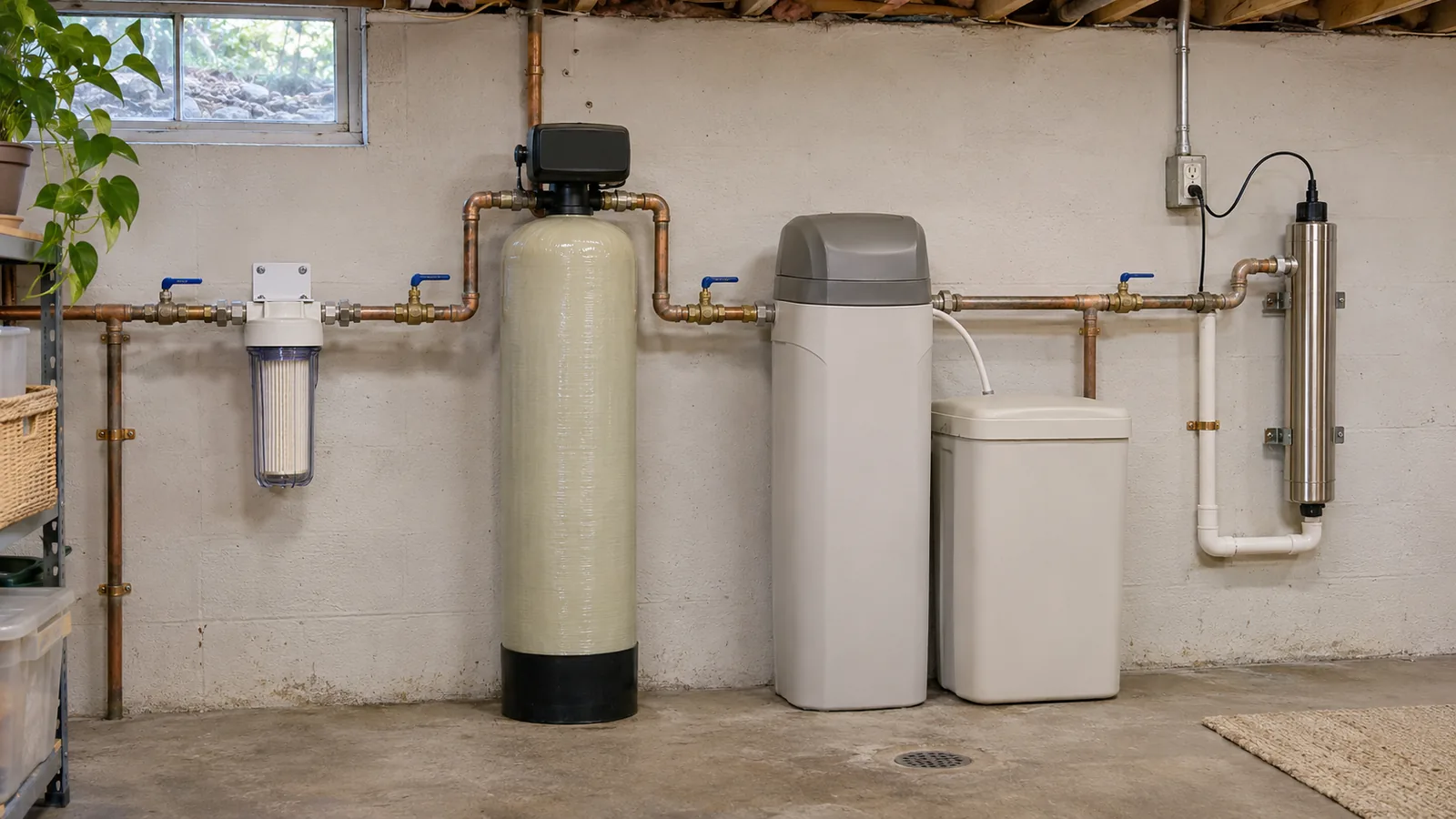

Water treatment systems for home use are one topic where the shopping routinely comes before the diagnosis. A treatment system is not a product category you pick from, it is a response to a specific water report — the equipment that fixes one house does nothing in the next street.
So this page follows the order the job is done in: find what is in the water, understand what each stage removes, then decide how much of the house needs protecting. No price list, no form to fill in.
Test First — Nothing Else Makes Sense
Hardness, iron, sulphur smell, bacteria, nitrate and arsenic all look like "bad water" at the tap and need completely different equipment. Guessing from taste is how people end up with a softener that cannot touch their problem.
On a municipal supply, your utility publishes an annual report — describing the water as it leaves them, not what your own pipes add. On a well, the testing is yours: see well water test kits and professional testing. Either way, get numbers on paper before anyone quotes you.
The Treatment Train: What Each Stage Actually Removes
Requests for well water treatment system diagrams are among the most common on this topic, because the sequence is the design. Water meets the stages in order, each protecting the next.
| Stage | What it removes | Why it sits here |
|---|---|---|
| Sediment filter | Sand, silt, rust, visible particles | First. Grit shreds everything downstream. |
| Oxidation / iron removal | Dissolved iron, manganese, sulphur smell | Turns dissolved metals into catchable particles. |
| Softener | Calcium and magnesium — hardness only | After iron, which otherwise fouls the resin. |
| Activated carbon | Chlorine, taste, odour, many organic compounds | Needs clean water to work, and protects membranes. |
| Reverse osmosis | Nitrate, arsenic, fluoride, most dissolved solids | Usually point-of-use. Slow, and wastes water. |
| UV disinfection | Bacteria and viruses — inactivates, does not filter | Last. Needs clear water or the light cannot reach. |
Two things follow. There is a logical water treatment system installation order, and it is not a matter of taste — a softener ahead of iron removal, or UV ahead of a sediment filter, means paying for a stage that cannot work. And the common well water treatment methods are not alternatives; they are components combined according to what the test found.
Whole-House or Point-of-Use
A whole-house system treats everything entering the building: showers, laundry, the water heater, every tap. A point-of-use unit treats one outlet, usually the kitchen cold tap. They solve different problems, which is why the types of house water filters question rarely has one answer.
Treat the whole house when the problem damages plumbing or affects bathing — hardness scaling the water heater, iron staining laundry, sediment clogging valves. Treat one point when the fix is slow or wasteful: reverse osmosis for nitrate is impractical for a whole building and entirely sensible under a sink. A house with hard well water and a nitrate problem needs both, and anyone proposing one box is ignoring half the report.
A Private Well Is a Different Job
On a municipal supply, someone else disinfects and tests the water continuously. On a well that responsibility is yours, which is why well water treatment systems are usually more elaborate than a city-water filter: they may have to handle sediment, iron, hardness and disinfection at once, without anyone watching.
Three differences matter when specifying equipment. Well chemistry changes with rainfall, drought and season, so one test is a snapshot rather than a specification. Bacterial contamination is a live possibility rather than a theoretical one, which puts disinfection on the table. And the well itself — casing, cap, seal, pump — is part of the system: no filtration downstream fixes a bad seal letting surface water in. If a test returns bacteria, the first question is not which filter but why the well is being contaminated.
What Drives the Cost, and Why We Do Not Publish One
A water treatment system cost or a whole house water filter cost cannot be answered honestly at national scale: the same specification moves with water chemistry, flow rate, where the equipment can go, and local plumbing and electrical requirements. A figure here would be one you could not hold anyone to. What we can give you is what moves it, so you can read a quote:
- How many stages the report demands. The biggest factor, set by the test rather than by you.
- Flow rate and household size. Equipment is sized to peak demand; undersizing shows up as pressure loss mid-shower.
- Where it goes. A basement with a floor drain and a nearby panel is straightforward. A crawl space is not.
- Drainage and power. Softeners and reverse osmosis need a drain; UV needs a reliable circuit. Adding either is work in its own right.
- Consumables. Cartridges, salt, membranes and lamps are the running cost. A cheap system with expensive consumables is not cheap — ask for annual replacement costs in writing.
- Permits and backflow rules, set locally, which occasionally change the design.
The same holds for a well water treatment cost: it follows the report, not the brochure, and two neighbours can get legitimately different quotes.
Choosing a Company Without Being Sold To
The market for well water treatment companies contains both plumbers who treat water and salespeople who arrive with a test kit. The difference shows up in a few questions, worth asking before you let anyone test your water for free.
- Will you work from an independent lab result? A company insisting its own on-site test is the only valid basis for a design is selling, not diagnosing.
- Which stage addresses which number on my report? Every component should map to a measured problem.
- What does this cost to run per year? Consumables, salt, regeneration water, electricity.
- Who services it, and what happens in year six? Proprietary cartridges with a single supplier are a long commitment.
- Is it certified for the specific contaminant reduction claimed, rather than certified in general?
Test independently, have the design explained line by line against the report, and compare quotes on scope rather than on the bottom figure. We recommend no companies and take no referral fees.
One last point: a well pump is an electrical appliance, so a power cut stops your water as surely as a broken pipe. See backup power and energy and water storage tank sizes.
Common Questions
Do I need a water softener or a filter?
Different jobs. A softener removes hardness — calcium and magnesium — and essentially nothing else. A filter removes particles, chemicals or organisms depending on type. Hard water with a chlorine taste needs both; neither substitutes for the other.
Will a whole-house filter make my water safe to drink?
Not necessarily. Most target sediment, chlorine, taste and odour, which improves water without making unsafe water safe. Bacteria, nitrate and arsenic need disinfection or reverse osmosis specifically, usually as separate stages.
How often does a system need servicing?
It depends on the stage and on your water, which is why the question belongs in the quote. Sediment cartridges can need changing in months, carbon lasts longer, UV lamps are typically annual regardless of use, and membranes last years. A system nobody maintains stops working silently.
Can I install a treatment system myself?
Some point-of-use units are genuinely DIY. Whole-house equipment usually means cutting into the main, providing a drain and sometimes a new circuit, which brings in local code and often a permit. The risk is not just leaks — a wrong connection can contaminate your own supply.
My water tastes fine. Is testing still worth it?
Yes, on a well. Nitrate, arsenic, bacteria and lead are tasteless at the levels that matter. Taste tells you about chlorine, sulphur and iron — mostly nuisances.
Sources
- U.S. Environmental Protection Agency — National Primary Drinking Water Regulations, and guidance for private drinking water wells
- U.S. Environmental Protection Agency — Consumer Confidence Reports, the annual water quality report published by community water systems
- Centers for Disease Control and Prevention — private well water treatment, disinfection and water testing guidance
- National Ground Water Association — well construction, maintenance, and the relationship between well integrity and water quality
- NSF/ANSI standards for drinking water treatment units — contaminant-specific reduction claims and certification
Water chemistry is local and seasonal, and treatment that is correct for one property can be useless at another. Permit requirements, backflow rules and plumbing and electrical code are set locally. This page is general information, not a system design; have your water tested by an accredited laboratory and have equipment specified against that report. We recommend no companies and receive no referral fees. See our Editorial Policy, Sources & Fact-Checking and Affiliate Disclosure.