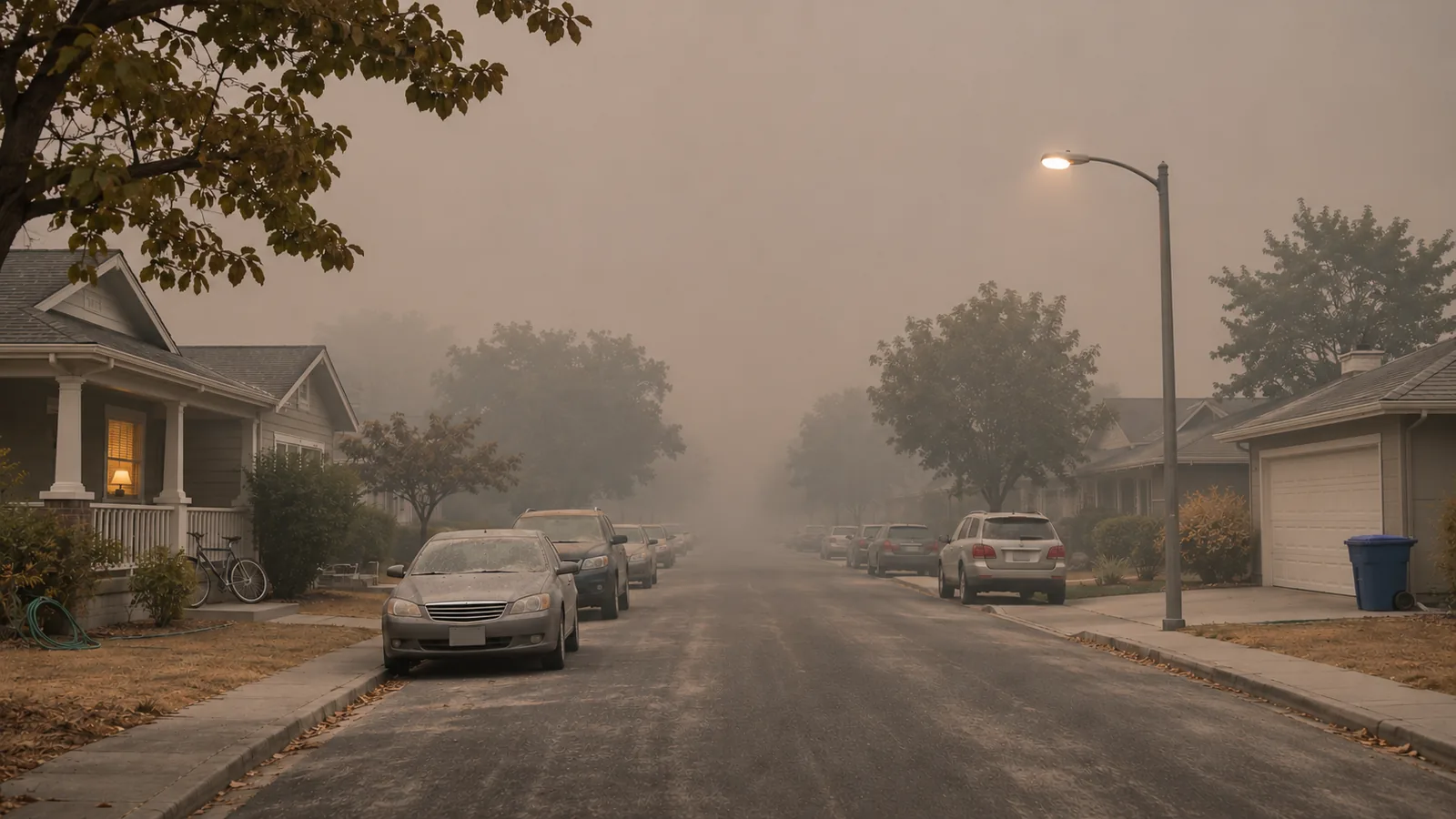

The orange sky is not the measurement. It is the most visible part of wildfire smoke and the least useful, because the particles that do the damage are far too small to see and the days that look merely hazy can be worse than the ones that look apocalyptic.
What follows is how to tell, using a number rather than a window, and what to change once you know.
What's Actually in Wildfire Smoke
Smoke from burning vegetation is a mixture, and the component health agencies focus on is fine particulate matter — PM2.5, meaning particles two and a half micrometres across or smaller. A human hair is around seventy.
Size is what makes them matter. Larger particles are caught in the nose and throat; PM2.5 reaches the deepest part of the lung, and the smallest fraction crosses into the bloodstream. So the effects are not limited to coughing: the EPA and CDC both associate short-term exposure with worsened asthma and COPD, and with cardiac events in people who already have heart disease.
The mixture also carries carbon monoxide — a serious hazard close to an active fire, much less so at a distance — plus volatile organic compounds and the ingredients that make ozone downwind. When a fire burns through buildings and vehicles rather than forest, the smoke carries whatever those were made of.
One consequence worth holding on to: smoke travels thousands of miles and does not require a fire anywhere nearby. A cool, clear day far from any fire can still be sitting under a plume that arrived overnight.
The Symptoms, and the Ones That Mean Call Someone
The common wildfire smoke symptoms are irritation: scratchy throat, sore or watering eyes, a dry cough, a headache, a blocked nose, tiredness that does not match what you did. They usually fade when the air clears, and are not in themselves a reason to seek care.
Three groups should treat the same air as more serious: people with asthma, COPD or heart disease; children, whose airways are smaller and who breathe more relative to their size; and older adults. Pregnancy is also on the EPA's list of conditions warranting more caution.
Asked about wildfire smoke exposure symptoms over longer periods, the honest answer is that the research is still developing. Repeated seasons of heavy smoke are being studied and the evidence is not settled — a reason to reduce exposure where it is cheap to do so, not a reason for alarm.
Reading AQI Without Over- or Underreacting
The Air Quality Index converts a pollutant concentration into one number on a fixed scale. During smoke episodes it is almost always driven by PM2.5, and the EPA's AirNow publishes it by ZIP code alongside a smoke-specific map.
| AQI | Category | What changes |
|---|---|---|
| 0–50 | Good | Nothing |
| 51–100 | Moderate | Unusually sensitive people may notice it |
| 101–150 | Unhealthy for Sensitive Groups | Sensitive groups indoors, no hard exercise outside |
| 151–200 | Unhealthy | Everyone limits time outdoors |
| 201–300 | Very Unhealthy | Stay indoors with filtration; avoid outdoor exertion entirely |
| 301+ | Hazardous | Emergency conditions; follow local public health instructions |
Two cautions. The number is a rolling average, so a fast-moving plume can be worse than the reading suggests for an hour or two. And the first thing to drop is not going outside — it is exertion outside. Hard breathing pulls far more particulate into the lungs than a short walk does.
Keeping Indoor Air Breathable
Good wildfire smoke safety indoors comes down to two moves: stop more smoke coming in, and take out what already has.
Close windows and doors, and switch any air conditioning to recirculate rather than fresh air — on a window unit, that means shutting the outdoor air damper. With central HVAC, a filter rated MERV 13 or higher captures a useful share of fine particles, and running the fan continuously pulls air through it.
Then add filtration. A portable HEPA air cleaner sized for the room is the single most effective purchase, and it does more good in one bedroom with the door shut than spread across the house. The EPA has also tested do-it-yourself box-fan filters and found them reasonably effective short-term — worth knowing when the shops have sold out.
What not to do matters as much. Smoke is particulate, and so is frying, candles, incense, wood stoves and vacuuming without a HEPA filter. Adding to the load inside a sealed house is common and avoidable.
Asked wildfire smoke what to do when the house cannot be sealed or filtered, the answer is to leave the air rather than fight it: a library, a mall, a public clean-air centre, a relative in a cleaner ZIP code. Smoke arriving alongside heat and a power cut stacks badly — Heat Wave Preparedness covers that combination.
FAQ: Wildfire Smoke
Is wildfire smoke dangerous?
Yes, mainly because of PM2.5 — particles small enough to reach deep lung tissue. For most people the effect is short-term irritation; for people with asthma, COPD or heart disease it can be considerably more serious.
What are the symptoms of smoke exposure?
Sore throat, irritated eyes, cough, headache, sinus congestion and fatigue are typical. Breathlessness at rest, chest pain, severe wheezing or confusion are not, and need urgent care.
At what AQI should I stay inside?
From 101 if you are in a sensitive group, and from 151 for everyone. Before that, the thing to drop is strenuous outdoor exercise rather than going outside at all.
Does an N95 help against smoke?
A well-fitted N95 or P100 filters fine particles. Cloth and surgical masks do not. The seal is what does the work, so facial hair or a poor fit removes most of the benefit.
How long does it take to recover?
Irritation generally settles within days of the air clearing. Symptoms that persist beyond that, or any change in how a chronic lung or heart condition behaves, are worth a medical opinion.
Can I run air conditioning during smoke?
Yes, and you should if it is hot — but set it to recirculate and close the fresh air intake, otherwise it draws smoke in. Keep the filter clean and replace it more often than usual.
Sources
- EPA — AirNow, the Air Quality Index and the Fire and Smoke Map
- EPA — Wildfire Smoke: A Guide for Public Health Officials; research on DIY air cleaners
- CDC — wildfire smoke and health, and groups at higher risk
- American Lung Association and NIOSH — particulate exposure and respirator fit
This page is general information and not medical advice, and it does not replace an asthma or cardiac action plan agreed with a clinician. For current conditions see the Live Emergency Map; for air quality, see AirNow. When a warning is active, follow local authorities and public health instructions before any general guidance. See our Editorial Policy, Sources & Fact-Checking and Emergency Medical Disclaimer.