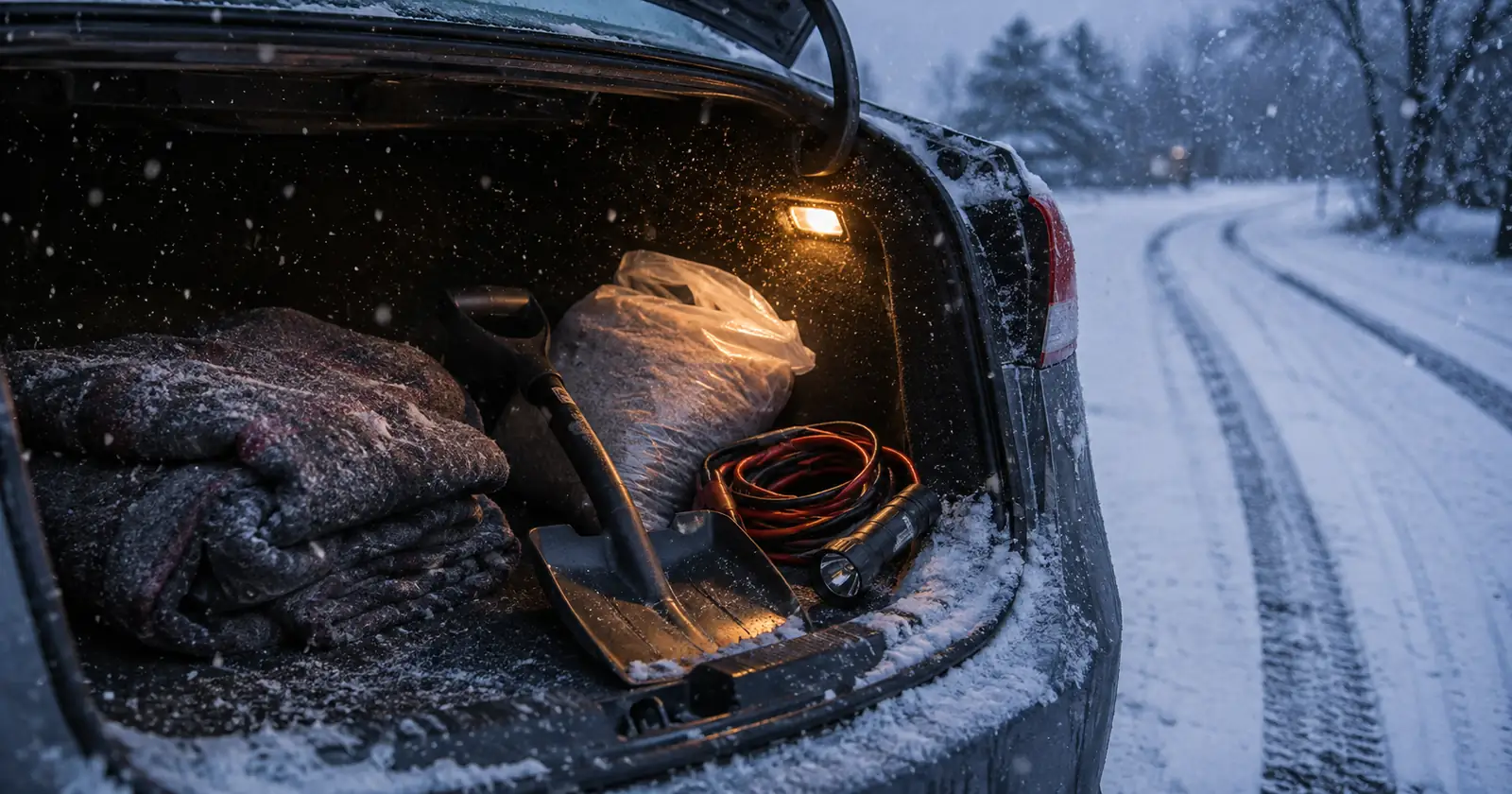

Your car probably already has jump leads, a torch and a first aid kit. Winter doesn't replace any of that — it adds a short list of things that solve three specific problems: getting traction, staying warm without the engine, and digging out.
The checklist below is the additions only. The year-round base is in Car Emergency Kits, and it's worth having that sorted first.
The Winter Additions
| Item | What it solves |
|---|---|
| Folding shovel | Digging the wheels out, and clearing the exhaust pipe |
| Grit, sand or cat litter | Traction under a spinning wheel |
| Traction boards or chains | The same problem, better, where it's legal to use them |
| Ice scraper and snow brush | Visibility, and clearing the roof before it slides onto your windscreen |
| Wool or synthetic blankets, one per seat | Warmth with the engine off |
| Hat, gloves, spare socks, warm boots | The gap between how you're dressed to drive and how you'd need to be dressed to walk |
| Hand warmers | Hours of warmth with no flame and no fuel |
| Extra water and calorie-dense food | A long wait. Keep water where it won't freeze solid |
| Bright cloth or a marker flag | Being seen from the road in falling snow |
| Windscreen washer fluid rated for cold | A frozen reservoir on the first hard night |
Two of those matter more than the rest. The shovel, because clearing the exhaust is a safety step and not just a digging step. And warm boots, because the gap between office shoes and a walk through snow is where a bad evening becomes a medical one.
Grit deserves a note too. Cat litter and sand both work, and a bag of either lives happily in a boot for years. Traction boards work better and cost more; chains work better still where they're legal and where you're willing to fit them in the cold. Any of the three beats spinning a wheel until it polishes the ice underneath.
One thing that isn't on the list: a second phone charger. It should already be in the year-round kit, and if it isn't, add it there rather than here — winter doesn't change that item, it just makes forgetting it worse.
If You Get Stranded in Snow
A common winter car emergency is a simple one: stuck, in the cold, with the engine still working. The protocol is well established and worth knowing before you need it.
- Stay with the vehicle. It's shelter, and it's far easier to find than a person walking. Leave only if help is clearly visible and clearly reachable.
- Make yourself visible. Hazard lights, a bright cloth tied to the aerial or hanging from a window, and the interior light on while the engine runs.
- Clear the exhaust pipe. Before you run the engine, and again each time you restart it. Snow packed around the tailpipe pushes exhaust into the cabin.
- Run the engine intermittently. Roughly ten minutes an hour is the usual guidance, enough to take the edge off without emptying the tank.
- Crack a downwind window slightly while the engine runs.
- Move. Flex your hands, arms and legs periodically to keep circulation going, without sweating.
The Candle Heater Question
Some winter car preparedness lists recommend a candle in a tin as an emergency heat source. We don't.
An open flame in a sealed cabin consumes oxygen, produces carbon monoxide, and sits in a small space full of fabric, plastic and — in an accident — fuel. The heat it produces is marginal. Blankets, proper cold-weather clothing and chemical hand warmers deliver more warmth with none of the risk, and they work whether you're awake or asleep.
If it's already in your kit, that's your call. But it isn't on our checklist, and the reason is worth knowing rather than assumed.
Before the First Freeze
The kit is half the job. The vehicle is the other half.
- Check tyre tread and pressure — cold air drops pressure, and tread is what traction actually is.
- Test the battery. Cold is what finds a battery that was already marginal in October.
- Top up cold-rated washer fluid and check the antifreeze.
- Replace wiper blades if they're smearing.
- Put the warm clothing in the car, not in a cupboard at home.
Do the tyres and the tank this week. Those two change the outcome more than anything you can buy for the boot.
FAQ: Winter Car Kit Checklist
What should be in a winter car emergency kit?
On top of your year-round kit: a shovel, grit or traction boards, an ice scraper, blankets, warm clothing and boots, hand warmers, extra food and water, something bright to be seen with, and cold-rated washer fluid.
Should I stay in the car if I'm stuck in snow?
Yes, in almost all cases. The vehicle is shelter and it's much easier for rescuers to spot than a person on foot. Leave only if help is clearly visible and clearly reachable.
How long can I run the engine to stay warm?
Roughly ten minutes an hour, with the exhaust pipe cleared each time and a downwind window cracked. Never continuously, and not while the occupants are asleep.
Is a candle heater a good idea in a car?
We don't recommend one. Open flame in a small sealed cabin means oxygen consumption, carbon monoxide and a fire risk, for very little heat. Blankets and hand warmers do the job more safely.
How much fuel should I keep in winter?
Above half a tank as a habit. It costs nothing, and it's one of the changes that does the most to turn a long wait into a manageable one.
Does this replace the standard car kit?
No — it's the winter layer on top. The year-round base is in Car Emergency Kits.
Sources
- NWS — winter storm safety and vehicle guidance
- Ready.gov — Winter Weather
- CDC — carbon monoxide poisoning prevention
- NHTSA — winter driving preparedness
- State departments of transportation
When a warning is active, follow local authorities and official emergency instructions before any general guidance. See our Editorial Policy and Sources & Fact-Checking.