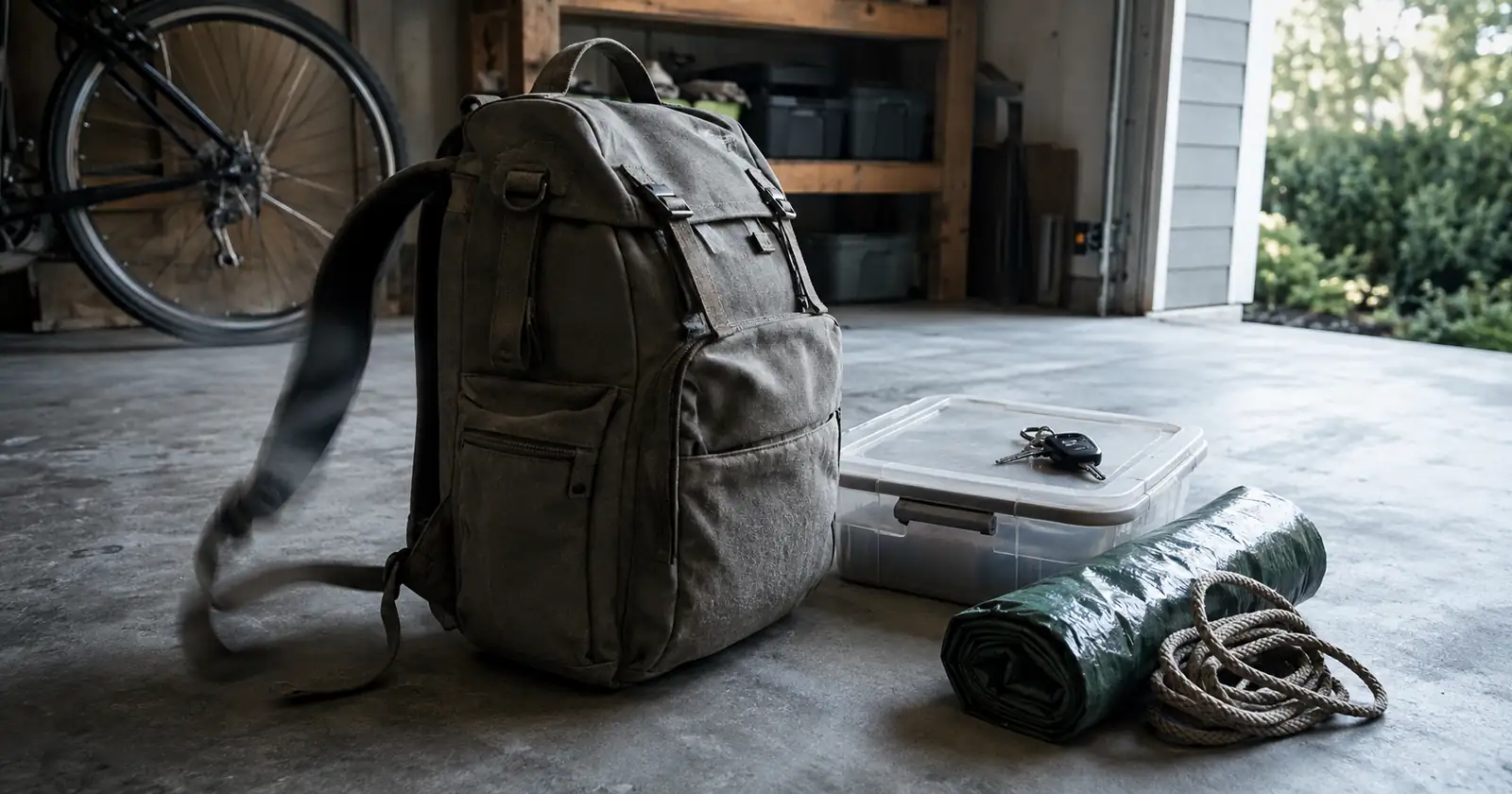

Every kit on this site answers one of four questions. Are you staying home without services? Leaving in a hurry? Stuck in a vehicle? Or sleeping somewhere that isn't your house?
Those four need different contents and different trade-offs, and buying the wrong one is the most common way to spend money here without getting safer. Pick the job first, then the guide.
Home Kit or Bag by the Door
This is the first fork, and it isn't about size. A home kit assumes you're staying — power, water or shops are out, and you're judging it on days of coverage per pound spent. A grab-and-go bag assumes you're leaving, and the constraint becomes weight.
Emergency & Survival Kits sorts between the two. 72-Hour Kits is the three-day standard both are measured against, and it's the page to read if you're comparing ready-made options.
Bags: Which One, and Which Bag
Three pages cover bags, and they're not repeats. Go Bags is the checklist for an evacuation that ends somewhere with a roof. Bug-Out Bags is for genuine self-sufficiency, which costs more and weighs more. If you're not sure which describes you, the comparison page settles it in two minutes.
Emergency Backpacks is separate because the pack itself is a frequent weak point in ready-made kits, and it's worth choosing deliberately rather than inheriting.
GO BAG
You're heading to a shelter, a hotel or a relative. Light, documents-heavy, packed today.
BUG-OUT BAG
You're carrying your own shelter, water treatment and heat for around three days.
Where the Kit Lives
A kit at home is no use to someone at work, and a kit in a hallway is no use to someone whose car has stopped. These three pages cover the kits that live somewhere other than your house.
Winter Car Kits assumes the car kit already exists — it's the cold-weather layer on top, not a replacement.
Sleeping Somewhere Else
Displacement is its own category. The house may be standing and still unusable, and the answer is shelter and warmth rather than a bag.
Tents and tarps solve where you sleep. Blankets and bivvies solve whether you're warm once you're there — and the second one matters more than people expect, because a tent is a windbreak, not a heater.
ONCE A YEAR
- Check food and water dates
- Check batteries and power banks
- Check medication against current prescriptions
- Check clothes and shoes still fit
- Lift each bag and carry it a short distance
Tie that check to something you already do once a year. A kit nobody has opened in three years is a kit with expired food and a flat power bank in it.