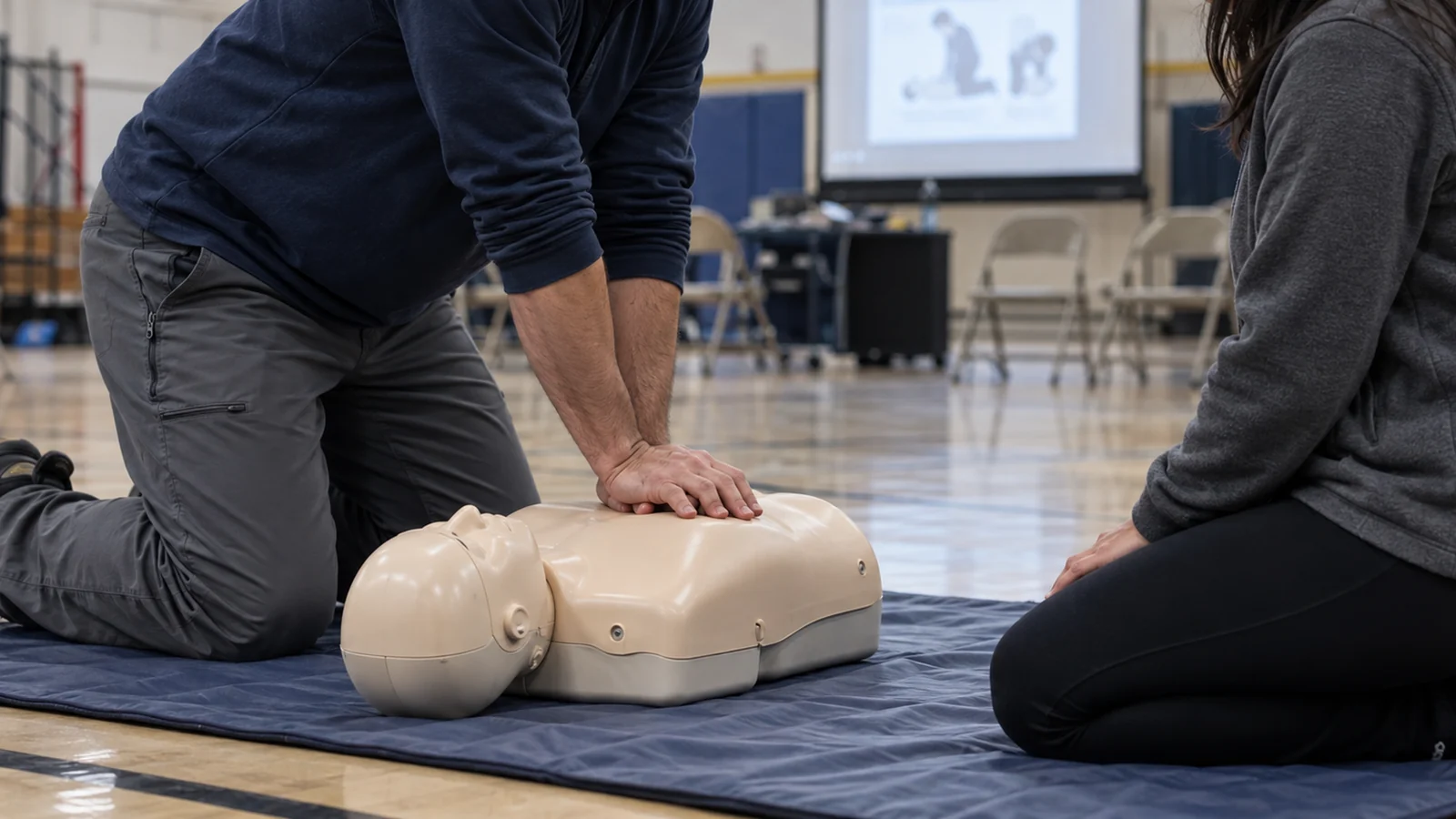

The BLS vs CPR question has a short answer: BLS contains CPR, plus the parts a healthcare team needs. If nobody has told you to get BLS, you almost certainly want the ordinary CPR course.
The confusion is worth clearing up because the two certificates cost differently, expire the same way, and are not interchangeable when an employer asks for one by name.
Who Needs Which
CPR certification teaches a bystander to act alone: recognise cardiac arrest, call for help, push hard and fast in the centre of the chest, and use an AED. That is the whole job, and it is the right course for teachers, coaches, parents, site workers and anyone who simply wants to be useful.
BLS certification — Basic Life Support — is built for people who will be part of a team with equipment. It covers everything above, then adds two-rescuer compressions with role swapping, ventilation with a bag-valve mask, pulse checks, and working alongside arriving professionals.
The American Red Cross puts it plainly: BLS is the more comprehensive certification, designed for healthcare workers and first responders, and it includes CPR plus additional skills.
So the practical test in BLS vs CPR isn't which is better. It's whether you'll be alone with your hands, or part of a team with a kit.
What the Extra Content Actually Is
The gap between the two courses is narrower than the price difference suggests, and it's almost entirely about equipment and teamwork.
| CPR/AED | BLS | |
|---|---|---|
| Built for | The public, workplaces, coaches, parents | Healthcare workers and first responders |
| Compressions | Single rescuer | Single and two-rescuer, with role swapping |
| Ventilation | Face shield or pocket mask | Bag-valve mask, usually two-person |
| Assessment | Responsiveness and breathing | Adds pulse checks and team dynamics |
| Format | Often bundled with first aid in one session | Standalone, in person or blended |
| Validity | Two years | Two years |
Both cover adult, child and infant. Both require hands-on assessment. Neither is a medical qualification on its own.
What an Online-Only Course Is Worth
Not much, on its own, and this is where money gets wasted.
A fully online course with an instant printable card teaches the theory and assesses nothing. No instructor has watched your compression depth, which is the single thing people get wrong and the single thing that decides whether compressions circulate blood. Most employers and every clinical programme reject online-only certificates for exactly that reason.
Blended is the format to look for: theory at home, then a short in-person skills session with a manikin and an assessor. It costs a little more than the online-only version and is accepted where the online-only one isn't.
If you're renewing rather than certifying for the first time, blended is also the faster route — you're demonstrating a skill you already have.
Where to Train
The American Heart Association and the American Red Cross are the two providers whose names appear in employer requirements. Hospitals, community colleges and fire departments run sessions that are often cheaper and less visible online.
Before booking, ask the organisation requiring it which provider and which course code they accept. Clinical programmes in particular are specific, and a card from the wrong provider is a wasted afternoon.
Costs, formats and what a general first aid certificate covers are in First Aid Training. If you want the bystander version of all this without any certificate at all, First Aid Basics covers what to do before help arrives.
Ask your employer which one they need, then book that one. The question answers itself much faster than the internet does.
FAQ: BLS and CPR
Is BLS the same as CPR?
No. BLS includes CPR and adds two-rescuer technique, bag-valve mask ventilation, pulse checks and team roles. It is designed for healthcare workers and first responders.
Do I need BLS if I'm not a healthcare worker?
Almost certainly not. A CPR/AED course, usually bundled with first aid, is the right certificate for the public, workplaces, coaches and parents.
How much does certification cost?
It varies by provider and region, and BLS typically sits a little above a standard CPR/AED course. Ask the provider directly, and ask your employer whether they will pay.
How often must I recertify?
Every two years for both, with most providers. Renewal is shorter than the original course.
Is an online-only certificate accepted?
Rarely. Most employers and all clinical programmes require an in-person skills assessment. Choose a blended course — online theory plus a short hands-on session.
Should I do anything if I'm not trained at all?
Yes. Call 911 and start hands-only chest compressions. Dispatchers will coach you through it, and doing something is substantially better than waiting.
Sources
- American Red Cross — Difference Between BLS and CPR Certification
- American Heart Association — BLS and Heartsaver course descriptions
- OSHA — workplace training requirements
Course content, pricing and acceptance vary by provider and state; verify with the organisation requiring the certificate before booking. This page is general information, not medical advice, and does not teach resuscitation. When an emergency is underway, follow 911 dispatchers and emergency services first. See our Editorial Policy and Sources & Fact-Checking.