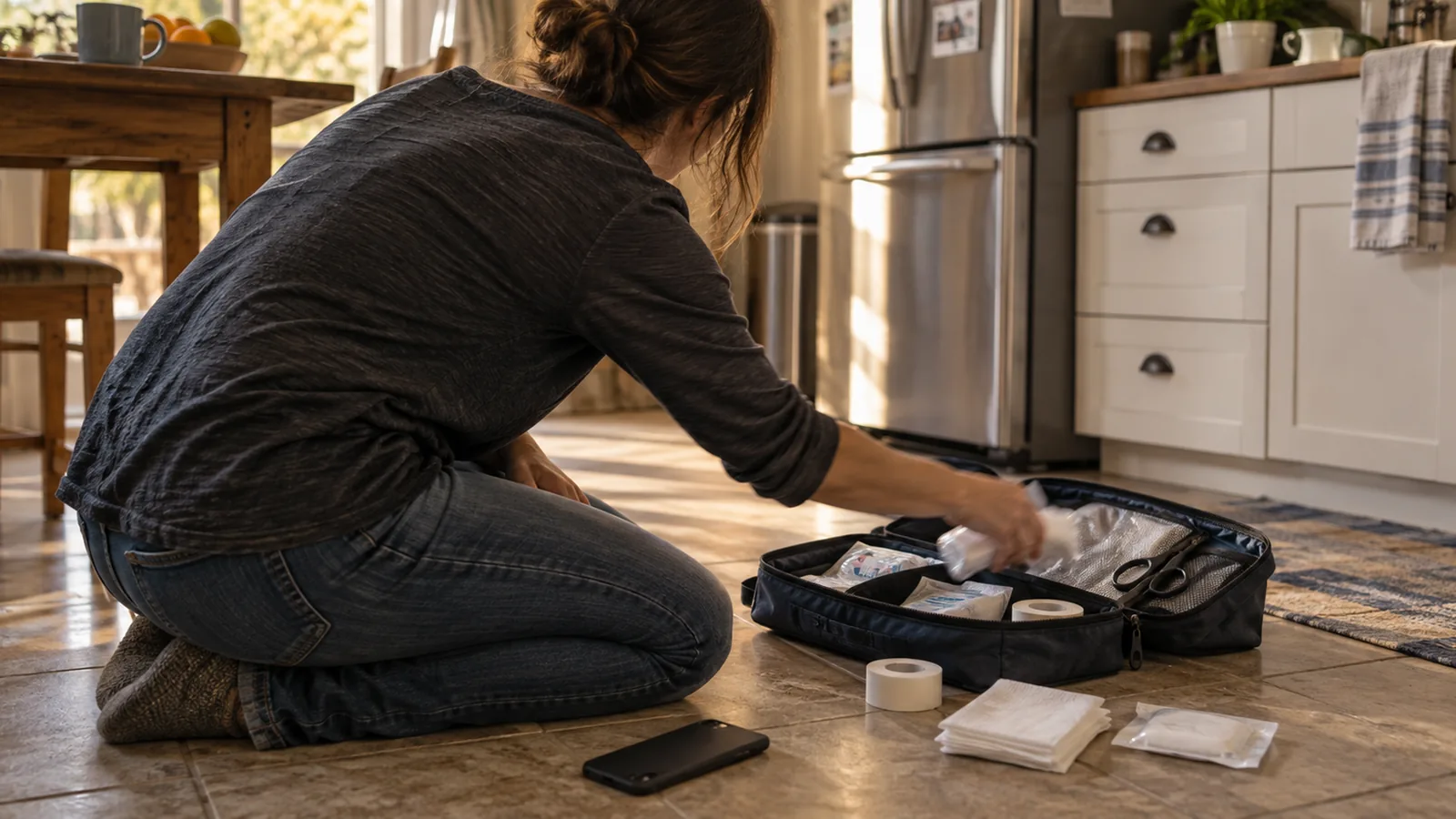

Most people freeze not because they don't care, but because they can't remember the order. The first aid basics worth knowing are fewer than you'd think, and the ones that matter are the ones you can do while waiting for an ambulance.
This page covers what a member of the public can safely do. It is not a substitute for training — and the single most useful thing on it is the recommendation to get some.
The Three That Change an Outcome
Almost everything a bystander does is comfort and containment. Three things are different — they change whether someone survives the next ten minutes.
Severe bleeding. Direct, firm pressure on the wound with whatever clean material is to hand, and keep it there. Don't lift to check. If blood soaks through, add material on top rather than replacing it.
Cardiac arrest. If someone is unresponsive and not breathing normally, call 911 and start chest compressions in the centre of the chest, hard and fast. An AED, if one is nearby, talks you through itself — it will not shock a heart that doesn't need it.
Choking. If they can cough, let them cough. If they cannot speak, cough or breathe, follow the back-blow and abdominal-thrust sequence taught in your local course.
Those are the first aid basics everyone should know, and they are the reason a two-hour class is worth more than any article, including this one.
What to Do Before Help Arrives
The basic first aid steps, in the order they are taught, are easier to recall under stress than a list of conditions.
- Look at the scene. Traffic, fire, fumes, water, live electricity. A second casualty helps nobody.
- Check for a response. Speak to them, tap their shoulders.
- Call 911, on speaker, and say where you are before anything else.
- Check breathing. Look at the chest for no more than ten seconds. Gasping is not breathing.
- Treat what you can see — bleeding first, then everything else.
- Keep them warm and still, and keep talking to them.
That last one gets skipped and it shouldn't. Someone frightened and cold deteriorates faster, and a person who is being spoken to is a person you are monitoring.
What Not to Do
Some of the most confidently repeated advice is wrong, and a few pieces of it are dangerous.
Don't tilt a nosebleed backwards. Lean forward, pinch the soft part of the nose for ten minutes without checking.
Don't put butter, ice or toothpaste on a burn. Cool running water for twenty minutes, then cover loosely with cling film or a clean non-fluffy cloth.
Don't try to hold down someone having a seizure, and don't put anything in their mouth. Move hard objects away, cushion the head, and time it.
Don't make someone vomit after a suspected poisoning. Call Poison Control on 1-800-222-1222 and follow what they say.
Don't apply a tourniquet you haven't been trained to use, and never one improvised from a belt. That belongs to a different level of response, covered under Trauma Kits.
Where the Kit Fits
A kit does not make you capable — it makes a capable person faster. The relationship runs in that order, which is why this page comes before any of the buying guides.
That said, a household with no gloves, no dressings and no shears is limited to improvisation. What belongs in one, and where each kit should live, is in First Aid Kits, and the printable inventory is in First Aid Kit Checklists & Contents.
Learn the three that change an outcome, put 911 and Poison Control on the fridge, and book the class. The rest is refinement.
FAQ: First Aid Basics
What are the basics of first aid?
Checking the scene is safe, getting a response, calling 911, checking breathing, stopping serious bleeding, and keeping the person warm and still. Bleeding, cardiac arrest and choking are the three where a bystander changes the outcome.
What should I do before help arrives?
Make the scene safe, call 911 on speaker, control any severe bleeding with firm direct pressure, and keep the person warm, still and talked to. Do not leave to fetch things you can do without.
When should I move someone?
Only when staying where they are is more dangerous than moving — fire, traffic, water, fumes. Otherwise wait, particularly if a spinal injury is possible.
Do I need training, or is reading enough?
Training. Reading gives you the sequence; a class gives you the practice that survives adrenaline. Chest compressions in particular are almost impossible to do correctly on the first attempt without having felt the depth required.
Can I be sued for helping?
Every US state has some form of Good Samaritan law protecting bystanders who act reasonably and in good faith. The specifics vary by state — check yours, and act within what you have been trained to do.
Sources
- American Red Cross — first aid steps and training guidance
- American Heart Association — CPR and choking guidelines
- CDC — burns, bleeding and emergency response
- Poison Control (1-800-222-1222) — poisoning first response
This page is general information, not medical advice, and does not replace training. When a warning is active or an emergency is underway, follow 911 dispatchers, emergency services and local authorities before any general guidance. See our Editorial Policy and Sources & Fact-Checking.