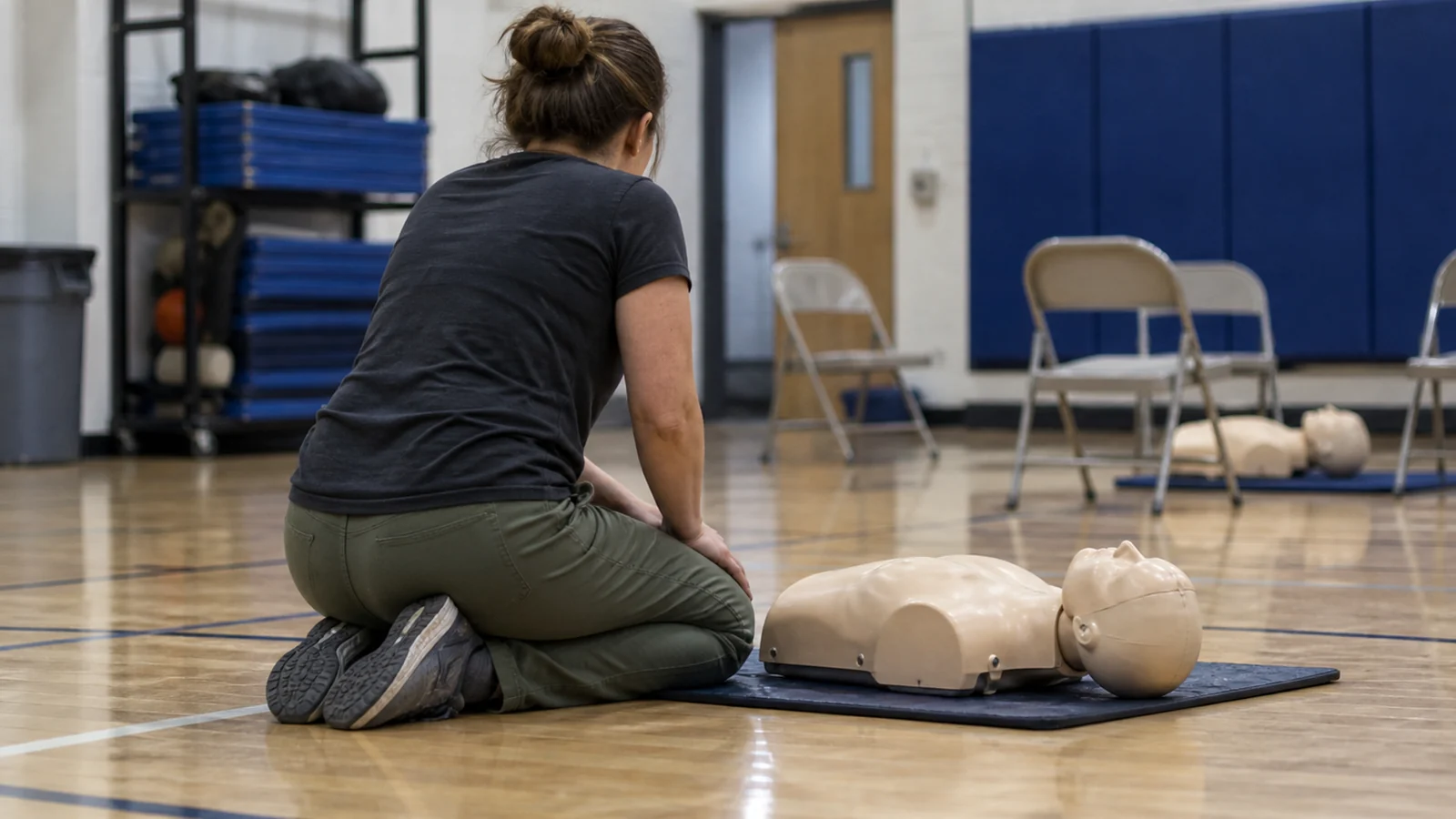

First aid training is the one thing on this site that keeps working when the kit is in the other room, the battery is flat, or you are standing in someone else's kitchen. An afternoon of your time, and it changes what you can actually do — which no amount of upgrading a kit will.
The confusing part is the naming. First aid, CPR, AED, BLS and Basic First Aid are different courses with overlapping content, and providers bundle them differently. Here's what separates them and what each is worth.
What a Certification Actually Covers
A standard combined course is shorter than people expect and more physical than they expect.
You spend most of it on a manikin. Chest compressions at the right depth and rate, because almost nobody gets that right first time — the depth required surprises everyone. Then choking, on an adult and on an infant. Then an AED, which talks you through itself and will not shock a heart that doesn't need it.
The first aid half covers bleeding control, burns, sprains, seizures, allergic reactions and when to move someone. It is deliberately narrow: what a bystander can do safely before professionals arrive.
What it does not cover is anything clinical. First aid certification is not a medical qualification and doesn't pretend to be — which is exactly why it's teachable in an afternoon.
Online or In Person
This is where most of the money gets wasted, so it's worth being blunt.
Fully online first aid training teaches the knowledge and tests it with a quiz. You cannot learn compression depth from a video, and no assessor has watched you do anything. It's genuinely useful as a refresher and as preparation, and most employers, schools and volunteer organisations will not accept it.
Blended — online theory, then a short in-person skills session — is the format most national providers now push, and it's the sensible default. You do the reading at home and the hands-on part takes an hour or two.
Fully in person remains the best for a first certificate, because the instructor corrects you in real time on the things a video can't see.
If a course is cheap and entirely online and promises an instant printable card, assume it will not be accepted where it matters.
What It Costs
There is no national price, and any page quoting one is guessing. The American Red Cross states plainly that the cost of a class varies by learning format and location — courses are priced by local chapters and training centres.
What you can compare before calling is the format, and whether it will be accepted.
| Format | What you get | Accepted by employers? |
|---|---|---|
| Full in-person First Aid/CPR/AED | Instruction and hands-on assessment in one session | Yes, with a national provider. OSHA-compliant |
| Blended: online theory plus skills session | Theory at home, short in-person assessment | Yes, with a national provider. OSHA-compliant |
| Online only | Knowledge and a quiz. No assessor sees you | Usually not |
| Community, fire department or college course | Varies widely. Often the cheapest route | Ask which provider before booking |
| Stop the Bleed (bleeding control) | Tourniquet and wound packing, often free | Not an employment certificate |
Red Cross in-person and blended courses carry a two-year certification that meets OSHA workplace requirements. Renewal is shorter than the original course, since you're demonstrating a skill rather than learning it.
Finding a Provider
The American Red Cross and the American Heart Association both publish searchable course listings, and between them they cover most of the country. Community colleges, fire departments and hospitals run sessions that are often cheaper and less advertised. Employers frequently pay, and many have never been asked.
If your interest is specifically bleeding control rather than general first aid, Stop the Bleed is the programme to look for — run by the American College of Surgeons, short, and free in many places. That's the training that makes the equipment in Trauma Kits usable rather than decorative.
For the difference between a general certificate and the healthcare-level one, see BLS vs CPR. And First Aid Basics covers what to do while you're waiting for the course date.
Book something this week. The gear can wait — it will still be on the shelf when you get back, and you will know what to do with it.
FAQ: First Aid Training
How much does first aid certification cost?
There is no national price — the Red Cross sets course costs locally, and they vary by format and region. Community and fire department sessions are often the cheapest, and Stop the Bleed is frequently free. Call your local chapter.
Is online certification valid?
For knowledge, yes. For employment, usually not on its own — most employers require an in-person skills assessment. Blended courses satisfy both.
How long is a certificate good for?
Two years with most providers, after which you recertify. Renewal is shorter and cheaper than the original course.
What's the difference between the formats?
In-person covers instruction and assessment in one session. Blended moves the theory online and keeps a short hands-on assessment. Online-only assesses nothing, which is why most employers don't accept it.
Will my employer pay for it?
Frequently, and it's rarely offered unprompted. Ask — particularly if your role involves machinery, driving, children or working alone.
Sources
- American Red Cross — course catalogue, formats and certification validity
- American Heart Association — CPR and first aid course structure
- Stop the Bleed / American College of Surgeons — bleeding control training
- OSHA — workplace first aid training requirements
Course prices and acceptance vary by provider and state; verify locally before booking. This page is general information, not medical advice. See our Editorial Policy and Sources & Fact-Checking.