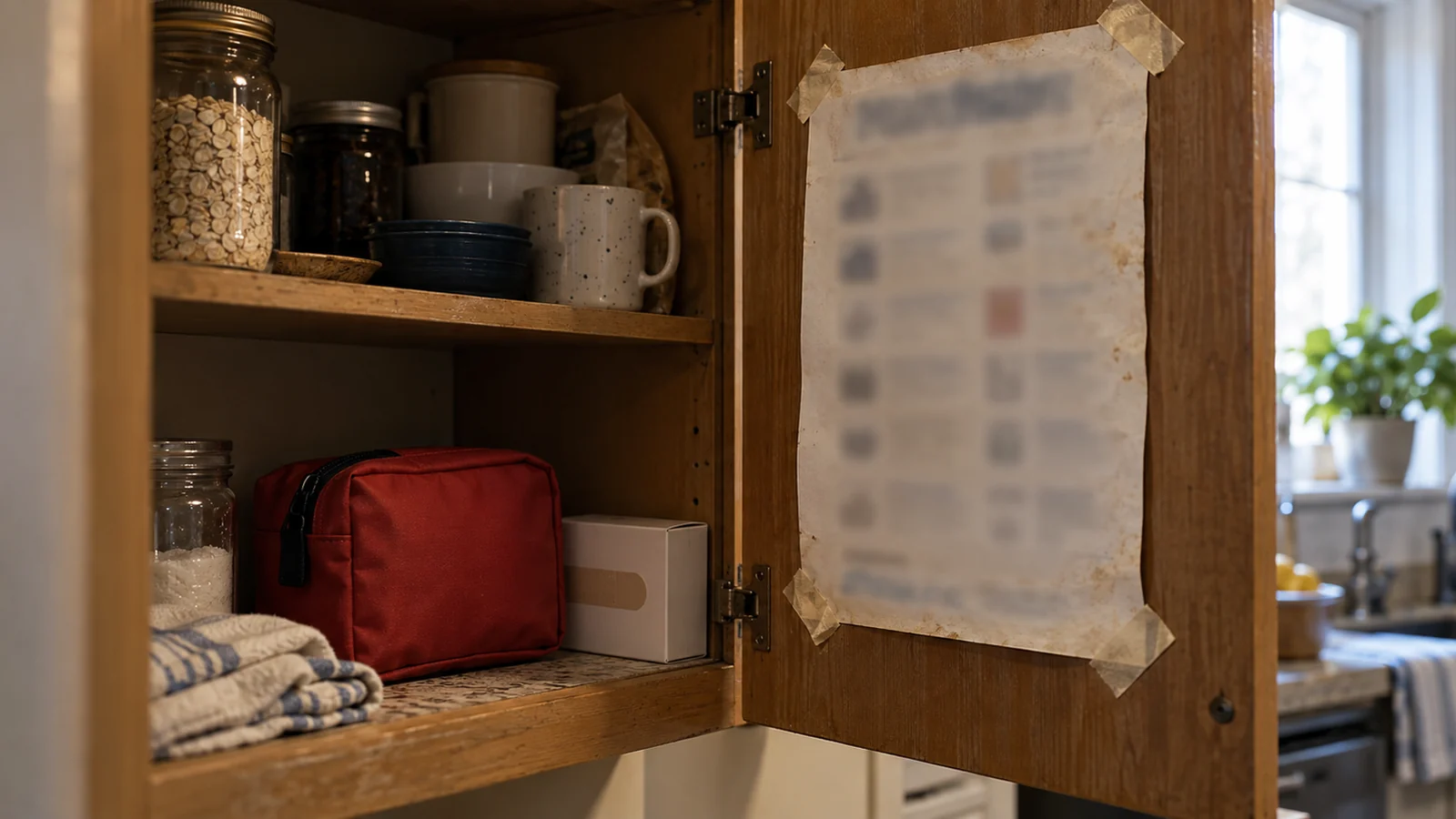

An emergency first aid guide on paper beats the same information on a phone, and the reason is unglamorous: in the moment that matters your hands are occupied, the screen has locked, and whoever is helping you doesn't know your passcode.
One sheet, taped inside a cupboard door, read by someone who isn't you. That's the whole design brief.
The Sheet You Tape Inside the Cupboard
A printable emergency first aid guide is not a manual. Manuals get read in advance by people who were going to read them anyway; a sheet gets read at the moment of need by someone panicking.
That imposes three constraints. It fits on one side of one page. The type is big enough to read standing up, from arm's length. And it starts with the phone number, because the most common failure is not doing the wrong thing — it's delaying the call.
Put it where the injuries happen. The kitchen cupboard door, the inside of the garage door, the workshop wall. Not in a drawer, and not inside the first aid kit alone, because the kit may be the thing someone is running to fetch.
What It Has to Cover
Six situations account for most of what a household will face, and they're the six worth having in front of you rather than remembered.
- Severe bleeding — firm direct pressure, keep pressing, add material on top rather than replacing it.
- Choking — if they can cough, let them. If they can't speak, cough or breathe, act.
- Unresponsive and not breathing normally — call, then chest compressions, then find an AED.
- Burns — cool running water for twenty minutes, then cover loosely. Nothing greasy, no ice.
- Suspected poisoning — do not induce vomiting, call Poison Control.
- Seizure — cushion the head, move hard objects, don't restrain, time it.
Each one is two lines. Anything longer stops being a reference and becomes reading. The reasoning behind each is in First Aid Basics, which is the page to read on a calm afternoon.
Why One Page
Length is the enemy here, and it's worth being specific about why.
A sheet that runs to three pages will be stapled, and a stapled document is a document someone has to turn over with one hand while holding a dressing with the other. A sheet that covers twenty situations makes finding the right one slower than remembering it. And a sheet in small type is a sheet that gets held close to the face — exactly what you can't do while kneeling next to someone.
The trade-off is real: one page means leaving things out. What it leaves out is everything you have time to look up, which is most of first aid. What stays is the handful of situations where the first ninety seconds decide the rest.
Laminate it if it's going in a garage or a car. Otherwise plain paper is fine and easier to replace when the guidance updates.
Where It Sits With Everything Else
The guide tells you what to do. The kit gives you something to do it with, and the training makes the two work together.
- First Aid Kits — which kit for which room, and what testers found.
- First Aid Kit Checklists & Contents — the printable inventory that pairs with this one.
- First Aid Training — because the sheet is a prompt, not a substitute.
Print it, tape it inside the cupboard door tonight, and write your full address at the top. That takes five minutes and it's the part that gets skipped.
FAQ: Emergency First Aid Guides
What should an emergency first aid guide cover?
Severe bleeding, choking, an unresponsive person who isn't breathing normally, burns, poisoning and seizures — plus 911, Poison Control and your full address. Two lines each.
Where should I keep it?
Taped where injuries happen: inside a kitchen cupboard door, on a garage wall, in a workshop. Not folded in a drawer, and not only inside the kit.
Is a printed copy really necessary?
Yes. Phones lock, batteries die, and the person helping you may not be able to unlock yours. Paper works with wet hands and no signal.
Should I laminate it?
In a garage, workshop or vehicle, yes. Indoors, plain paper is easier to reprint when official guidance changes — which it does.
Can a sheet replace a course?
No. It is a prompt for someone who has been trained, and a way to avoid the worst mistakes for someone who hasn't. Chest compressions in particular can't be learned from a page.
Sources
- American Red Cross — first aid steps and printable guidance
- American Heart Association — CPR and choking guidelines
- Poison Control (1-800-222-1222)
- CDC — burns and emergency response
This page is general information, not medical advice, and does not replace training. When an emergency is underway, follow 911 dispatchers and emergency services before any general guidance. See our Editorial Policy and Sources & Fact-Checking.