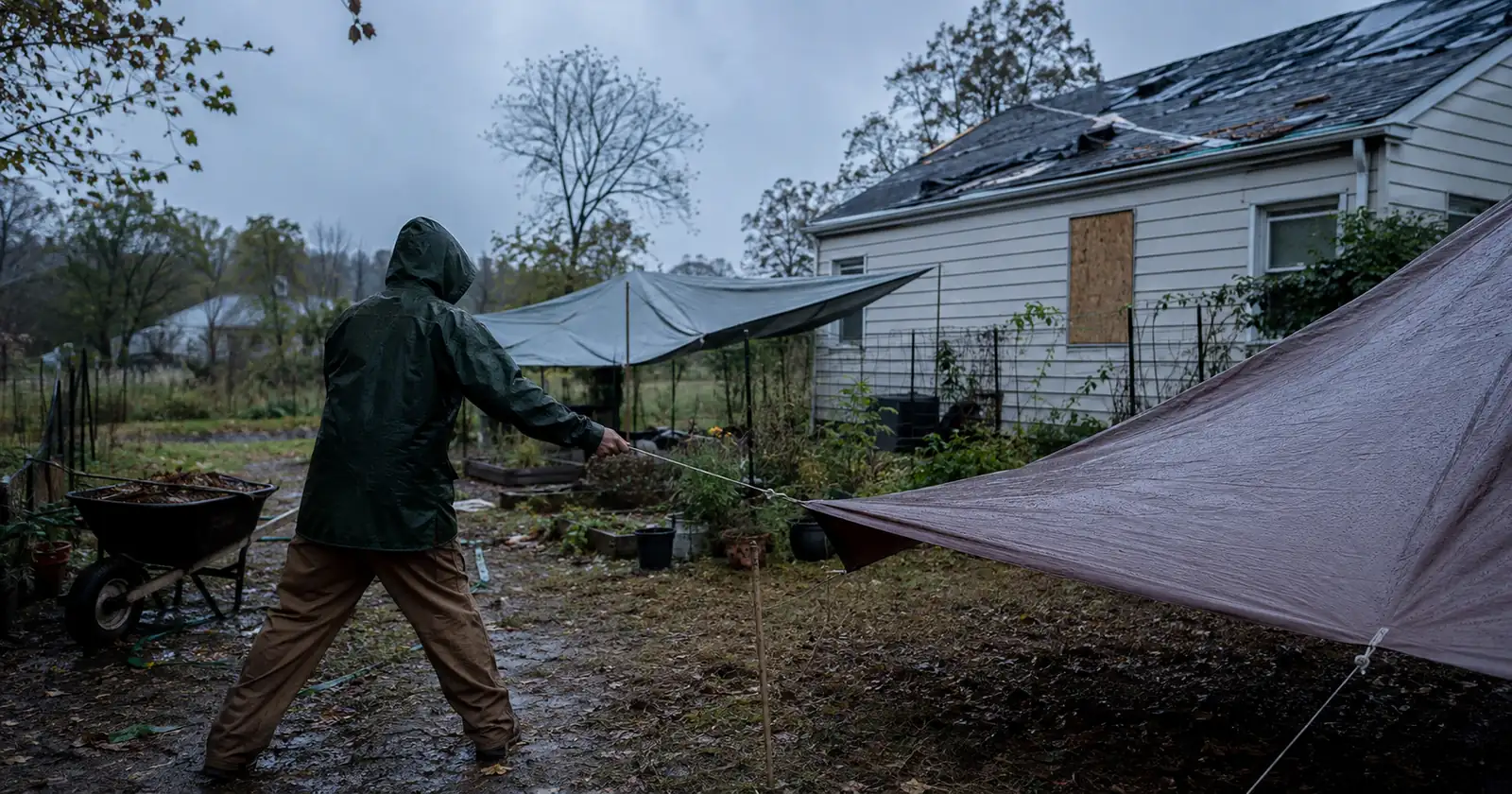
This isn't camping. The scenario is a damaged roof, a red-tagged building, or a week at a relative's place with nowhere for four people to sleep. The shelter goes up in a garden, a driveway or a car park, and it has to hold for days rather than a weekend.
That changes what matters. Pack weight barely counts. What counts is floor area, how fast one person can pitch it alone, and whether it survives a week of wind without anyone re-tensioning it at 3am.
How We Chose
We haven't tested these. OutdoorGearLab does long-running field testing on tents and tarps and weighs everything on its own scale; Trailspace publishes owner reviews from people who bought the gear. Both are cited here by name. Prices weren't verified directly for this page, so check current pricing before buying.
Two sources that rank well for these queries were deliberately left out — affiliate roundups with no traceable test protocol behind the claims.
Tent or Tarp
They solve different problems, and I'd argue for owning the tarp first.
A tent gives you a sealed room with a floor. It's what you want if people are sleeping outside for several nights, particularly with children or in insect season. It's also bulky, slower to pitch alone, and useless for the other jobs.
A tarp gives you covered area. It goes over a hole in a roof, over a doorway you're working through, over a picnic table that's become the kitchen, or pitched as a lean-to for sleeping. One tarp does five jobs badly and a tent does one job well — and in the week after a storm, five jobs is often the more useful trade.
Choosing a Tent for Displacement
Size up, hard. Capacity ratings assume adults lying shoulder to shoulder with no luggage. For real use, halve it. An eight-person tent is a comfortable four-person tent once you add bags, a cool box and somewhere to stand.
Pitch time and solo pitching. Instant-cabin designs with pre-attached poles matter more here than in camping, because the person putting it up may be doing it alone, in the wind, having slept badly. If a tent needs two people, that's a real constraint.
Standing height. Days rather than nights. Cabin tents let you stand up, and after seventy-two hours that stops being a luxury.
Floor. OutdoorGearLab specifically praised the tarp-style floors on the Skydome and the CORE for being durable, waterproof and easy to clean with kids and pets. That's the right test for this use.
| Shelter | Best for | Documented notes |
|---|---|---|
| Coleman Skydome XL 8 | A household staying put for days | OutdoorGearLab family favourite. Durable, cleanable tarp floor; battery string lighting they rated well for children |
| CORE 9 Instant Cabin | Larger households, fast pitching | Same OutdoorGearLab group. Instant-cabin format, spill-safe flooring |
| Kelty Wireless 6 | Two adults, two children, pets | Dual vestibules for gear storage, which matters when everything you own is in bags |
| Heavy poly tarp, 12 × 16 or larger | Roof damage, work areas, kitchen cover | The cheapest genuinely useful item here. Buy two |
| Hyperlite Mountain Gear Flat Tarp | A tarp that lives in a bag | 11 oz with cordage; OutdoorGearLab call it by far the most protective standalone tarp in their ultralight lineup |
| Sea to Summit Escapist | Multiple pitch configurations | Trailspace reviewers note it arrives ready to use out of the bag, with tie-outs along the edges and a diagonal seam, and pairs with a separate bug tent |
| HMG UltaMid 2 | Four-season, floorless | Pyramid shelter, easy to pitch with an extended pole, good in snow and wind |
Cold Weather, and What I'd Skip
A tent is a windbreak, not a heater. Nothing here changes the rule that no fuel-burning device goes inside a tent, ever — that includes catalytic heaters, stoves and lanterns. Cold-weather performance comes from sleeping bags, mats and layers, which is a separate purchase and the one people underestimate.
Ground insulation does more than tent rating. A sleeping mat between you and the floor is worth more than an extra season on a tent label.
Two Practical Details
Use a brown or green tarp as a groundsheet rather than the standard blue one, which OutdoorGearLab suggests for the simple reason that it's less visually obtrusive where you'll be living.
And don't let a groundsheet extend past the tent floor. OutdoorGearLab flag this directly: an oversized tarp collects rain and channels it under the tent. Tuck it in, or cut it down.
- Emergency Blankets & Sleeping Bags — what actually keeps you warm inside it.
- Portable & Camping Stoves — cooking outside the shelter, never in it.
- Emergency & Survival Kits — the rest of the displacement setup.
Buy the tarps first, and pitch whatever you buy once in daylight. Everything on this page works better if it isn't the first time.
FAQ: Emergency Tents & Tarps
What size emergency tent do I need for a family?
Roughly double your household count. Capacity ratings assume adults lying shoulder to shoulder with no luggage, which isn't how anyone lives in one for a week.
Is a tarp better than a tent for emergencies?
I'd buy the tarp first. It covers roof damage, work areas and outdoor cooking as well as sleeping. A tent does one job, and does it better.
Can I use a heater inside an emergency tent?
No. Nothing that burns fuel goes inside a tent — carbon monoxide and fire risk both apply. Warmth comes from sleeping bags, mats and layers.
What tarp size covers a damaged roof?
Bigger than the damage, with enough margin to secure the edges above the water line. Two medium tarps are more flexible than one huge one, and easier to handle alone.
Do you test these tents?
No. We use OutdoorGearLab's field testing and Trailspace's published owner reviews, and we name them. Check current pricing before buying — we haven't verified it directly.
Sources
- OutdoorGearLab — camping tent and ultralight shelter testing, 2026
- Trailspace — published owner reviews of tarps and shelters
- Ready.gov and FEMA — sheltering after a disaster
- CDC — carbon monoxide poisoning prevention
When a warning is active, follow local authorities and official emergency instructions before any general guidance. See our Editorial Policy and Sources & Fact-Checking.