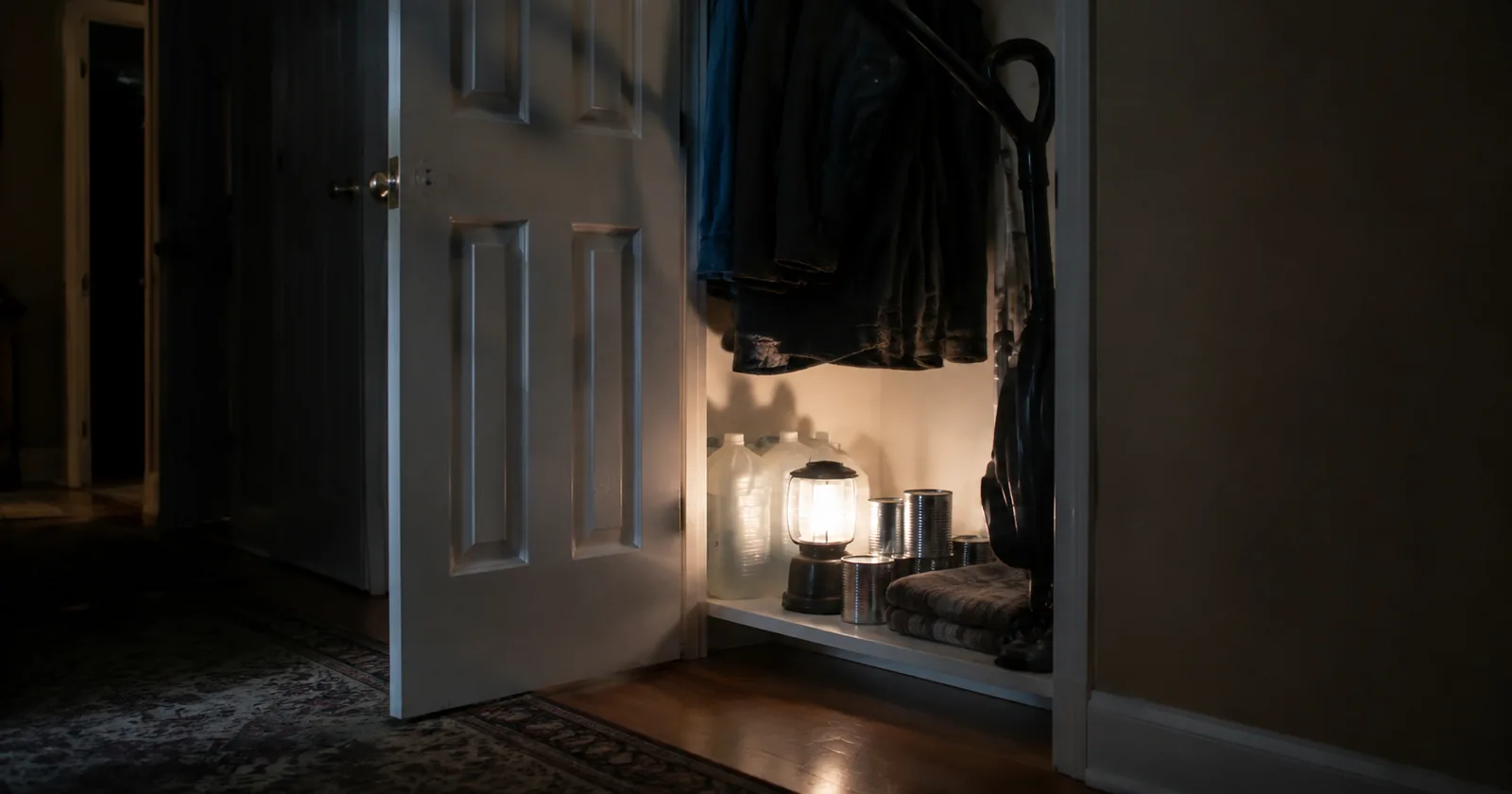

There are two kinds of emergency kit and they have almost nothing in common. One stays in the house and keeps you going when the power, water or shops stop. The other leaves with you in under a minute.
Sold side by side, they look like the same product at different sizes. They aren't. A home kit optimises for volume and cost per day. A grab-and-go kit optimises for weight. Buy the wrong one and you either can't lift it or it runs out on day two.
How We Chose
We haven't tested these. This page is built on manufacturer specifications, published contents lists, prices checked in September 2026, and what independent testers found when they bought the products — Reviewed.com and CNN Underscored have both unpacked kits in this category and their findings are cited where relevant, including the unflattering ones.
Home Kit or Grab-and-Go
The honest way to decide is to ask which scenario is realistic where you live. I'd answer that before comparing a single product.
If your risk is a multi-day outage, a winter storm or a water main failure, you're staying home. That kit lives in a cupboard, weighs whatever it weighs, and is judged on days of coverage per dollar. Water goes in containers, not pouches. Food is what you already eat.
If your risk is a wildfire, a flood or a building evacuation, you're leaving. That kit is judged on weight and on how fast you can be out of the door with it.
Many households end up wanting both. I'd build the home kit first, because it's cheaper per day of coverage and it covers a scenario that comes up regularly.
The Picks
| Kit | Job | Covers | Notes |
|---|---|---|---|
| Uncharted Basecamp 30L | Home | 4 people | YETI GoBox housing. Built to sit in a garage for years, not to be carried |
| Uncharted Basecamp 60L | Home | 4–8 people | Same idea, larger. Sensible for a big household or a shared building |
| Sustain Supply Comfort4 | Grab-and-go | 4 people | 399.99 $, 32 lb. Eight emergency meal kits and two 2,400 cal bars, six 1 L AquaLiterz, four filter straws, Mora carbon knife, plus a wood stove and cookware most kits leave out |
| Uncharted SEVENTY2 | Grab-and-go | 1 person | 349 $. Waterproof roll-top, labelled insert |
| Redfora Ready For Anything | Either | 1–4 people, 3 or 7 days | 135 $. Sold by household size, add-on driven, with a Refresh System that flags the food and water before they expire. Reviewed liked the build and the labelled contents; it also found the PALS-style webbing too narrow for a MOLLE pouch |
| Ready America | Grab-and-go | 1–4 people | Budget tier. Reviewed's value pick in the category |
What Separates a Real Kit From a Box of Objects
Water treatment, not water volume. Anything you carry runs out, so I judge a kit on the filter or the tablets rather than on how many pouches it ships.
Calories you'd actually eat. Freeze-dried meals need hot water, which needs a stove, which needs fuel — I'd check that chain is complete before buying, or pick food that doesn't need one.
A resupply path. My first question with any sealed kit is boring: can I buy refills in five years, or does the whole thing become landfill when the food dates out?
Where to Spend First
- Water and treatment. Cheapest, and it's the constraint everything else runs into.
- Light and power. Lanterns and a power bank. Used in the boring scenarios as well as the dramatic ones.
- Food you already eat, bought deeper rather than differently.
- The bag or box, once you know what's going in it.
- 72-Hour Kits — the three-day standard, in detail.
- Go Bags & Evacuation Bags — the checklist if you're building rather than buying.
- Emergency Backpacks — the pack itself.
Decide which of the two jobs you're solving before you compare anything. That one question clears up a lot of the confusion in this category.
FAQ: Emergency Survival Kits
What's the difference between an emergency kit and a survival kit?
Mostly marketing. What matters is whether the kit is designed to stay in the house or leave with you — those two require different contents and different trade-offs.
Which should I buy first?
A home kit, for many households. Extended outages come up regularly, and a home kit costs less per day of coverage.
Are expensive kits worth it?
Sometimes. What you're paying for is a waterproof container, better tools and a resupply path. What you're not paying for is more water — no kit carries three days of it.
How many people should one kit cover?
Home kits scale well to a household. Grab-and-go kits generally don't, because one person ends up carrying everything. Above two people, split it across bags.
Do you test these kits?
No. This page uses manufacturer specifications, published contents, current prices and the findings of reviewers who did buy and test.
Sources
- Uncharted Supply Co, Redfora, Sustain Supply — specifications and pricing, checked September 2026
- Reviewed.com — hands-on kit testing
- CNN Underscored — bug-out bag testing
- Ready.gov and FEMA — Build a Kit
When a warning is active, follow local authorities and official emergency instructions before any general guidance. See our Editorial Policy and Sources & Fact-Checking.