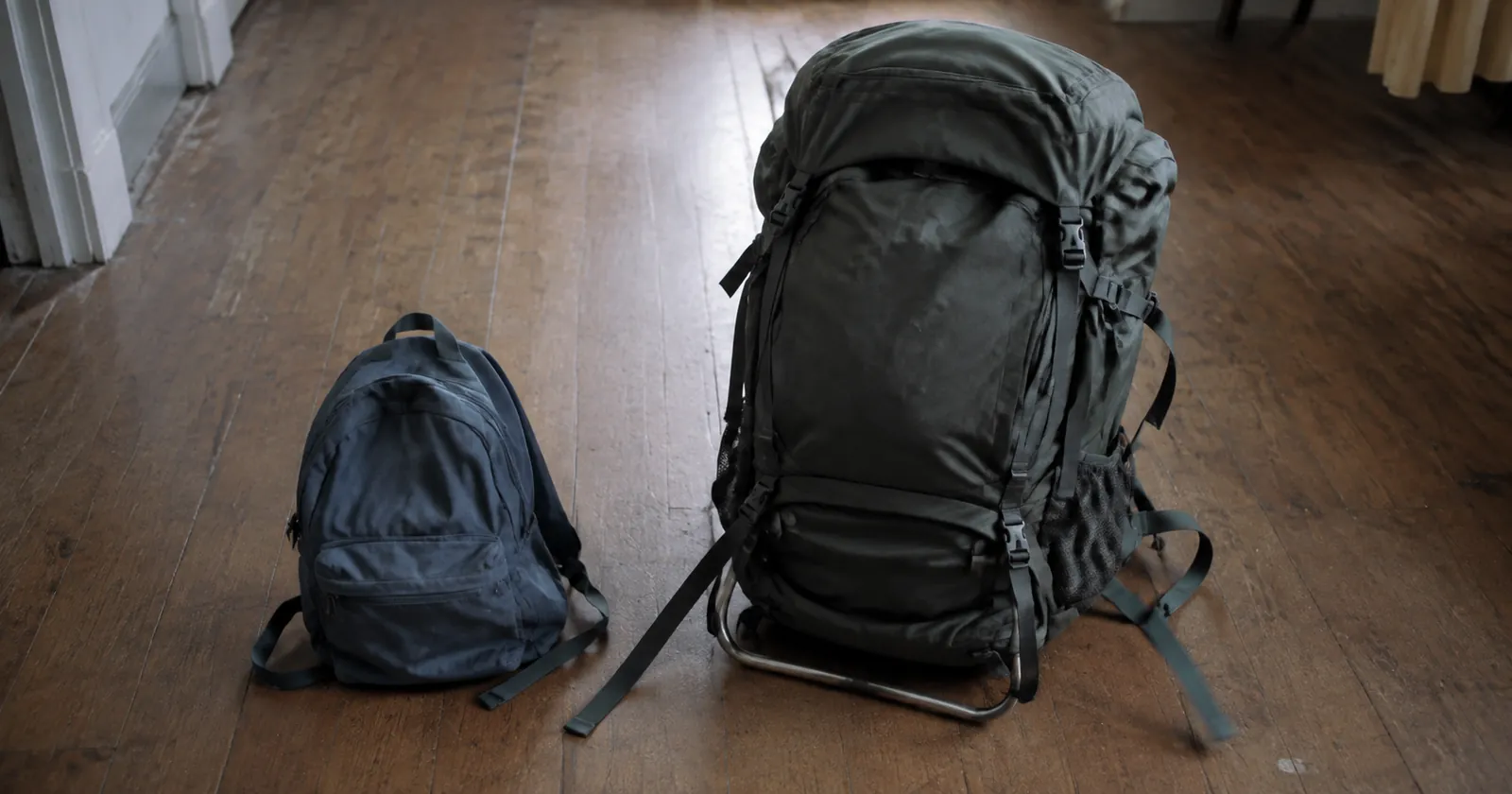

Same object, different mission. Both are a backpack you can grab in seconds. What separates them is the assumption underneath: a go bag assumes you're heading somewhere with a roof and a tap, and a bug-out bag assumes you aren't.
That one assumption drives everything else — weight, water, cooking, shelter, and how much of it you'll actually keep packed a year from now.
The Actual Difference
I find it helps to stop thinking about the bag and start thinking about the destination. Everything else falls out of that.
If the destination has walls, someone else is providing shelter, heat and water. Your bag only has to cover the gap — the drive, the queue, the first night on a camp bed in a school gym. That's a small, light bag, and much of what's in it is documents, medication and chargers.
If the destination is nowhere in particular, you're carrying the shelter, the water treatment and the heat source yourself. That's a much bigger bag, and now weight is the design constraint rather than an afterthought.
Side by Side
| Go bag | Bug-out bag | |
|---|---|---|
| Assumption | You're going somewhere with a roof | You're on your own |
| Duration | A day or two, then resupply | Around three days, unsupported |
| Weight | Light enough to carry down stairs without thinking about it | Heavy enough that you have to train with it |
| Water | A bottle, refill on the way | A filter or treatment, because there's no tap |
| Shelter | Provided at the destination | Carried — tarp, bivvy, sleep system |
| Cooking | None. Food that opens | Stove and fuel |
| Who it suits | Most evacuation-focused households | People with the skills and the terrain to use it |
My opinion, and it isn't a popular one in this corner of the internet: a lot of people shopping for a bug-out bag would be better served by a lighter, evacuation-focused go bag. It's easy to end up with forty pounds of equipment for a scenario that may never arrive, and no photocopy of a passport for the one that does.
Where People Get It Wrong
The failure mode isn't picking the wrong bag. It's building the heavy one and then never carrying it.
A bug-out bag is a skills package as much as a kit. A stove you've never lit in the cold, a filter you've never backflushed, a tarp you've never pitched in wind — that's not capability, it's weight. I'd rather own the simpler system I can use badly and still be fine than the sophisticated one I've never tested.
The other one I see is the hybrid. One bag, forty pounds, meant to cover both jobs, and so it's too heavy for the evacuation and too thin for the wilderness. If you genuinely want both, build the go bag first and make the bug-out bag an add-on module you can attach when the scenario justifies it.
Which One to Build
Start with the go bag. It's cheaper, it's lighter, it covers the scenarios that actually happen to people, and it's the one you'll still have packed properly in three years.
If you want the second one afterwards, build it as a separate kit rather than by inflating the first. The two have different jobs and should live as different bags.
- Go Bags & Evacuation Bags — the checklist, in two versions.
- Bug-Out Bags — what changes when there's no destination.
If you only do one thing today: weigh whatever bag you already have. My first question with any kit is boring, and it's this one — can the person it belongs to carry it up a flight of stairs? If not, nothing else in it matters.
FAQ: Go Bag vs Bug-Out Bag
Is a go bag the same as a bug-out bag?
No. Same format, different assumption. A go bag assumes a destination with shelter; a bug-out bag assumes you're providing your own for around three days.
Which one should I build?
The go bag. It matches the scenarios households actually face — evacuation orders, floods, fires, building emergencies — and it stays packed because it's light.
Can one bag do both jobs?
Badly. You end up too heavy for the evacuation and too thin for self-sufficiency. Build the go bag, then add a separate module if you want the second capability.
How much should each weigh?
There's no universal number — it depends on who carries it. The test that matters is whether that person can walk with it and manage stairs.
Do I need a bug-out bag if I live in a city?
Rarely. Urban evacuations end at shelters, hotels and relatives, not in the woods. A go bag plus a plan for where you're going covers it.
Sources
- Ready.gov — Build a Kit, Evacuation
- FEMA — household preparedness guidance
- American Red Cross — survival kit supplies
When a warning is active, follow local authorities and official emergency instructions before any general guidance. See our Editorial Policy and Sources & Fact-Checking.