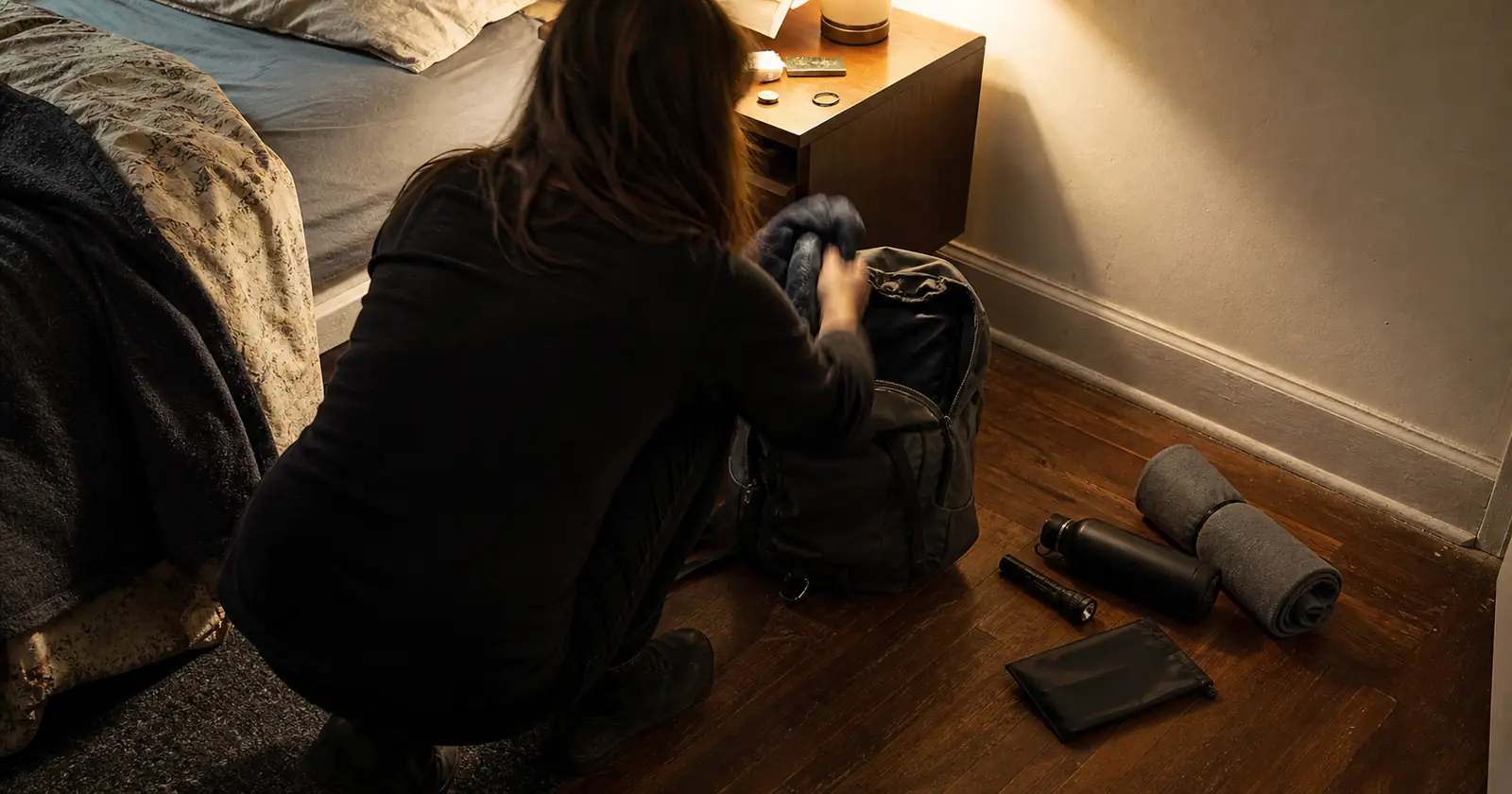

A go bag is what you carry out of the door when you have to leave and can't come back for a while. It's a civil evacuation bag — the kind that ends up in a car, a relative's spare room or a shelter. It isn't a wilderness kit, and building it like one is how people end up with a bag too heavy to carry.
The checklist below is one page, in two versions: what each person carries, and what the household shares. Print it, pack it once, and it's done for a year.
What Each Person Carries
One bag per person, packed by that person where possible, and light enough that they can walk with it and manage stairs.
Keep the vocabulary honest while you pack. This is a bag for a night at a relative's house or a cot in a school gym, not for living off the land. That framing settles a lot of the arguments about what goes in — if the item only makes sense with no roof over your head, it belongs in a different bag.
- Water for the trip, plus a way to refill.
- Food that needs no cooking, for a day.
- A change of clothes, and sturdy closed shoes if they aren't already on.
- A warm layer and a rain layer, whatever the season is now.
- Medication for several days, and a copy of the written medication list.
- Phone charger and a charged power bank.
- A torch and spare batteries.
- Copies of ID and the contact card.
- Cash in small notes.
- Toothbrush, soap, and anything personal you'd be miserable without.
- For a child: one comfort item, chosen by them.
What the Household Shares
One additional bag, carried by whoever has a free hand, holding the things it makes no sense to duplicate.
- The documents folder and the encrypted drive.
- A first aid kit.
- A battery or hand-crank radio.
- Spare phone cables and a multi-port charger.
- An emergency blanket or sleeping bag per person, if the season or the destination is uncertain.
- Pet food, a leash, a carrier, and vaccination records.
- Wet wipes, bin bags, and a roll of tape.
- Spare car and house keys.
The Fifteen-Minute Pack Drill
The purpose isn't speed for its own sake. It's finding out what's missing while it's still easy to fix.
- Minutes 0–5. Each person collects their own clothes, shoes, medication and charger. No decisions, just gathering.
- Minutes 5–10. One person handles the shared bag: documents, first aid, radio, pet gear.
- Minutes 10–15. Everything goes to the door. Bags get lifted and carried to the car or the bottom of the stairs.
Do it once with a timer. What it tends to surface is the same category of thing — a charger that lives in a car, a prescription that's nearly out, a bag no one can lift, and one person who didn't know where the documents were.
Run it a second time six months later and it takes half as long, because the drill is really about deciding things in advance. The first run is slow because people are choosing what to bring. The second is fast because they aren't.
Where It Lives, and When to Check It
By the door, or in a hall cupboard on the way out — not in a loft, not in a garage behind the bikes. Same principle as everything else: it lives where you'll be when you need it.
If a bag belongs to someone who isn't home during the day, think about where they'd actually be. A go bag at home is no use to a person at work forty minutes away, which is an argument for a small second one in a car or a desk drawer rather than for a bigger one at home.
| Item | Check | When |
|---|---|---|
| Medication | Dates, and that it matches the current prescription | Twice a year |
| Water and food | Dates, seals, leaks | Once a year |
| Batteries and power bank | Charge level, corrosion | Twice a year |
| Clothes and shoes | Still fit, right season | Once a year, and after any growth spurt |
| Documents | Nothing expired, nothing superseded | Once a year |
If the bag itself is the weak point — no waist belt, no rain cover, too small for a change of clothes — that's covered in Emergency Backpacks.
Print the checklist and pack the per-person version tonight. The shared bag can wait until the weekend; the individual ones are what get carried.
FAQ: Go Bag Checklist
What should be in a go bag?
Water, no-cook food for a day, a change of clothes, a warm and a rain layer, several days of medication, chargers, a torch, copies of ID, cash, and basic toiletries. Documents, first aid and a radio go in a shared household bag.
How heavy should a go bag be?
Light enough that the person carrying it can walk with it and manage stairs. Test it by walking around the block rather than by weighing it — that answers the question directly.
Is an evacuation bag the same as a go bag?
Yes. Different names for the same thing — a bag you carry out of the door during an evacuation. The checklist above covers both.
How is this different from a bug-out bag?
A go bag assumes you're heading somewhere with a roof — a shelter, a relative, a hotel. A bug-out bag assumes self-sufficiency for longer. See Go Bag vs Bug-Out Bag.
Do children need their own bag?
If they're old enough to carry one, yes — a small one, packed by them, with one comfort item they chose. A child carrying their own small bag is easier than an adult carrying two.
How often should I repack it?
Check it twice a year for medication and batteries, once a year for everything else, and immediately after anyone borrows something from it.
Sources
- Ready.gov — Build a Kit
- FEMA — evacuation guidance
- American Red Cross — survival kit supplies
- State and county emergency management offices
When a warning is active, follow local authorities and official emergency instructions before any general guidance. See our Editorial Policy and Sources & Fact-Checking.