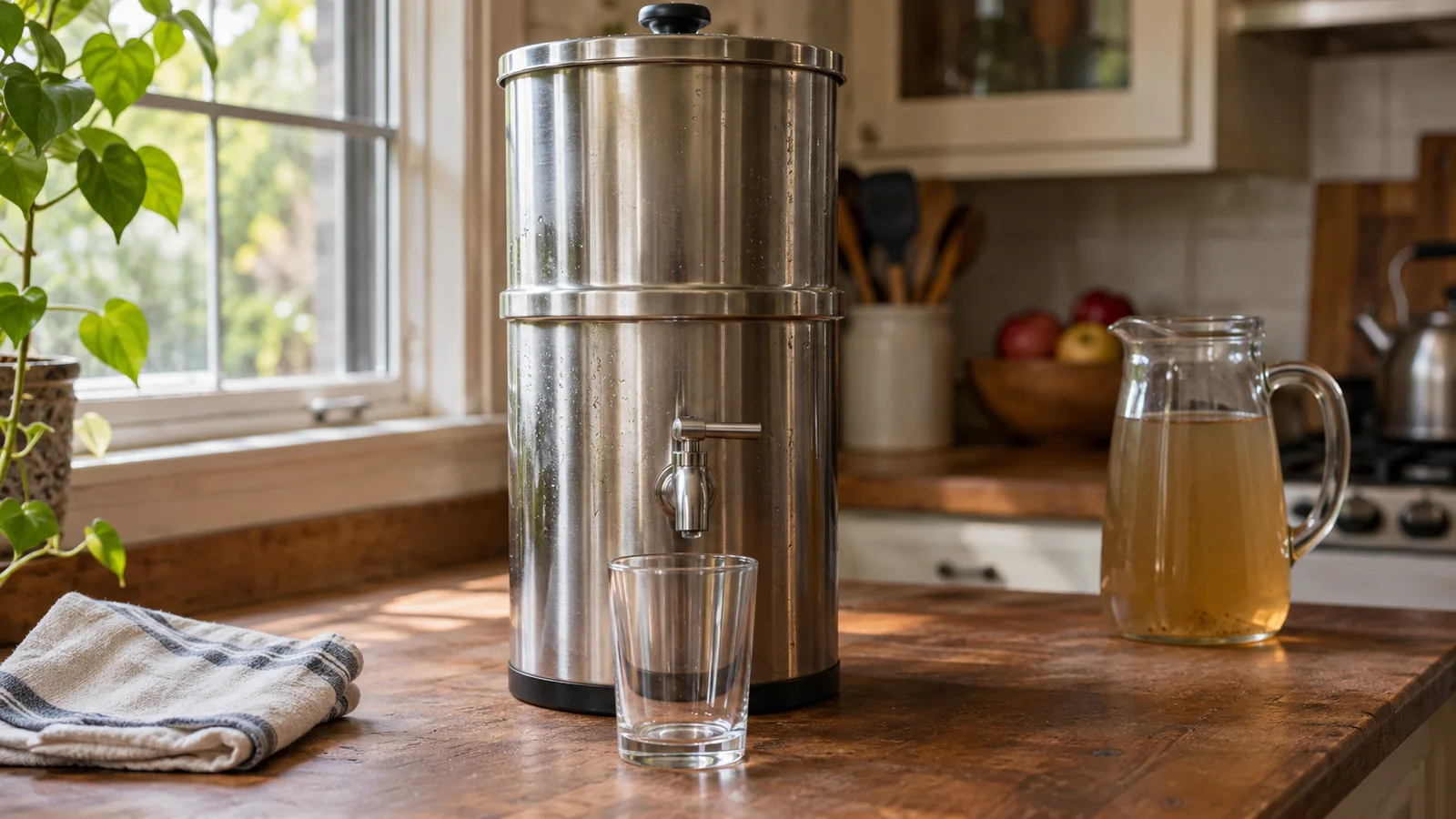

A gravity water filter system is the one piece of water equipment that works when nothing else does. No pump, no power, no plumbing — you pour dirty water into the top chamber, gravity pulls it through the elements, and clean water collects below. That is the entire mechanism, and it is why these sit in preparedness kits and on kitchen counters alike.
The trade-off is speed. A gravity system produces water at a trickle rather than on demand, and the honest way to choose one is to work out how much you need per day rather than which model has the best reviews.
How Gravity Filtration Actually Works
Two stacked chambers and one or more porous elements between them. Water in the upper chamber is pushed through the element by nothing but its own weight, which is a very low pressure — so the element must have pores fine enough to stop contaminants while remaining open enough to pass water at a usable rate.
That tension explains everything else about these systems. The finer the filtration, the slower the output. Larger systems get around it with more elements in parallel rather than faster ones, which is why capacity is usually described as a number of elements rather than a litres-per-hour figure.
Most elements are ceramic or a carbon composite. Ceramic works as a physical sieve and can usually be cleaned and reused; carbon composites adsorb chemicals as well as straining particles, and are replaced rather than scrubbed. Many systems combine both, and some add a fluoride or arsenic stage below the main element.
Choosing the Size: Work Backwards From Daily Need
This is where most purchases go wrong. A system described as holding twelve litres does not produce twelve litres an hour — it holds twelve litres while they slowly filter through.
So start with consumption. Plan on roughly four litres per person per day for drinking and cooking, more in heat, and then check the system's stated flow rate against that. A household of four needing sixteen litres a day is fine with a modest system if someone refills the top chamber twice; the same household trying to supply a full day's water in one evening sitting needs a considerably larger one.
Two practical notes on gravity water filters for home use. Counter height matters more than people expect, because the assembled unit is tall and needs clearance above it to pour. And a full upper chamber is heavy, so the whole thing wants a solid surface rather than a shelf.
For camping and backpacking the calculation inverts: weight and packed size dominate, and a gravity water filter bag hanging from a branch is the usual answer. A gravity water filter camping setup is chosen for grams; a gravity water filter system for home is chosen for throughput.
What It Removes, and What It Does Not
This is the question that matters, and the answer depends on the element rather than on the housing. A certification naming the contaminant is the only reliable evidence.
- Reliably removed by most elements: sediment, bacteria, protozoa and cysts, chlorine, taste and odour, many organic chemicals.
- Only by specific elements: fluoride, arsenic, lead, nitrate. These need a dedicated stage, and the base element does nothing about them.
- Generally not removed: viruses, unless the element is explicitly rated as a purifier; dissolved salts; hardness.
The filter-versus-purifier distinction is worth understanding. A filter is rated against bacteria and protozoa, which is sufficient for most North American and European backcountry water. A purifier additionally handles viruses, which matters where human sewage may be in the source. Many products use the words loosely; the rating does not.
For a wider comparison of mechanisms — what carbon, ceramic, reverse osmosis and UV each handle — see water filter types.
Making It Last
The difference between elements that reach their rated life and elements that clog in a season is almost entirely about what you pour in.
Pre-filter anything cloudy. Let silty water settle in a bucket, then decant the clear water off the top, or pour through a cloth first. Sediment blinds the surface of an element and no amount of scrubbing fully recovers it.
Clean ceramic elements when the flow drops, not on a schedule — a gentle scour with a clean pad under running water, never soap. Replace carbon composites rather than cleaning them. Track volume filtered rather than months elapsed, since a rated life in litres means nothing as a calendar date.
And keep the clean side clean. The lower chamber holds treated water with no residual disinfectant, so it will grow things if left sitting warm for a week. Empty it, rinse it, and do not put unwashed hands or a dirty spigot in contact with the output. This is the failure mode that actually makes people ill, and it has nothing to do with the element.
Stored filtered water also needs somewhere to go if the supply is off for days rather than hours — see water storage tank sizes.
Common Questions
Can a gravity filter make any water drinkable?
No. It handles organisms and many chemicals, but chemically contaminated water — industrial runoff, saltwater, water near a spill — is outside what any gravity element is designed for. Floodwater is the clearest example: assume it is chemically as well as biologically contaminated.
How long do the elements last?
Rated lives are quoted in litres or gallons, commonly in the thousands, and the number assumes reasonably clear input. Dirty water shortens it dramatically. Flow rate falling off is the practical signal, which is why keeping a rough tally of what you have filtered is more useful than a date.
Does it remove fluoride?
Only with a specific additional element, usually fitted below the main one and sold separately. Standard ceramic and carbon elements do not. If this matters to you, check the certification rather than the marketing copy.
Is a gravity filter better than a pump filter?
For sitting still, yes — it needs no effort and treats larger volumes. For moving, no: a pump or squeeze filter gives water immediately and weighs less. Many people with both use the gravity system at home or at camp and carry something smaller on the move.
Can I leave water sitting in it?
Overnight is fine. Days are not. Filtered water has no chlorine residual, so a warm chamber left standing becomes a growth medium. If a system will sit unused, empty and dry both chambers and store the elements according to the manufacturer's instructions.
Sources
- Centers for Disease Control and Prevention — household water treatment, filter pore size and effectiveness against bacteria, protozoa and viruses
- U.S. Environmental Protection Agency — emergency disinfection of drinking water, and guidance on chemically contaminated water
- World Health Organization — household water treatment and safe storage, including recontamination of treated water
- NSF/ANSI standards for drinking water treatment units — contaminant-specific reduction claims and rated capacity
- U.S. Environmental Protection Agency — the filter and purifier distinction, and registration requirements for microbiological purifier claims
Performance depends on the specific element and its certification rather than on the system it sits in, and rated capacities assume relatively clear source water. This page is general information; we test no products, recommend none, and receive no referral fees. In a declared emergency, follow the guidance issued by your local authority. See our Editorial Policy, Sources & Fact-Checking and Affiliate Disclosure.