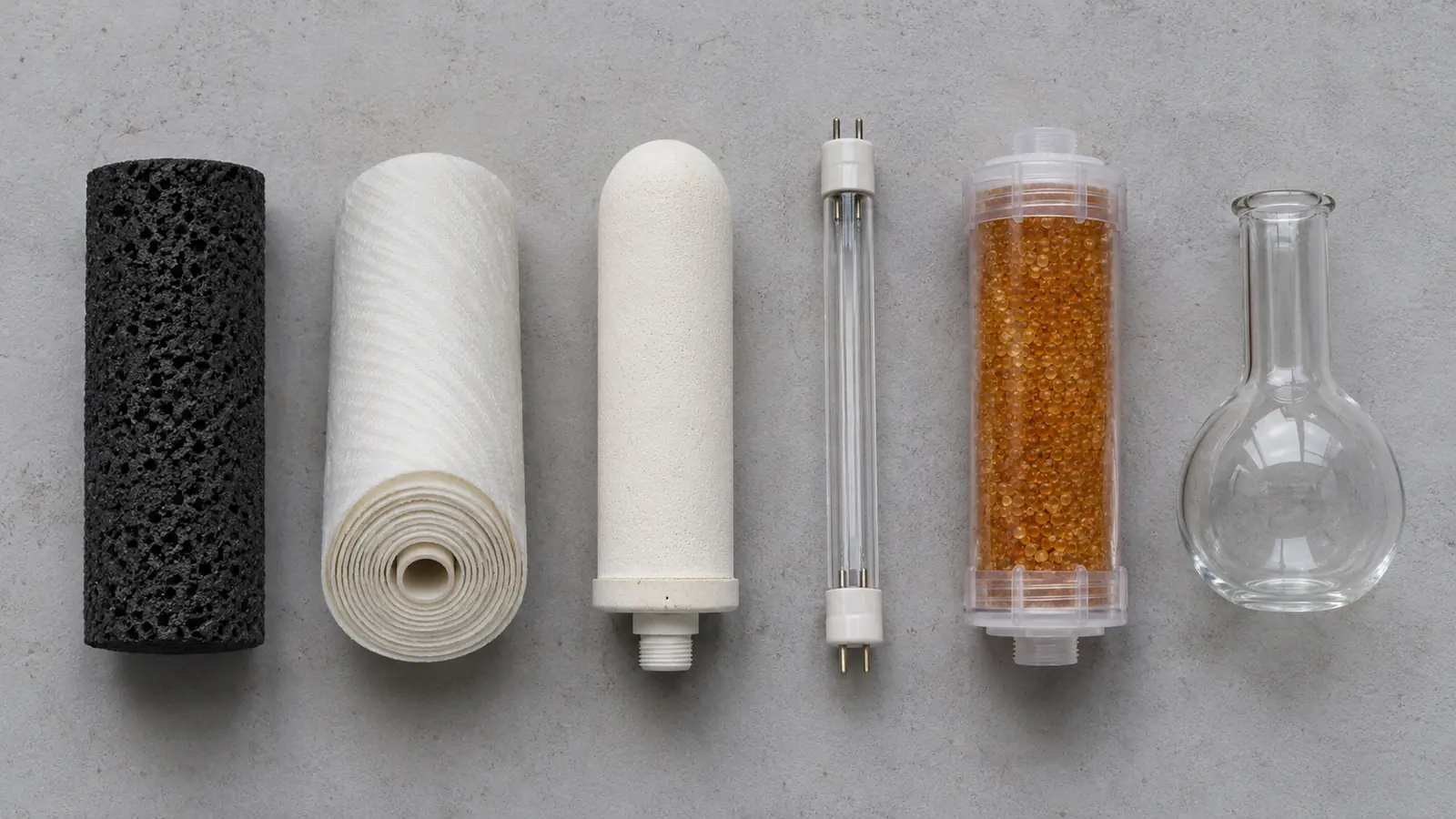

Almost every question about water filter types turns out to be the same question underneath: which kind removes the thing I am worried about. That is a better question than "which filter is best", because no filter is good at everything, and the honest answer depends entirely on what is in your water.
So this is a taxonomy rather than a shootout. Six families of filtration, what each one physically does, and — more usefully — what each one does not do.
The Six Families, and What Each Removes
People searching for types of water filters explained usually get a list of brand names. Here is the list that matters instead — the physical mechanism, because the mechanism determines the limits.
| Type | How it works | Removes | Does not remove |
|---|---|---|---|
| Activated carbon | Adsorption — contaminants stick to a huge internal surface | Chlorine, taste, odour, many pesticides and solvents | Minerals, nitrate, most metals, bacteria |
| Reverse osmosis | Pressure forces water through a semi-permeable membrane | Nitrate, arsenic, fluoride, lead, most dissolved solids | Some dissolved gases; wastes several litres per litre produced |
| Ceramic / hollow-fibre | Mechanical sieve with pores measured in fractions of a micron | Bacteria, protozoa, cysts, sediment | Viruses (mostly), dissolved chemicals, metals, salts |
| Ultraviolet | UV light damages the DNA of organisms passing it | Bacteria, viruses, protozoa — inactivated, not captured | Anything at all that is not alive. Needs clear water. |
| Ion exchange | Swaps unwanted ions for harmless ones on a resin bed | Hardness (softeners), or lead and specific metals | Organics, bacteria, sediment, taste |
| Distillation | Boils water and condenses the steam, leaving residue behind | Metals, salts, nitrate, minerals, organisms | Some volatile organics that boil alongside water |
That table answers the question behind how many types of water filters are there more usefully than a count would. There are six mechanisms; everything sold is one of them, or several in series.
Why "Best" Is the Wrong Question
Look down the "does not remove" column and the pattern appears: each family is blind to something another family handles. Carbon is excellent at the things you can taste and useless against nitrate. Reverse osmosis handles nitrate and is slow. A ceramic element stops the organisms that make you ill on a hiking trip and ignores the dissolved arsenic that might be in a well.
This is why different kinds of water filters get combined in real installations, and why anyone selling a single device as a complete solution is skipping a step. The types of water filtration you need come from a water test, not from a ranking.
It is also why the same filter can be the right answer and the wrong answer in two houses on the same street — one on a municipal main, one on a private well.
Matching the Type to the Problem
Working backwards from what you actually want to fix:
- Chlorine taste or smell — carbon, in any form. This is the one problem nearly every filter on the shelf genuinely solves.
- Hardness, scale, white deposits — ion exchange. Not a filter in the sieve sense at all, and no filter substitutes for it.
- Bacteria in a well test — UV or chlorination, after the water has been made clear. A taste filter does nothing here.
- Nitrate or arsenic — reverse osmosis, or distillation, or a specific ion-exchange medium. Nothing else touches them.
- Lead — certified carbon blocks or reverse osmosis. Certification matters more than mechanism, because performance varies hugely between products using the same material.
- Sediment, grit, cloudiness — a sediment filter first, which also protects everything downstream.
- Untreated surface water on a trip — a hollow-fibre or ceramic element rated for protozoa and bacteria. See portable water filter for travel.
On a municipal main the question narrows usefully, because the utility has already dealt with the organisms. The types of water filters for tap water that earn their place there are carbon for chlorine and taste, and a certified block or membrane if lead is a possibility in your own plumbing.
Where the water enters matters as much as the mechanism. The kitchen drinking water filter types — jug, tap-mounted, under-sink — all treat one outlet, which is the right scope when the concern is what you drink. Treating the whole building is a different project, covered in water treatment systems for home.
Reading a Certification, Not a Claim
Among the types of water filters available commercially, the gap between two products using the same medium can be larger than the gap between two mechanisms. "Filters 99% of contaminants" is marketing; a certification naming the specific contaminant and the standard it was tested against is evidence.
So look for the contaminant named explicitly — "certified for lead reduction" rather than "certified". Check the rated capacity in litres or gallons, because performance falls off a cliff once a cartridge is spent rather than degrading visibly. And treat flow rate as part of the specification: a filter that cannot keep up with a tap gets bypassed by its owner within a fortnight.
One category deliberately not covered here: fridge cartridges. They are a maintenance part for an appliance, not a water treatment decision, and the choice is made by the appliance rather than by your water report.
Common Questions
Which filter type removes the most?
Reverse osmosis and distillation remove the widest range of dissolved contaminants. Both are slow, both strip beneficial minerals along with everything else, and reverse osmosis sends several litres to the drain for each litre it produces. "Removes the most" and "is the right choice" are different questions.
Does boiling replace filtering?
Only for organisms. Boiling kills bacteria, viruses and protozoa and does nothing about lead, nitrate, arsenic or pesticides — in fact it concentrates them slightly as water evaporates. It is the correct response to a boil-water notice and the wrong response to a chemical result on a well test.
Do I need to remove minerals from my water?
Generally no. Calcium and magnesium are the minerals that cause scale, and removing them is about protecting plumbing and appliances rather than health. Filters that strip everything are chosen for a specific contaminant, with mineral loss as a side effect rather than a goal.
Can I combine filter types myself?
Yes, and under-sink systems are usually sold that way — sediment, then carbon, then a membrane. The order is not optional: coarse before fine, and anything that needs clear water goes last. Combining them in the wrong sequence shortens the life of the expensive stage.
How do I know which type I need?
Test the water. On a municipal supply, start with your utility's annual report; on a well, with an accredited laboratory. The result names contaminants, and the table above maps contaminants to mechanisms. Choosing a filter before testing is choosing an answer before hearing the question.
Sources
- U.S. Environmental Protection Agency — drinking water treatment technologies and point-of-use and point-of-entry guidance
- Centers for Disease Control and Prevention — household water treatment, filtration mechanisms and pore-size effectiveness against organisms
- World Health Organization — household water treatment and safe storage, performance of filtration and disinfection methods
- NSF/ANSI standards for drinking water treatment units — contaminant-specific reduction claims, rated capacity and testing protocols
- U.S. Environmental Protection Agency — National Primary Drinking Water Regulations, contaminant limits and health effects
Filter performance depends on the specific product and its certification, not on its material alone, and the right choice depends on a water test for your own supply. This page is general information, not a product recommendation; we test no products, recommend none, and receive no referral fees. See our Editorial Policy, Sources & Fact-Checking and Affiliate Disclosure.