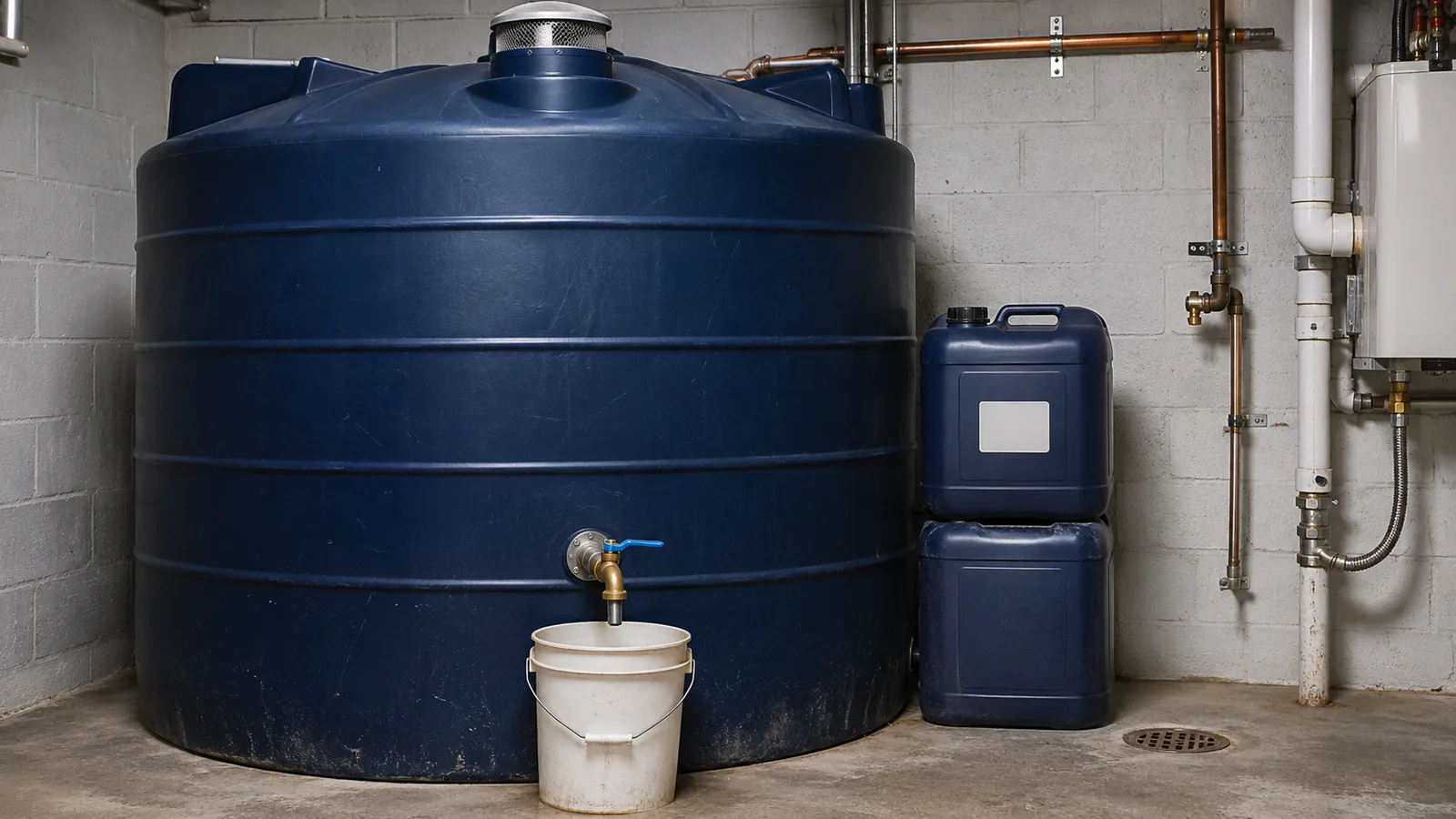

Water storage tank sizes are the part of this decision that actually matters, and the only way to choose one honestly is to work out how much water you need for how long. Everything else — material, shape, where it goes, what it costs — follows from the volume, and a tank bought before that calculation is usually either useless or absurd.
So this page is a sizing guide first. Then the practical constraints that stop people installing the tank they calculated: weight, access, and the fact that stored water does not keep itself safe.
Sizing: Work It Out Before You Shop
The baseline figure in emergency planning is one gallon per person per day — about four litres — split evenly between drinking and everything else: cooking, washing, basic sanitation. It is a floor rather than a comfortable allowance.
Multiply by people, then by days, then adjust for reality:
- Pets. Add their daily intake; a large dog drinks like a person.
- Heat. Consumption rises substantially in hot weather, and outages in heat waves are common.
- Medical needs. Dialysis, wound care and formula feeding all raise the figure, sometimes sharply.
- Toilets. Flushing is the hidden consumer. If you are planning for sanitation rather than just drinking, non-potable storage covers it more cheaply.
- A well, not a main. If your water comes from a pump, a power cut is a water cut, so plan for outage length rather than for supply failure.
A worked example: four people and a dog, two weeks, one gallon each per day is about 60 gallons — roughly 230 litres. That is the water storage tank capacity you are actually shopping for, as a single large vessel or several smaller containers, and it is considerably more than most households think they are storing.
The useful reframing for a home water storage tank is that there are two separate problems. Drinking water must be potable, rotated and certified. Flushing and washing water need not be, and can live in a cheap barrel or even a bathtub bladder filled when a storm is forecast.
Weight, Access and Where It Actually Goes
This is where calculated volumes meet physical buildings. Water weighs about 8.3 pounds per gallon, or one kilogram per litre. A 60-gallon tank is around 500 pounds when full; a 250-gallon tank is over a ton.
Three consequences follow. A full tank needs a floor rated for it — a concrete slab or basement floor is fine, a wooden upper floor or a shelf is not, and the load is concentrated rather than spread. Tanks must be filled in place, never moved full, so the route in has to accommodate the empty tank through doorways and down stairs. And a tall narrow tank is less stable than a squat one, which matters in earthquake country, where strapping is standard practice rather than an optional extra.
A residential water storage tank is therefore usually sited in a basement, a garage, a crawl space with access, or outside on a prepared pad. Outside brings its own issues: freezing, and sunlight, which drives algae growth through any translucent wall.
Material, Certification and Shape
For drinking water the specification is narrow and worth insisting on. Food-grade polyethylene certified to NSF/ANSI 61 is the common answer, in an opaque colour — dark blue or black — to keep light out. "Food-safe" as a marketing phrase is not the same as a certification, and a drum that previously held something else is not made potable by rinsing.
Fittings matter as much as the vessel. You want a sealed, screened vent so the tank can breathe without admitting insects, a bottom drain or a tap high enough to get a container under, and an inlet you can close. An overflow is worth having if the tank is ever connected to anything that fills it automatically.
Shape is mostly about fit: slimline tanks exist specifically to go against a wall or into a crawl space, at the cost of stability and cleaning access. Several smaller containers rather than one large one is a legitimate strategy — easier to move, easier to rotate, and a single failure does not empty your whole supply.
Keeping Stored Water Drinkable
Stored water does not stay good on its own. Municipal water arrives with a chlorine residual that dissipates over weeks, after which there is nothing stopping growth, and warmth and light accelerate everything.
Three habits cover it. Rotate on a schedule — every six months for containers of municipal water is a common practice, and labelling the fill date is what makes it actually happen. Keep tanks sealed, dark and cool, away from solvents, fuel and pesticides, because some plastics allow vapour through. And treat water storage tank cleaning as part of the cycle rather than an occasional chore: drain, scrub, sanitise and rinse before each refill. Topping up a part-full tank carries any problem forward indefinitely, which is why a tank that is never emptied is the one that eventually becomes undrinkable.
Installation deserves the same realism. Anyone asking how to install a water storage tank of any size is really asking three questions — can the floor take it, can the empty tank get there, and where does an overflow or a failed fitting drain to. Answer those before the tank arrives rather than after.
If the water came from a well or any untreated source, it needs disinfecting before storage, not after. And treat a long-stored tank as suspect rather than safe: if there is any doubt, boil or filter it before drinking — see gravity water filter system for treatment that works without power, and water treatment systems for home if the source itself is the problem.
One connection worth making explicit: if a pump fills your tank, the tank is only as available as your electricity. See backup power and energy.
Common Questions
How much water should I store for emergencies?
One gallon — about four litres — per person per day is the standard planning figure, and two weeks is the target most current guidance uses. For four people that is 56 gallons before you account for pets, heat or medical needs. Three days is a minimum, not a goal.
How long can water be stored?
Commercially bottled water carries a best-before date and generally keeps well beyond it if unopened and cool. Water you store yourself in a clean, sealed, opaque container is commonly rotated every six months — not because it becomes dangerous on a date, but because nothing is maintaining it.
Can I use any barrel or drum?
Only if it is food-grade, certified for potable water, and has not held anything else. A drum that previously contained chemicals, or a translucent container that lets light in, is not suitable for drinking water. For flushing and washing, the requirements are far looser.
Where should the tank go?
Somewhere with a floor that can take the full weight, access to get the empty tank in, protection from sunlight and freezing, and ideally a drain nearby. Basements and garages are the usual answers. Never on an upper floor without checking the structure, and never where a leak would do serious damage.
Do I need to add anything to stored water?
Municipal water usually needs nothing if the container is clean and sealed — it arrives disinfected. Water from a well or an untreated source should be disinfected before storage. Guidance on what to add, and in what quantity, comes from your local health authority rather than from a general rule.
Sources
- Ready.gov (U.S. Department of Homeland Security) — water storage quantities and emergency supply planning
- Centers for Disease Control and Prevention — creating and storing an emergency water supply, container requirements and rotation
- U.S. Environmental Protection Agency — emergency disinfection of drinking water
- NSF/ANSI 61 — drinking water system components, health effects, as applied to tanks and fittings
- Federal Emergency Management Agency — non-structural seismic bracing guidance for tanks and heavy household equipment
Structural capacity, seismic bracing requirements and plumbing rules are set locally; so is guidance on disinfecting stored water. Weights given are approximate and exclude the tank itself. This page is general information rather than a structural or plumbing design — check floor loading and local code before installing a large tank, and follow your local health authority on disinfection. See our Editorial Policy, Sources & Fact-Checking and Affiliate Disclosure.