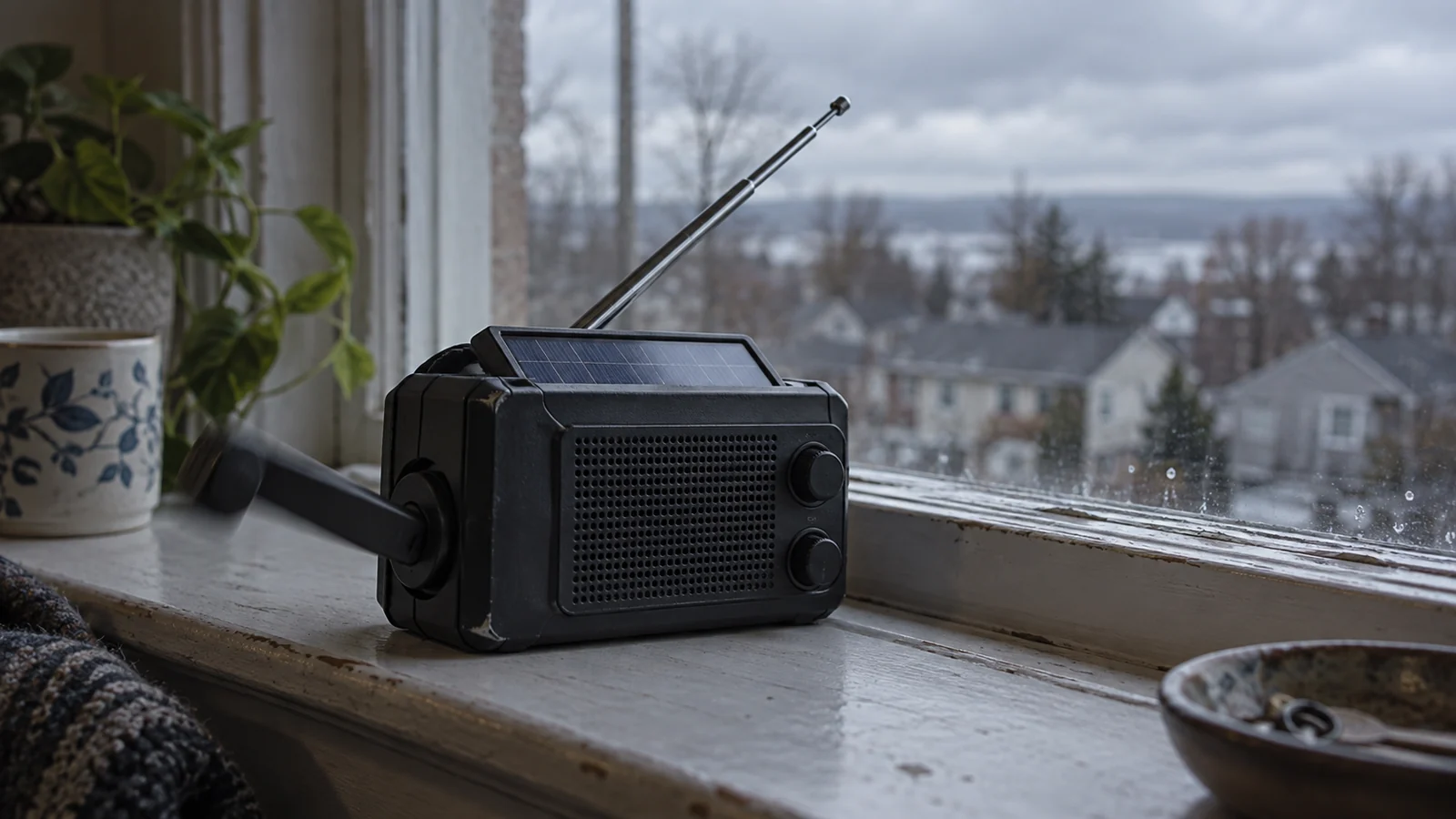

A solar powered emergency radio is sold on a fantasy: the crank handle and the little panel suggest infinite power from nothing. What you actually get is a receiver that will always turn on, and a phone charger that barely works.
Both of those are worth knowing before you buy, because one of them is genuinely valuable and the other is the reason people are disappointed.
How We Chose
We haven't bench-tested crank radios, and we don't publish measured charge times because we haven't measured any. What's here comes from manufacturer specifications, the published limits of the technology, and the failure pattern that shows up consistently in owner reviews across brands: the internal battery is dead when the radio is finally needed.
Where a claim comes from a manufacturer rather than a measurement, it's labelled that way. Where we don't know, we say so rather than inventing a number.
What the Crank and the Panel Really Deliver
Turning the handle drives a small generator. For running a receiver — which draws very little — that works well, and a minute of cranking buys you a useful stretch of listening. This is the honest core of the product.
Charging a phone is a different order of magnitude. A phone battery holds far more energy than a radio needs in an evening, and a hand crank delivers power slowly, through your arm. Expect enough for a short call or a few messages after sustained effort, not a full battery. Manufacturers rarely state the ratio plainly, and the ones that do are describing ideal conditions.
The solar panel is smaller again. On most of these units it's a trickle: useful for keeping the internal cell topped up if the radio lives on a windowsill, not for recovering a flat battery in an afternoon. Treat it as maintenance, not generation.
None of this makes the category pointless. A radio that always works is worth having. It just isn't a power station, and a solar emergency radio with phone charger should be bought for the radio.
What to Check Before Buying
A hand crank radio kit sold as a bundle is usually the same receiver with a pouch and a whistle. Judge the receiver.
| Feature | What to look for | Why it matters |
|---|---|---|
| Power sources | Crank, solar, USB and removable AA/AAA | The alkaline path is what saves you when the internal cell has died in storage |
| Bands | AM, FM and the seven NOAA weather channels | A crank radio without weather channels misses the broadcast built for this |
| Alerting | Whether it merely receives NOAA or actually alarms | Most portables receive but don't wake you. Different device, different job |
| Light | A flashlight, and ideally a wide beam | The one genuinely useful extra. See Emergency Lighting & Lanterns |
| Crank feel | A handle that folds flat and doesn't creak | The handle is the most common mechanical failure on cheap units |
| Charge-out port | USB-A or USB-C that works while cranking | Some only charge from the internal cell, which defeats the purpose |
Where It Belongs, and What It Doesn't Replace
This is the radio for the go bag and the car — the one that leaves the house. Its virtue is independence from everything: no grid, no network, no charger. Put it where the kit is, not on a shelf. 72-Hour Kits and Car Emergency Kits both have a slot for it.
It does not replace the home alerting radio. A crank portable receives the weather broadcast; a certified alerting receiver with county coding switches itself on at 3am and wakes you. Those are different products, and the household that owns one usually assumes it owns both.
Twice a year, crank it for a minute, check the light, and swap the alkalines. That single habit is the difference between a working radio and an ornament — the same maintenance rhythm as the rest of the kit, in Emergency Checklists & Templates.
Buy for the radio, not the charger. Then test it twice a year and it will be there.
FAQ: Hand-Crank & Solar Emergency Radios
Can a hand crank radio really charge a phone?
A little, slowly, and with effort. Expect enough for a short call or a few messages, not a full battery. Buy the radio for the radio and treat charging as a bonus.
Is the solar panel useful?
As trickle maintenance, yes — it keeps the internal cell topped up if the radio sits in light. It is not sized to recover a flat battery in an afternoon.
Why does my crank radio seem completely dead?
Usually the internal lithium cell after long storage at zero charge. It's the most common failure in this category, and it's why a model that also takes AA or AAA cells is worth insisting on.
Does it replace a NOAA weather radio?
No. Most portables receive the weather channels but don't alarm. A home alerting receiver with county coding is a separate device with a separate job.
Where should I keep it?
With the kit that leaves the house — the go bag or the car. Its whole advantage is working away from mains power.
Do you test these radios?
No, and we don't publish charge times we haven't measured. We work from manufacturer specifications and the consistent failure pattern owners report, and we say which is which.
Sources
- NOAA / National Weather Service — NOAA Weather Radio All Hazards frequencies and coverage
- Manufacturer specifications for crank and solar receivers, checked September 2026
- Published owner reviews across multiple brands, for the storage-failure pattern
This page is general information. When a warning is active or an emergency is underway, follow local authorities, National Weather Service alerts and emergency services before any general guidance. See our Editorial Policy and Sources & Fact-Checking.