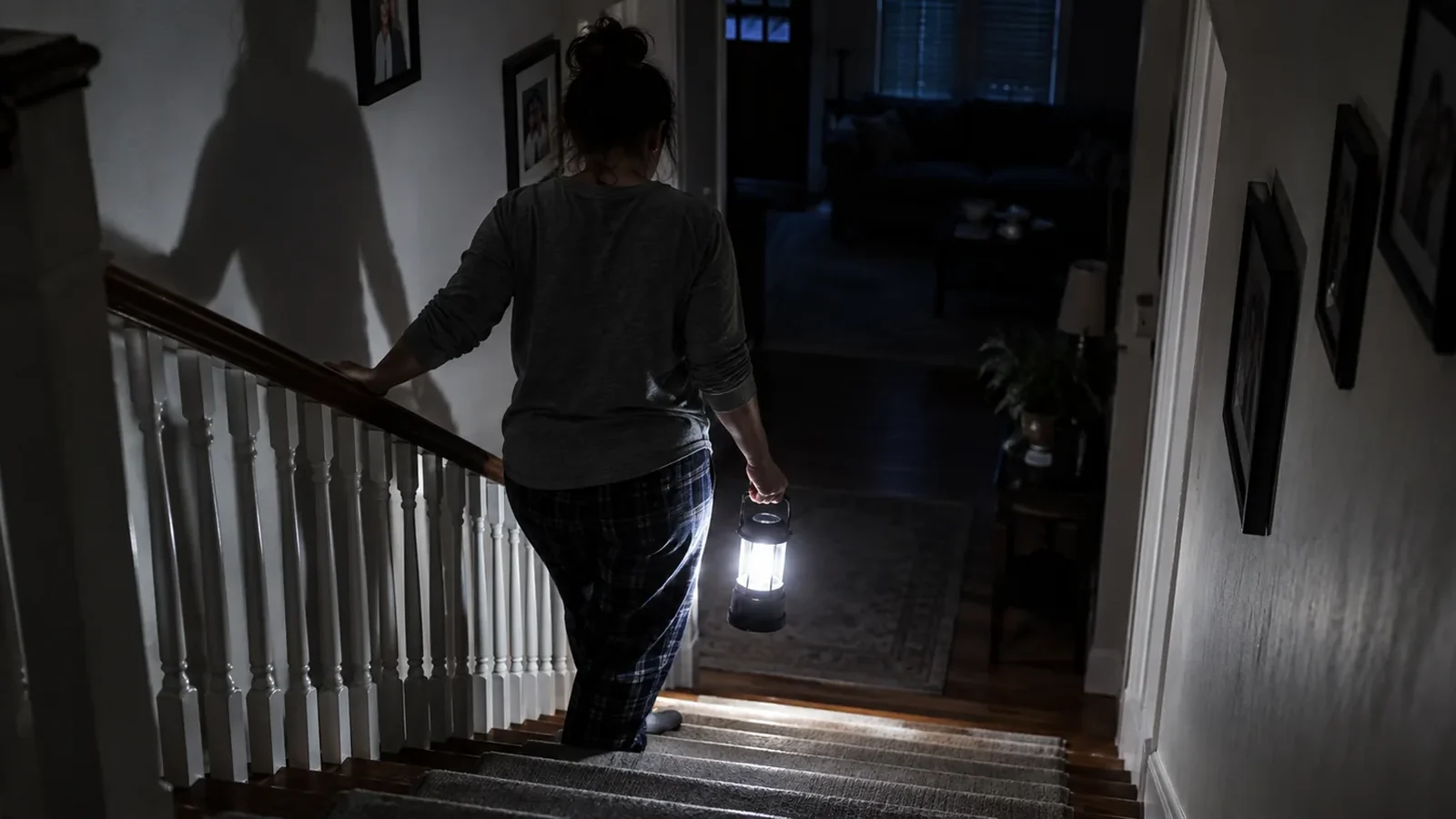

The candle is the reflex, and it's the wrong one. An emergency lantern costs less than a takeaway, runs for days, and doesn't burn a house down while everyone is asleep. House fires go up during outages, and open flame is why.
What makes one lantern better than another isn't brightness. Every LED lantern on the shelf is bright enough to light a room. The question that decides whether yours works on the third night is how it gets its power.
Why Not Candles
A candle gives roughly the light of a weak torch, consumes oxygen, and sits unattended in a house where the smoke alarms may also be on dead batteries. LED lighting removes that risk entirely, for the price of two candles.
The rule gets stricter indoors. If you're sheltering in a room you've sealed against smoke or a chemical release, nothing that burns fuel goes in with you — that includes candles, camping stoves and catalytic heaters. We set that out in full under Shelter in Place, and it's the one place on this site where we won't offer a nuanced alternative.
How the Lantern Gets Its Power
Four options, and they are not equally good at sitting in a drawer for two years.
Disposable batteries. The boring answer and usually the right one. A sealed alkaline cell holds its charge for years. The failure mode is corrosion — cells left inside a device leak and destroy it, so store them beside the lantern rather than in it.
Rechargeable. A rechargeable emergency lantern is cheaper to run and brighter for its size, and it is only as good as the last time you charged it. Lithium cells self-discharge, and one charged eighteen months ago may give you an hour. Good for a household that keeps a schedule, poor for one that doesn't.
Hand crank. Never flat, never bright. A minute of cranking buys minutes of light, not hours — a backstop, not a main source.
Solar. Excellent for a long outage, useless on night one if it has been in a drawer.
Most households want two of these: disposable cells in the units that sit unused, and one crank or rechargeable that does something else as well. That mix is what keeps an emergency lantern for a power outage working on night three.
The Lantern That Charges Your Phone
This is the upgrade that changes how the kit behaves. An emergency lantern with a power bank turns a single object into lighting and a phone charge — and during an outage the phone is the radio, the map and the way you tell people you're fine.
Look at the USB output rating, not the headline capacity: a unit outputting 1 amp takes most of a night to fill a modern phone. Check too that charging doesn't disable the light, which on cheaper units it does.
If the phone is the priority rather than the light, a dedicated power bank will do it better and cost less. The combination unit is for people who want one thing in one hand.
| Product | Price | What it's for, and what to check |
|---|---|---|
| Hand-crank and rechargeable camp lantern | 29.99 $ | The main room light. The crank means it is never fully flat — check minutes of light per minute of cranking |
| Four-function emergency power station | 29.99 $ | Light, AM/FM radio, siren and phone charging on one crank. The best value here if you own no radio |
| Solar 600-lumen lantern, micro-USB | 79.99 $ | Long outages — charges in a window by day. Check how many hours of sun a full charge needs |
| Hand-crank flashlight with solar panel and clip | 11.99 $ | The one that lives in a bag. Clips to a strap |
| 12 Hour Green Lightstick | 1.99 $ | Stairwells and bedside. No batteries, no failure mode. Check the shelf life on the wrapper |
| Long-life alkaline cells, D and AA | 3.99 / 1.79 $ | Forgotten until the lantern is dark. Buy the size your lanterns actually take |
How Many, and Where
One per floor is the minimum, not the target. Aim for one per room anyone would be in after dark.
- Bedrooms. One each, within reach of the bed — the one that matters at 3am.
- Kitchen or main room. The brightest, because it's where people gather.
- Stairwell. A lightstick is enough and can't fail.
- In each bag. Covered under 72-Hour Kits and Go Bags & Evacuation Bags.
Apartments change the maths slightly — no garage to store spares, and a windowless internal corridor that goes fully dark. That's dealt with in Apartment Preparedness.
Buy one lantern per bedroom this week and keep the batteries beside them, not inside them. Everything else on this page is refinement.
FAQ: Emergency Lanterns
What is the best lantern for a power outage?
The one you can find in the dark with working cells in it. Beyond that, the best emergency lantern for a power outage is the one whose power source matches how you will actually maintain it.
How long should an emergency lantern run?
Days at low output, hours at full brightness, on alkaline cells. Manufacturers quote the low figure — assume less, and keep spares.
Rechargeable or battery-powered: which is better?
Only if you charge it. A rechargeable emergency lantern is cheaper to run and brighter for its size, but lithium cells self-discharge; alkaline cells hold for years.
Can a lantern charge a phone?
Some can. Check the USB output rating rather than the advertised capacity, and check that charging doesn't switch the light off.
Are candles a reasonable backup?
No. Poor light, oxygen consumption, and a fire risk in a house where the alarms may also be on dead batteries.
Sources
- Manufacturer and retailer product listings — pricing checked September 2026
- Ready.gov — Power Outages
- FEMA — lighting and power during extended outages
- CDC — carbon monoxide poisoning prevention
- U.S. Fire Administration — candle fire safety
When a warning is active, follow local authorities and official emergency instructions before any general guidance. See our Editorial Policy and Sources & Fact-Checking.