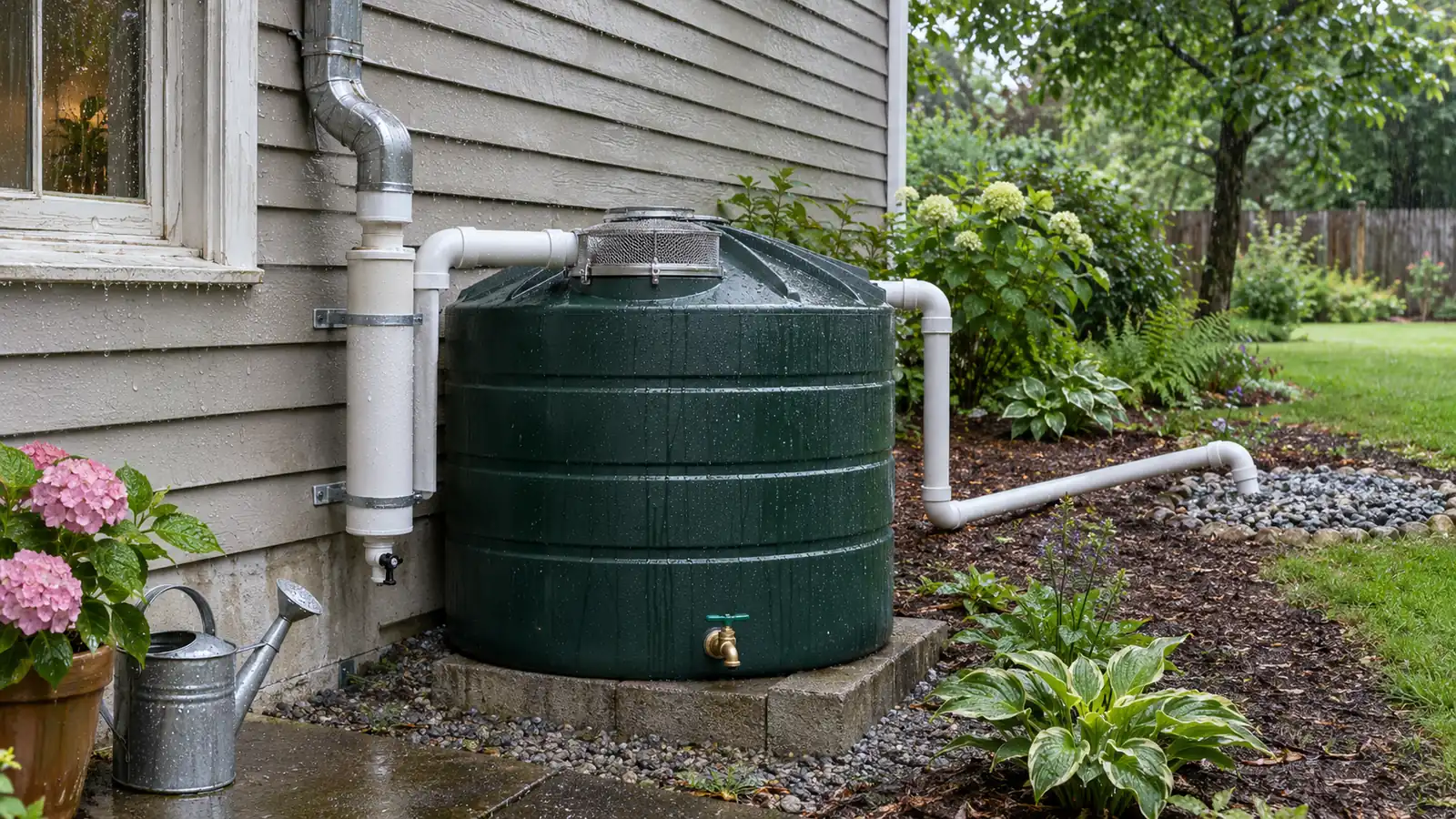

A rainwater collection system cost depends almost entirely on one decision made at the start: whether the water is for the garden or for the house. Collecting rain into a barrel for plants is a weekend and a modest outlay. Collecting it to drink is a treatment project with permits, and the gap between the two is far larger than the gap between any two products.
So this page separates them properly, gives you the one calculation that sizes any system, and is honest about what moves the price rather than quoting a figure that could not survive contact with your roof.
The One Calculation You Need
Yield is roof footprint multiplied by rainfall, minus losses. In imperial units, one inch of rain falling on 1,000 square feet of roof yields about 623 gallons; in metric, one millimetre on one square metre gives one litre. Real systems collect perhaps 75 to 90 per cent of that, losing the rest to the first flush, splash, evaporation and gutter overflow.
Two things surprise people. The footprint that matters is the plan area the roof covers, not the sloped surface, so pitch does not increase yield. And annual totals are misleading — what sizes a tank is the dry gap between rains, not the yearly figure. A region with 30 inches spread evenly needs far less storage than one with 30 inches arriving in four months.
So size the tank against the longest dry spell you want to ride out, and check it against what the roof can actually deliver in the wet season. A tank larger than the roof can fill is money sitting empty; a tank smaller than your dry gap runs out regardless of how much rain fell earlier.
This is the heart of any rainwater collection system design, and it is worth doing on paper before anyone quotes you for hardware. Any rainwater harvesting calculator is doing exactly this arithmetic, so the quality of the answer depends entirely on the rainfall figures you feed it — local records, not averages from a national map.
Garden, Household, or Drinking
A rainwater collection system for home can mean any of three things, with genuinely different requirements.
Garden irrigation. A downspout diverter, a barrel or two, a screened inlet and an overflow. No treatment needed, because plants are not drinking it. This is where most people start, and a rainwater collection system for garden use is well within normal DIY territory — most of the searches for a rainwater collection system diy land here, and sensibly so.
Household non-potable. Flushing toilets, laundry, outdoor taps. Needs a larger tank, a pump, filtration for sediment, and — critically — complete separation from the drinking water plumbing, with labelled pipes and backflow prevention. This is where plumbing code becomes involved, because a cross-connection contaminates the potable supply.
Drinking water. Everything above plus real treatment: sediment filtration, carbon, and disinfection by UV or chlorination. The roof material matters too — some coatings, treated shingles and lead flashings are not suitable for a potable catchment. In many jurisdictions this requires an approved design, a permit and testing.
A rainwater collection system for potable water is entirely achievable, and it is not a barrel with a filter on it. Treat it as the same class of project as a well: see water treatment systems for home for what the treatment train involves.
Components, and the One Most People Skip
- Catchment and gutters. Clean, screened, and sized so heavy rain does not simply overshoot.
- Leaf screening. A mesh at the gutter or downspout. Organic debris in a tank is what causes smell.
- First-flush diverter. Discards the initial volume off the roof, which carries dust, droppings and whatever has accumulated since the last rain. The single highest-value component and the most commonly omitted.
- Tank. Opaque, vented with insect screening, with an accessible outlet. Sizing and weight follow the same rules as any large vessel — see water storage tank sizes.
- Overflow. Routed deliberately away from foundations. An overflow that discharges against the house creates a damp problem to solve a water problem.
- Pump and pressure tank, where water goes into the building rather than out of a tap by gravity.
- Treatment, scaled to the end use as above.
Mosquito control deserves a mention of its own: any standing water needs sealed, screened openings, which is both a public health matter and often an explicit legal requirement.
What Drives the Cost
We publish no figures, because the same specification varies several-fold with site conditions and local requirements. What moves it:
- End use — the garden-to-potable gap dominates everything else.
- Storage volume, and whether the tank is above ground or buried. Burial adds excavation and a much stronger tank.
- Pump and pressurisation, needed for indoor use, not for a gravity-fed hose.
- Treatment stages, each one adding equipment and annual consumables.
- Permits, inspection and approved design, which in some jurisdictions are the biggest single line.
- Site access — whether a large tank can be delivered and placed, or has to be assembled in position.
- Retrofit versus new build. Gutters, downspouts and buried pipework are far cheaper to route during construction.
Two offsets are worth asking about locally: rebates and incentives exist in water-scarce regions, and some jurisdictions reduce stormwater charges for properties that retain runoff.
If you are hiring, the specialists here are plumbers and, for potable systems, anyone qualified to certify a cross-connection control. Ask whose responsibility the permit is, what the system needs annually, and what happens if a test fails. We recommend no companies and take no referral fees.
Legality: Check Before You Buy
Rainwater harvesting is not uniformly permitted. Some jurisdictions actively encourage it with rebates; some limit the volume that may be stored; some regulate it through water rights, on the basis that runoff is already allocated downstream; and many require permits and approved designs for any potable use or any connection to household plumbing.
The rules are set at state, county or municipal level and they change. Before buying hardware, ask your local building department and water authority what is permitted, what requires a permit, and whether any incentive applies. That one phone call occasionally changes the entire design.
Common Questions
Is it legal to collect rainwater?
In most places yes, but with conditions that vary widely — storage limits, permit requirements for potable use, and in some regions water rights considerations. Because it is set locally and does change, confirm with your building department or water authority rather than relying on a general answer.
Can I drink rainwater from my roof?
Only with proper treatment — filtration plus disinfection — and a catchment suitable for potable use. Untreated roof runoff carries bacteria from droppings and debris, and possibly metals or compounds from the roofing itself. Many jurisdictions also require an approved design and testing.
How big a tank do I need?
Size it to the longest dry period you want to cover, then check the roof can fill it in the wet season. Roof area times local rainfall gives the yield; daily demand times dry days gives the need. The smaller of those two realities sets the useful tank size.
Does the roof material matter?
For irrigation, rarely. For drinking, very much: metal roofs are generally well regarded, while some treated shingles, coatings and older flashings can shed compounds or lead. If potable use is the goal, the catchment surface is part of the specification.
Will a tank breed mosquitoes?
Not if it is properly sealed and screened, which is why fine mesh on every opening including the overflow and the vent is standard. It is frequently a legal requirement as well as a sensible one.
Sources
- U.S. Environmental Protection Agency — soak up the rain, rainwater harvesting and stormwater management guidance
- Centers for Disease Control and Prevention — rainwater collection, treatment requirements and risks of drinking untreated roof runoff
- Texas Water Development Board — The Texas Manual on Rainwater Harvesting: sizing calculations, first-flush diversion and system components
- National Conference of State Legislatures — state statutes and regulations governing rainwater harvesting
- NSF/ANSI 61 — drinking water system components, as applied to tanks, fittings and potable catchment
Rainwater harvesting law, permit requirements, incentive programmes and plumbing and cross-connection rules are set locally and change; rainfall and dry-season length are specific to your site. Yield figures given are approximate and before collection losses. This page is general information, not a system design — confirm requirements with your local building department and water authority, and have potable systems designed and tested accordingly. See our Editorial Policy, Sources & Fact-Checking and Affiliate Disclosure.