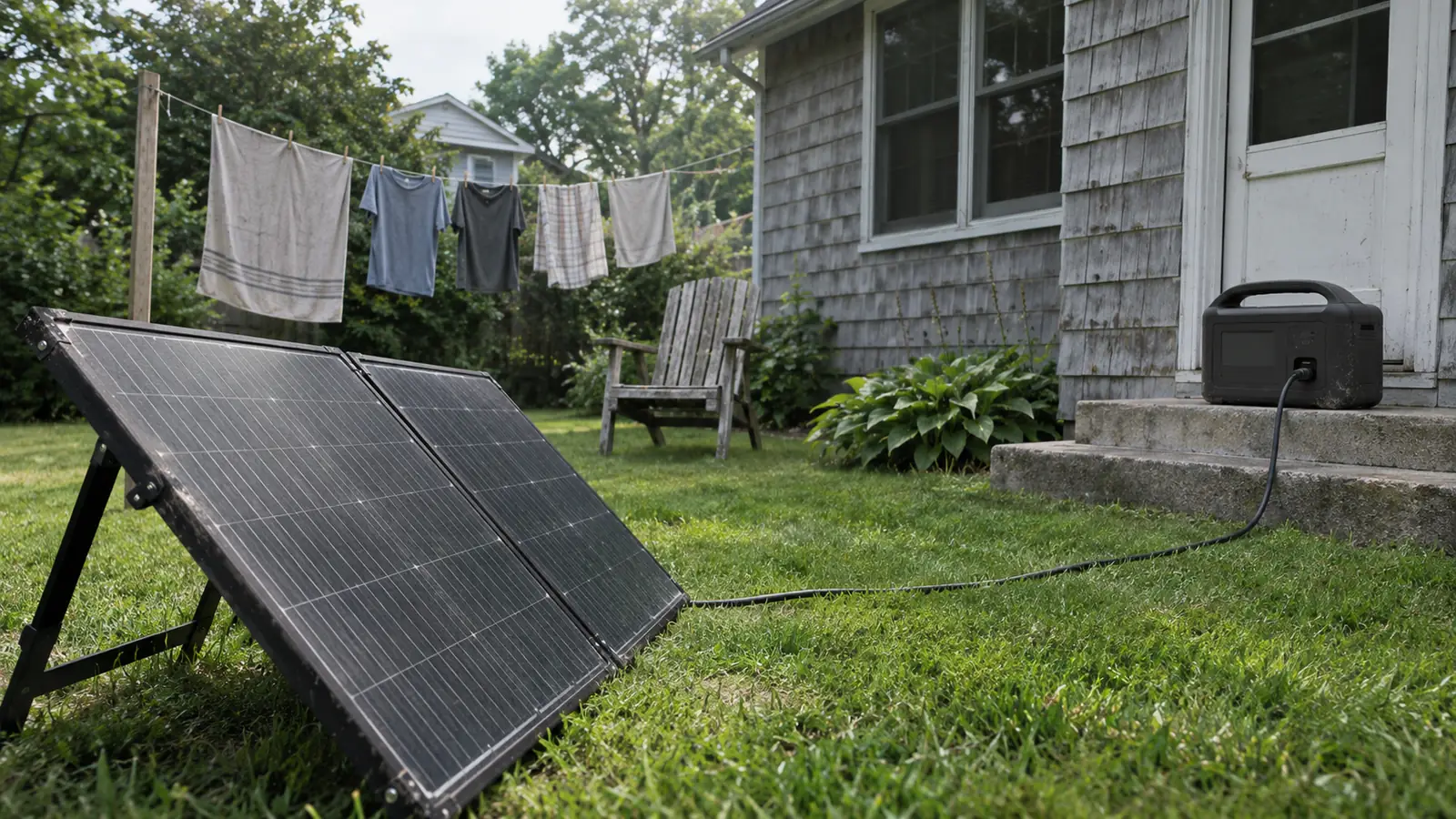

There is no such thing as a solar generator. The phrase describes a battery power station sold together with folding photovoltaic panels, and the word "generator" is doing no engineering work at all — nothing is generating anything except the panels, and they are the part most people underestimate.
That is not a reason to dismiss the category. A solar generator for home use is genuinely useful, silent and safe indoors. It is a reason to read the specification rather than the name, because the name is hiding the two numbers that decide whether it works for you.
What the Name Is Hiding
Strip the marketing and you have three components: lithium cells, an inverter that turns their output into household alternating current, and a solar charge controller that accepts panel input. The panels are an accessory, sometimes in the box and sometimes not.
Which means the solar generator vs power station question answers itself: they are the same device, and the only real difference is whether panels are bundled and whether the charge controller is generously rated. Everything in portable power stations about watt-hours, continuous output and surge applies here unchanged, because it is the same hardware.
The solar generator vs inverter comparison is different and worth knowing: a bare inverter has no battery and no panels. It converts from a battery you already own. Cheaper, more fiddly, and only sensible if that battery exists.
The Panels Are the Part People Get Wrong
Panel ratings are measured under standard test conditions — a specific irradiance, a specific cell temperature, perpendicular light. Your driveway in October is not that. In practice, expect a meaningful fraction less than the nameplate, more in cloud, more again when the panel is flat on the ground rather than angled at the sun, and more still when it is hot.
The consequence is arithmetic people skip. If a unit holds a given capacity and your panel set returns a modest real-world figure, a full recharge is not an afternoon. It is most of a clear day, and on an overcast one it may only offset what you are drawing. That is still valuable — it turns a fixed reserve into a slowly renewing one — but it is not the same as refuelling an engine.
Three things that actually change the result: angle the panels toward the sun and move them once or twice during the day; keep them out of partial shade, because a shadow across one cell can cost more than its area suggests; and keep them cool, which mostly means not resting them on hot asphalt.
When a unit is sold as a solar generator with panels included, check what is included — the panel wattage, the count, the connector type, and whether that total is within the unit's input limit. Bundles are often sized to look generous rather than to fill the battery quickly.
What It Covers, and What It Does Not
A solar generator for home use has the same ceiling as any battery of comparable size. Comfortably: phones, laptops, a router, LED lighting, a radio, tool batteries. Possible with a larger unit: a fridge for a day, a furnace control board and blower if an electrician has provided a connection. Not at all: electric heating, kettles, hobs, air conditioning, well pumps.
What the panels change is duration, not capability. They cannot make a 300 W inverter run a 1500 W heater, and no amount of sun will change that. Any solar generator calculator that asks only for capacity and not for continuous output is answering the wrong question.
Where this category earns its place is a multi-day outage with daylight. A fuelled machine stops when the cans run out; this one keeps topping up as long as the sun returns, silently and with no exhaust. Against a portable generator, that is the trade: finite but renewable and indoor-safe, against powerful but noisy, outdoor-only and dependent on stored fuel and its carbon monoxide risk.
What to Check Before Buying
- usable capacity in watt-hours, and continuous and surge output in watts;
- cell chemistry and rated cycle count to a stated remaining capacity;
- maximum solar input in watts, and the acceptable voltage range;
- which panels are included, at what rating, with which connectors;
- whether it can power loads while charging;
- recharge time from mains as well as from solar;
- true sine wave output, if you have anything sensitive;
- weight, including the panels, which are bulkier than they look.
Building your own solar generator comparison chart from those fields beats any ranking, because the right unit depends entirely on your load list and your latitude. Write the load list first; it decides more than the product does.
FAQ: Solar Generators
Is a solar generator the same as a power station?
Essentially yes. A solar generator for home use is a battery power station, usually bundled with panels. Nothing generates power except the panels, and the specification to read is the same one.
How long does it take to recharge from solar?
Longer than the arithmetic on the box suggests. Panels return well under their rated wattage in real conditions, so plan in most of a clear day for a full recharge, and in partial offsets on an overcast one.
Can I add more panels?
Up to the charge controller's stated maximum input and within its voltage range, and no further. That ceiling is a hard limit, not a guideline.
Will it run a fridge?
A larger unit often will, if the surge rating covers the compressor start. Panels extend how long, but the inverter rating decides whether it works at all.
Can I use one indoors?
Yes — there is no combustion and no exhaust, which is the main advantage over an engine. The panels go outside; the unit can stay with you.
Is it worth it if I live somewhere cloudy?
Less so, and honestly sometimes not. In poor light the panels become a trickle rather than a recharge, which leaves you with a plain battery — in which case buy it as one and skip paying for the bundle.
Sources
- National Renewable Energy Laboratory — photovoltaic performance under real conditions, temperature coefficients and shading losses
- U.S. Department of Energy — solar photovoltaic basics and standard test conditions
- U.S. Department of Energy — appliance energy use and typical running wattages
- Underwriters Laboratories — safety standards for portable power packs, inverters and charge controllers
- Federal Emergency Management Agency — power outage preparedness guidance for households
Panel output depends on irradiance, angle, shading and temperature, and manufacturers state both capacity and panel wattage under test conditions you will not reproduce outdoors; treat nameplate recharge times as optimistic and check your own appliance labels. Anyone dependent on powered medical equipment should confirm arrangements with their supplier. See our Editorial Policy, Sources & Fact-Checking and Affiliate Disclosure.