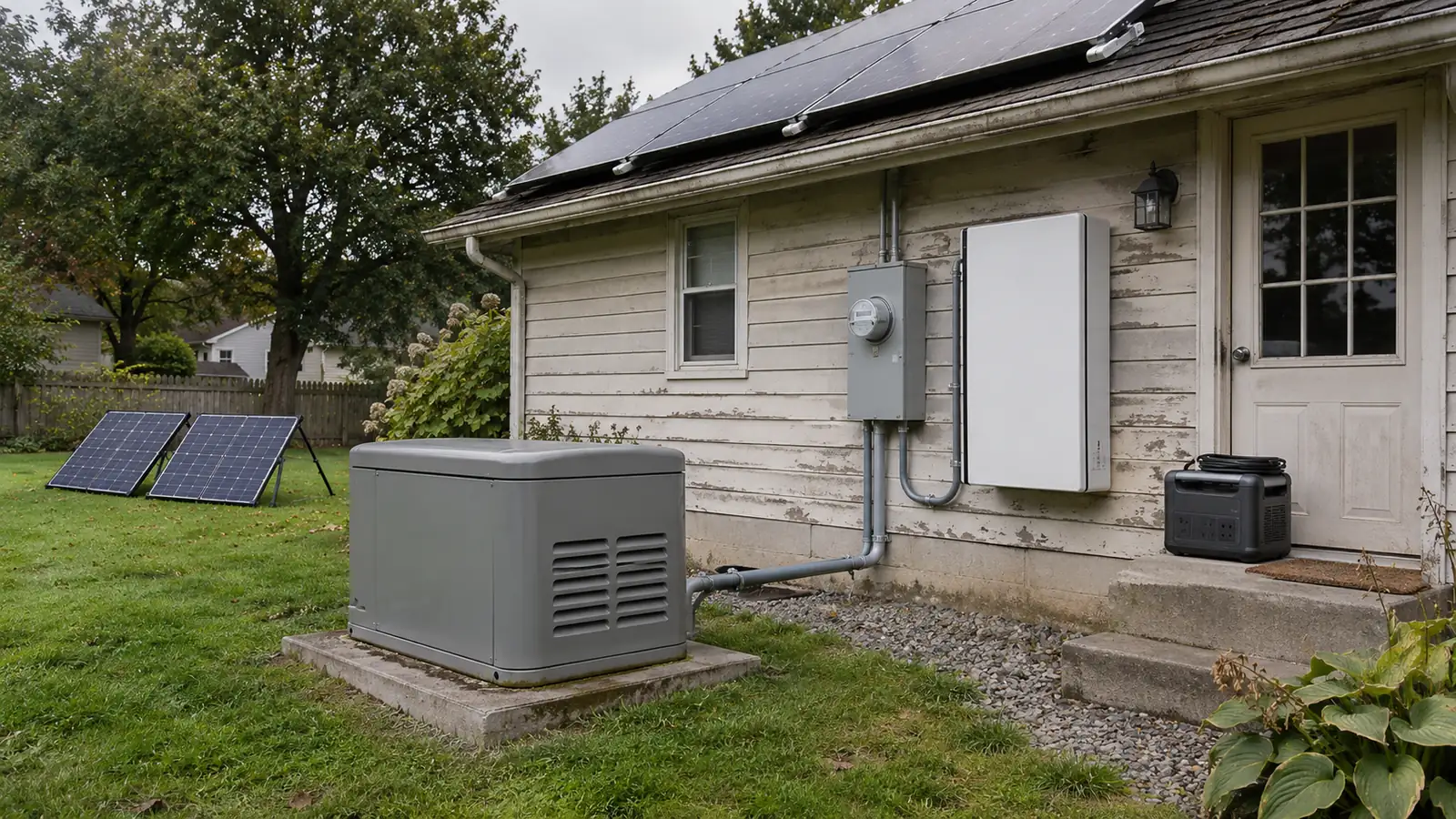

Eight guides live here, and they answer two questions that get mixed together constantly. One is what to buy. The other is what to have installed — and those are not the same purchase, not the same price, and not the same decision.
The line runs in one place: whether the equipment connects to your wiring, or you connect to it. On one side are quotes, permits and a licensed electrician, and the hardware is often not the expensive part. On the other side is a box that arrives in a van and works the afternoon it lands. Most households eventually want something from both sides, and the mistake is buying from one while thinking about the other.
Keep the House Running
These are the three jobs that involve your electrical panel, and all three are priced per house rather than per product. The same equipment in two different homes is two different installations: what moves the number is the distance from the panel, the condition of the service, which circuits you want backed up, and what your local authority requires on paper.
Which is why a figure from a national average is worth very little here, and why the useful skill is not finding the cheapest quote but being able to tell whether three quotes are describing the same work. They frequently are not.
One thing worth saying plainly before any of it: panels on their own do nothing in an outage. A grid-tied array shuts down when the grid does, by design and for the safety of anyone working on the lines. Backup during a cut comes from the battery or the generator, not from the roof — the roof is a bill decision that can be combined with a backup decision, which is a different sentence from the one most sales pitches use.
Portable Power
Everything in this block is something you own rather than something you have fitted. No permit, no electrician, no appointment — and a much lower ceiling. The honest description of this category is that it keeps information, light and refrigeration going, and does not keep a house warm.
Two numbers decide what any of it can actually do, and people read them in the wrong order. Capacity, in watt-hours, tells you how long. Output, in watts, tells you whether it works at all. A large battery with a small inverter will not run a kettle for one second, and no amount of capacity changes that.
A portable generator sits awkwardly between the two halves of this page. You buy it like a product, but connecting it to house circuits is an installed job — an interlock or a transfer switch, fitted under permit. Run it on extension cords and you are running appliances; run it through the panel and you are back in the first block.
Choose It, Then Use It Safely
The comparison most people actually need is not between brands. It is between two failure modes: a battery that runs out, and an engine that runs on as long as you keep feeding it. Neither answer is better in the abstract, because the right one depends on how long your outages last and whether you would rather manage fuel or accept a ceiling.
BATTERY
Silent, indoor-safe, zero maintenance, works the moment the power drops. Finite, and recharges only if the sun or the grid comes back.
GENERATOR
Runs for days and powers heavy loads. Loud, outdoors only, carbon monoxide risk, and dependent on fuel you have to store and rotate.
And then the part that is not a purchasing decision at all. Generators kill people after storms, and not through anything exotic: carbon monoxide in an attached space, and backfeeding into the utility lines. Both are covered by rules short enough to print, which is why the last guide here is a one-page sheet rather than an article.
If you only do two things after reading this page: write down the list of what you want running, with the watts from the labels rather than from memory, because that list decides more than any product comparison will. And if there is a generator in your plan, settle now where it will stand and how it will connect — outdoors, clear of the building, and never through a wall socket. For the outage itself, see power outage preparedness.
Sources
- U.S. Department of Energy — appliance energy use, residential solar basics and home energy storage
- National Renewable Energy Laboratory — residential PV cost breakdowns and real-world panel performance
- National Fire Protection Association — National Electrical Code provisions for transfer equipment and energy storage systems
- U.S. Consumer Product Safety Commission and CDC — portable generator carbon monoxide hazard and poisoning after outages
- Occupational Safety and Health Administration — generator grounding, backfeed and safe use
- Federal Emergency Management Agency — power outage preparedness guidance for households
This page publishes no price and no quote of its own. Installed costs, permit requirements, interconnection rules and incentives are set locally and change; equipment ratings come from the manufacturer. Transfer equipment, battery installation and roof-mounted arrays are work for licensed trades under permit, and nothing here is a wiring procedure. Anyone dependent on powered medical equipment should confirm arrangements with their supplier rather than rely on any backup plan described here. See our Editorial Policy, Sources & Fact-Checking and Affiliate Disclosure.