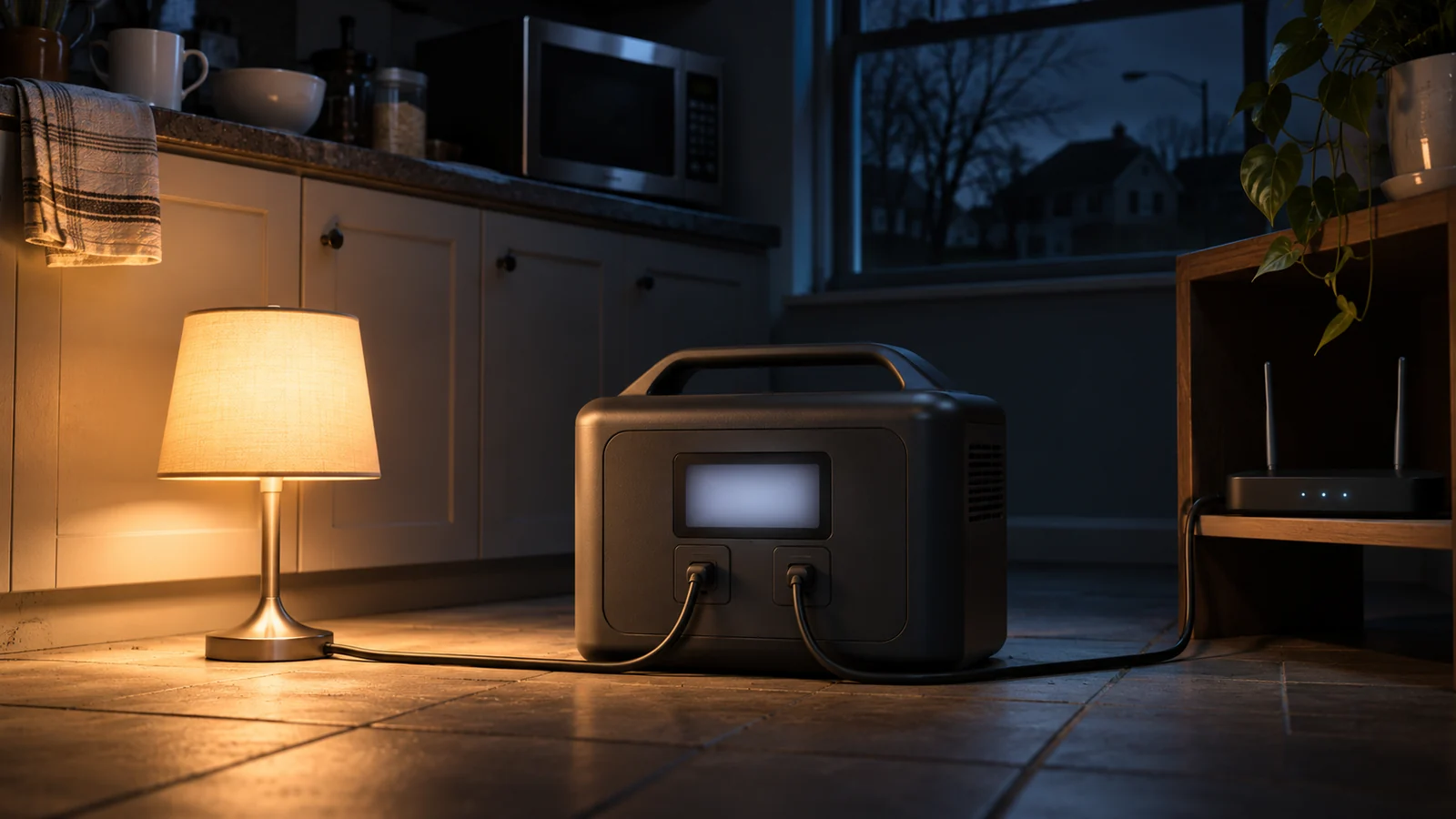

A portable power station for home use is a battery in a box with sockets on the front. No fuel, no fumes, no noise, nothing to start — and a hard ceiling on what it can do. Understanding that ceiling before you buy is the difference between a useful piece of kit and an expensive phone charger.
Two numbers decide everything, and neither is the one on the marketing. Here is how to read them, and what these things genuinely cover during an outage.
The Two Numbers That Decide Everything
Capacity, in watt-hours. How much energy is stored. A 1000 Wh unit will, very roughly, run a 100 W load for somewhat under ten hours — losses and inverter overhead eat some of it, so treat the nameplate as optimistic rather than wrong.
Continuous output, in watts. How much it can deliver at any instant, set by the inverter rather than the cells. This is the number that decides whether an appliance works at all. A unit with a large battery and a 300 W inverter cannot run a 700 W appliance for one second, let alone an hour.
Then the one people miss: surge, sometimes called peak. Motors and compressors draw a brief multiple of their running draw when they start. A fridge rated at 150 W running may want several hundred for a moment. A unit whose continuous rating covers the appliance but whose surge headroom does not will simply trip.
Any portable power station calculator worth using asks for all three, plus the hours you want. Add up the running watts of what you intend to power at once, check that the largest motor's surge fits, then divide capacity by total running watts for a rough runtime. Then subtract a fifth for losses and winter.
What One Actually Covers
Realistically, for a portable power station for home backup during a mains failure — and this is where most of the disappointment with a portable power station for home comes from:
- Comfortably: phones, tablets, a laptop, a router and modem, LED lamps, a radio, a CPAP machine on its battery-friendly settings, charging tool batteries.
- Possible with a mid-size unit: a modern fridge for a day if you open it rarely, a furnace's control board and blower if an electrician has provided a way to connect it, a small pump for a short run.
- No: electric heaters, kettles, hobs, air conditioners, electric ovens, well pumps. The question people ask as portable power station for home appliances usually founders here — a heating element is a brick wall, not a challenge.
The medical case deserves its own line. If someone in the house depends on powered equipment, size the backup around that device's actual draw and duty cycle, confirm the arrangement with the supplier, and treat a power station as one layer rather than the plan.
How It Compares to the Alternatives
The portable power station vs generator question comes down to the same trade as everywhere in backup power: silent and finite against noisy and refuellable. A power station can sit beside you on the kitchen floor; a portable generator cannot come indoors at all, because of carbon monoxide. The generator will outlast it by days if you have fuel.
The portable power station vs solar generator distinction is mostly marketing. A "solar generator" is a portable power station with solar panel sets bundled in, and the generator word is doing no work — see solar generators. What matters is whether the panels are included and whether the unit's charge controller is rated for the ones you want.
A portable power station vs inverter comparison is different: a bare inverter has no battery, it converts from one you supply, usually a car or a deep-cycle bank. Cheaper, more fiddly, and only sensible if you already own the battery. And the portable power station vs ups question is about purpose — a UPS is built to bridge seconds cleanly for a computer, not to run a household for hours.
For a house rather than a room, the comparison moves up a level entirely: see home battery backup vs generator.
What to Check on the Datasheet
- capacity in watt-hours, not just amp-hours at an unstated voltage;
- continuous output and surge output, separately;
- cell chemistry, and the rated cycle count to a stated remaining capacity;
- whether the output is a true sine wave — some sensitive equipment objects to anything else;
- recharge time from mains, and the maximum solar input;
- whether it can be used while charging, which matters more than it sounds;
- socket count and type, including how many can run at once;
- weight, honestly assessed against who has to carry it.
A portable power station comparison chart you build yourself from those fields will be more useful than any ranking, because the right unit depends entirely on your list of loads. Write the list first.
FAQ: Portable Power Stations
What can a portable power station run?
Electronics, lighting, a router, and with a mid-size unit a fridge for a day. Not heating, cooking or cooling: anything with a heating element or a compressor will empty one quickly or exceed its output entirely.
How do I work out what size I need?
Add the running watts of everything you want on at once, check the biggest motor's surge fits the surge rating, then divide capacity in watt-hours by total running watts for a rough runtime — and take a fifth off for losses.
Can I use one indoors?
Yes. There is no combustion and no exhaust, which is the main practical advantage over a generator. Keep it ventilated and off soft furnishings while charging, as with any large battery.
Will it run my fridge?
Often, if the surge rating covers the compressor's start and the capacity is large enough. Check the fridge's label rather than assuming, and expect noticeably less runtime if the room is warm.
Is a bigger battery always better?
No. Output decides what works at all, and capacity only decides how long. When sizing a portable power station for home use, read the inverter rating first: a large battery behind a small inverter cannot run a demanding appliance for any length of time.
How long will one last before it degrades?
Lithium iron phosphate cells are typically rated for several thousand cycles to a stated remaining capacity, and other chemistries for fewer. The datasheet should give a cycle count and the capacity it refers to; if it gives neither, that is informative.
Sources
- U.S. Department of Energy — appliance energy use and typical running wattages
- National Renewable Energy Laboratory — lithium cell chemistries, cycle life and temperature effects
- U.S. Consumer Product Safety Commission — lithium battery storage and charging safety
- Underwriters Laboratories — safety standards for portable power packs and their inverters
- Federal Emergency Management Agency — power outage preparedness guidance for households
Appliance draw varies by model, age and ambient temperature, and manufacturers state capacity and output under test conditions you will not reproduce at home; check the labels on your own appliances and treat nameplate runtimes as optimistic. Anyone dependent on powered medical equipment should confirm arrangements with their supplier. See our Editorial Policy, Sources & Fact-Checking and Affiliate Disclosure.