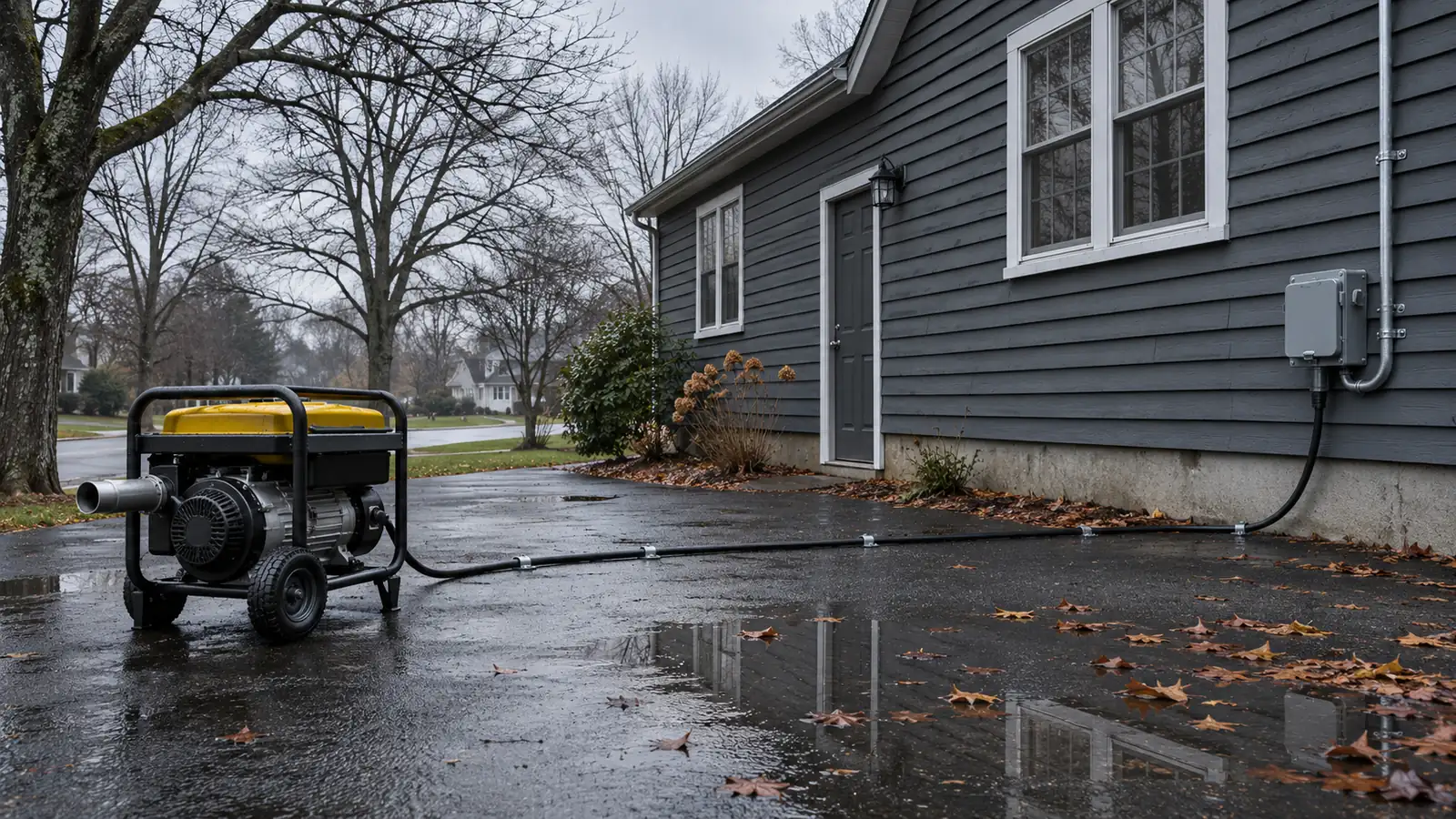

A portable generator for home backup is the cheapest way to make real power during an outage and the easiest way to get it badly wrong. The machine is the simple part. Where it stands, how it connects and how it is earthed are the parts that hurt people, and they are the parts the box does not explain.
So: how to size one, how it should connect to the house, where it can run, and the three mistakes that account for most of the harm.
Sizing: Running Watts, Then Surge
Sizing a portable generator for home use starts on paper, not in a shop. Write the list of what you want on at once, add the running watts from the appliance labels rather than from memory, then look at the largest motor on the list and check that its starting surge fits within the generator's surge rating. Fridges, freezers, furnace blowers, sump and well pumps all draw a brief multiple of their running figure.
Published portable generator sizes are quoted as a pair — running watts and peak watts — and the running figure is the one you size against. The peak figure exists to absorb those starting surges, not to run anything continuously.
Two practical notes. Running a generator at near its ceiling all night is hard on it and loud; leaving headroom is worth more than the next size up costs. And fuel type changes the arithmetic: the same engine on propane typically produces slightly less than on petrol, so check the rating for the fuel you will actually use.
How It Should Connect to the House
A portable generator for home circuits has three possible connections, and only two of them are acceptable.
Extension cords to individual appliances. Fine, and how most people start. Use outdoor-rated cords heavy enough for the load and the distance, keep them out of doorways where they get pinched, and accept that you are running appliances, not the house.
A transfer switch or an interlock. This is the proper answer for powering house circuits. A portable generator transfer switch physically separates your wiring from the utility before connecting the generator; a portable generator interlock kit achieves the same result at the panel by making it mechanically impossible to close the generator breaker and the main breaker at once. Either is installed by a licensed electrician under permit, with an inlet box on an exterior wall.
A cord into a wall socket. Never. This is backfeeding, it puts your generator's output onto the utility's lines, and it can kill someone working to restore your power. It also bypasses every protective device in the house. There is no version of this that is acceptable, including briefly.
On portable generator grounding: a portable unit used with cords is normally bonded within its own frame and does not need a separate earth rod, while one connected to house wiring through a switch is grounded through the house system. Which applies depends on the machine and the installation, and it is one of the specific things to ask your electrician rather than infer.
Where It Can Actually Run
Outdoors, well clear of the building, with the exhaust pointed away from windows, doors and vents, and never in a garage, carport, porch, shed or basement — including with the door open. Carbon monoxide is colourless, odourless and has killed people who ran a generator in a space they thought was ventilated enough.
That rule collides with weather, which is why searches for a portable generator enclosure, a shed or a cover are so common. The honest position: purpose-made running covers exist and are designed to shed rain while allowing the airflow and exhaust clearance the engine needs. A garden shed, a packing crate or a tarpaulin draped over the machine is not that, and restricting airflow creates both an overheating and a carbon monoxide problem. If you want it housed, it needs a structure built for a running engine, sited with the manufacturer's clearances.
Keep a working CO alarm on every level of the house whenever one is running. See generator safety for the full set of rules, and power outage preparedness for everything around them.
How It Compares
The portable generator vs standby generator choice is manual against automatic. A standby unit starts itself, runs on piped gas and needs nothing from you; a portable one needs someone to wheel it out, connect it and refuel it, in the dark, in whatever weather caused the outage. The portable generator vs whole house framing is the same question with the sizing attached — a portable unit runs chosen circuits, not everything. See standby generator installation cost.
The portable generator vs inverter generator distinction is about how the power is made. An inverter model conditions its output electronically, which makes it quieter, more fuel-efficient at light load, and cleaner for sensitive electronics; a conventional one is louder and cheaper for the same output. For sensitive equipment, or for anywhere noise matters, the inverter type is usually worth it.
And against a battery: silent, indoor-safe and finite, versus noisy, outdoor-only and refuellable. That trade is laid out in home battery backup vs generator and portable power stations.
FAQ: Portable Generators
What size portable generator do I need for a house?
Size a portable generator for home use from a written list. Add the running watts of what you want on at once from the appliance labels, then confirm the largest motor's starting surge fits the peak rating. Size against the running figure and leave headroom rather than running it at its ceiling.
Can I plug a generator into a wall outlet?
No. That is backfeeding: it energises the utility lines, can kill a line worker and bypasses the house's protection. Use cords to appliances, or have an electrician fit a transfer switch or interlock.
Can I run it in the garage with the door open?
No. Carbon monoxide accumulates in attached and partly enclosed spaces, and an open door does not make a garage safe. Outdoors, clear of the building, exhaust pointed away from openings.
What is the difference between an interlock kit and a transfer switch?
Both prevent the generator and the utility being connected at once. An interlock does it mechanically at the existing panel; a transfer switch is a separate device that switches the supply. Both need a licensed electrician and normally a permit.
Can I run it in the rain?
Not uncovered. Use a running cover designed for the machine, which sheds water while keeping the airflow and exhaust clearances. Do not improvise an enclosure out of a shed or a tarpaulin.
How should I store the fuel?
In approved containers, outside living space, in the quantity your local fire code allows, and rotated — petrol degrades in months. Stabiliser extends that but does not remove the need to use and replace it.
Sources
- U.S. Consumer Product Safety Commission — portable generator carbon monoxide hazard and placement guidance
- Occupational Safety and Health Administration — generator grounding, backfeed and safe use
- National Fire Protection Association — National Electrical Code, transfer equipment, and fuel storage provisions
- Centers for Disease Control and Prevention — carbon monoxide poisoning after storms and power outages
- U.S. Department of Energy — appliance running wattages and typical starting loads
Appliance draw varies by model and age, and permit requirements, fuel storage limits and grounding practice are set locally; check your own appliance labels, your local building department and the manufacturer's manual. This page is general information, not an electrical design, and nothing here is a wiring procedure — transfer equipment is work for a licensed electrician. See our Editorial Policy, Sources & Fact-Checking and Affiliate Disclosure.