
More than a quarter of what people type about residential solar is about money — what it costs, who installs it, whether it pays. The solar panels for home installation cost is the question underneath almost all of it, and it is also the one where a published number does the most damage, because the same array on two roofs is two different jobs.
What follows is the structure of that cost, what a real quote has to contain, and the honest answer to whether it pays. No prices, no companies named.
What You Are Actually Buying
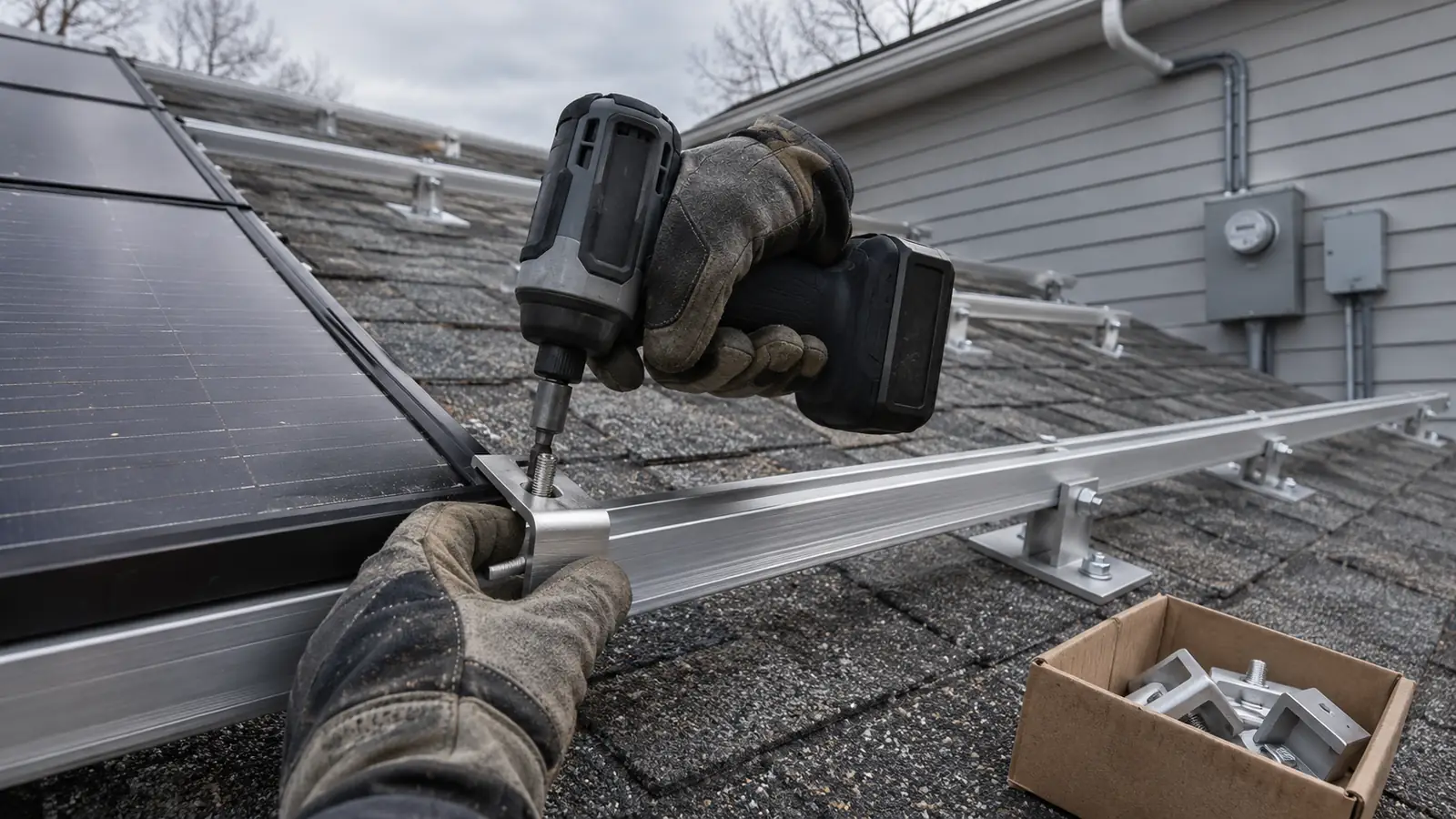
A grid-tied residential array is four things: the modules on the roof, the mounting system that attaches them without causing leaks, an inverter that converts their direct current into something the house and the grid can use, and the electrical work that ties it into your panel and your meter. Plus the permit, the inspection, and the utility's interconnection approval.
When people search solar panels for home they are usually picturing the modules, which is the part that has fallen most in price and now represents the smaller share of a quote. The rest — scaffolding, roof penetrations, conduit runs, the inverter, the paperwork, the crew's time — is the part that varies house to house, and the part that makes an average meaningless.
One thing a plain array does not do: keep your lights on. Grid-tied systems are required to disconnect when the grid goes down, so that they cannot energise lines that someone is working on. If outage coverage is the goal, the battery is the component that provides it — see home battery backup.
What Moves the Installation Cost
The solar panels for home installation cost moves with the house, not the catalogue. In rough order of how much each swings a quote:
- System size. Set by your consumption and your roof, not by a catalogue tier. Bigger arrays cost more in total and usually less per unit of capacity.
- Roof condition and type. An old covering may need replacing first, and that is a roofing project arriving inside a solar project. Tile and slate cost more to work on than asphalt shingle; a steep or complex roof costs more than a simple one.
- Shading and orientation. These change how much you get back rather than what you pay, but they also change the equipment: heavy shading pushes you toward per-module electronics.
- Electrical work. Panel capacity, the position of the service, and the run from the array to it.
- Permitting and interconnection. Varies by jurisdiction and by utility, in both fees and in how long it takes.
- Attic and structural access. Hard access is labour, and labour is the quote.
This is why a solar panels for home cost calculator is a starting guess rather than a quote. The inputs that matter most — roof age, shading at four in the afternoon in December, panel capacity — are not things a form can see.
How to Read Quotes and Compare Them
When you contact solar panels for home installation companies, ask each for the same information, itemised:
- array capacity, module count and module rating;
- inverter type — single string, or per-module electronics — and why;
- the modelled annual production, and the assumptions behind it;
- mounting system, roof penetrations, and the flashing warranty;
- electrical work and any panel upgrade;
- permit, inspection and interconnection application, and who files them;
- equipment warranty, workmanship warranty, and production guarantee if offered;
- what is explicitly excluded — roof work, tree removal, panel upgrade.
The solar panels for home cost on two quotes is only comparable if the array capacity and the modelled production are close. A smaller array at a lower total is not a better deal, and a higher production estimate from the same roof is a claim worth questioning rather than a bonus. Financing changes the comparison again: a cash price, a loan and a lease are three different products, and the monthly figure is not the price.
Are Solar Panels Worth It?
Asking are solar panels for home worth it is reasonable, and the only honest answer is that it depends on two local numbers: what you pay per unit of electricity, and how much sun your roof actually gets. High rates and good exposure make the arithmetic work comfortably. Low rates and a shaded north slope can mean it never does. That is also why the solar panels for home installation cost on its own tells you nothing about whether to proceed — it is one side of a ratio.
The solar panels for homes pros and cons that hold up regardless of location:
- For: a long-lived asset with no fuel cost, a hedge against rate rises, and a platform a battery can be added to later.
- Against: a large commitment tied to your roof's remaining life, no outage protection on its own, and a payback period sensitive to rate changes you do not control.
Two practical cautions. Incentives — the federal credit, state programmes, utility rebates, net metering terms — carry eligibility conditions and get revised; verify each with the programme itself rather than with a sales sheet. And if your roof is near the end of its life, resolve that first; removing and refitting an array later is a cost nobody budgets for.
FAQ: Solar Panels for Home
How much does a home solar installation cost?
The solar panels for home installation cost depends on array size, roof condition and type, electrical work and local permitting, so a single figure would mislead you. Get three quotes stating array capacity and modelled production, and compare those before the totals.
Will solar panels keep my power on in an outage?
Not on their own. A grid-tied array is required to shut down when the grid fails, to protect line workers. Outage coverage comes from adding a battery.
Do I need a new roof first?
If the covering is near the end of its life, yes — do it first. Removing and reinstalling an array to replace a roof underneath it is an avoidable cost.
How do I know the production estimate is realistic?
Ask what shading data and what orientation the model used, and compare the estimates across your three quotes. A notably higher figure for the same roof needs an explanation, not applause.
Which company should I use?
We keep no directory and recommend no contractors. Ask for the licence, references on roofs like yours, who carries the workmanship warranty, and whether the crew is employed or subcontracted.
Is a battery better than panels if I only care about outages?
For outages alone, usually yes — the battery is the part that provides the backup. See home battery backup vs generator for the wider choice.
Sources
- U.S. Department of Energy, Solar Energy Technologies Office — homeowner's guide to going solar
- National Renewable Energy Laboratory — PVWatts production modelling and system cost benchmarks
- Internal Revenue Service — residential clean energy credit and its eligibility conditions
- Database of State Incentives for Renewables and Efficiency — state, local and utility programme terms
- National Fire Protection Association — National Electrical Code, the article covering solar photovoltaic systems and rapid shutdown
Permit requirements, interconnection rules, net metering terms and incentive eligibility are set locally and are revised; verify with your local building department, your utility and the programme administrator. This page is general information, not an electrical or structural design. We recommend no contractors and receive no referral fees. See our Editorial Policy, Sources & Fact-Checking and Affiliate Disclosure.