
The home battery installation cost is the first thing people want and the last thing anyone can state honestly, because the same battery in two houses is two different jobs. What is knowable is the shape of the work, the rules it has to satisfy, and the handful of variables that decide whether a quote is reasonable.
So: what a home battery backup system actually does, what gets installed, what the rules require, and how to read three quotes. No prices, no installers named.
What a Home Battery Actually Does
A battery stores electricity and gives it back. That sounds too simple to matter, but it is the whole difference from an engine: a generator makes power for as long as you feed it fuel, and a battery hands back only what it holds. When people compare home backup power solutions, this is the line that separates them — see home battery backup vs generator for that comparison properly laid out.
Two different jobs get sold under the same hardware. One is bill management: charging when power is cheap or the sun is out, discharging when it is expensive. The other is backup: carrying chosen circuits when the grid drops. A unit can do both, but only the second needs the switching equipment that separates your house from the grid safely, and that equipment is where a surprising share of the quote lives.
The useful question is never how many kilowatt-hours you want. It is which circuits you want alive, and for how long. Refrigeration, a furnace fan, well pump, a few lights and outlets is a modest list that a single unit can often hold overnight. Air conditioning and electric heat are a different conversation.
What Gets Installed
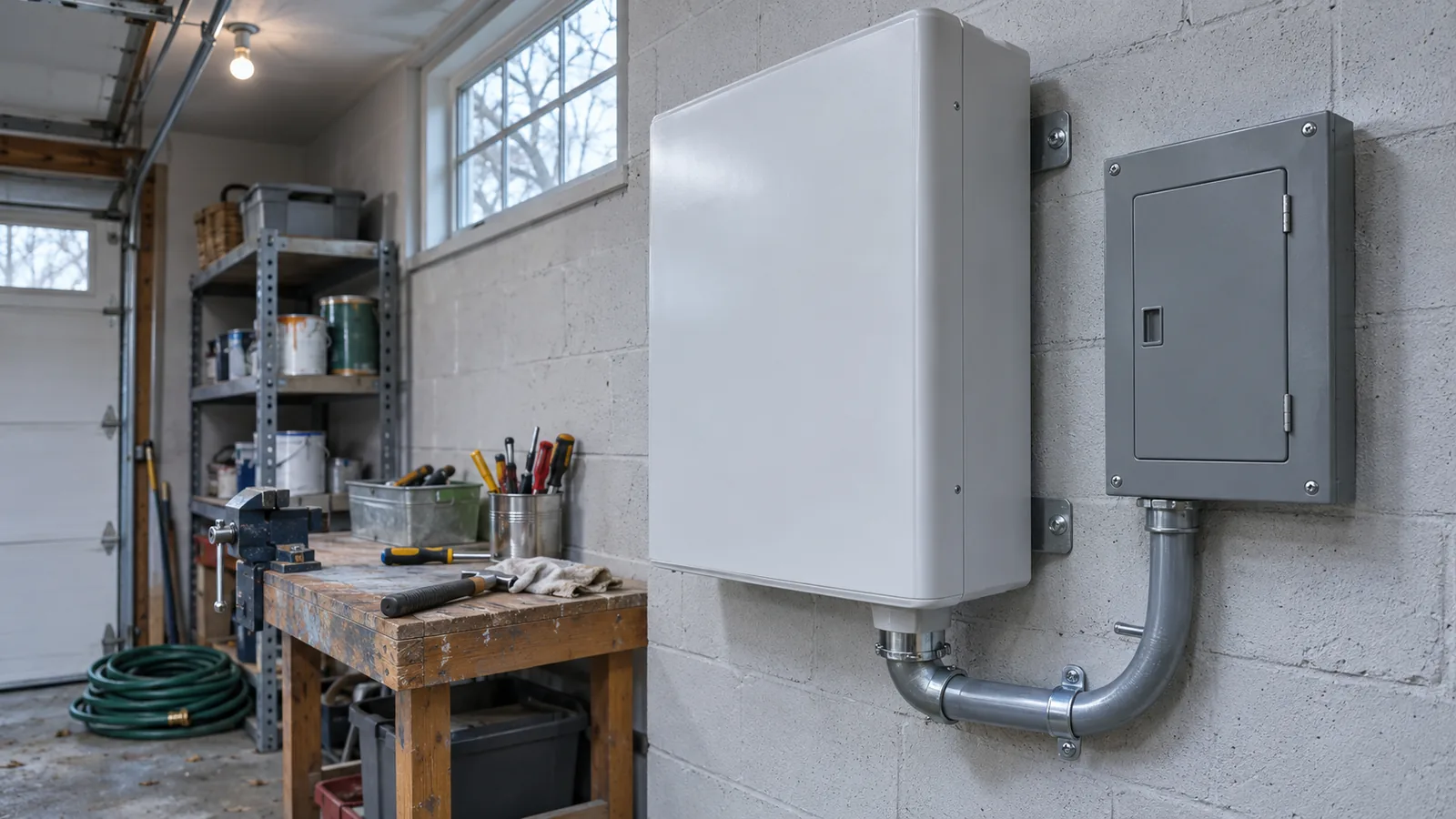
The battery and its enclosure. Wall-mounted or floor-standing, indoors or out, depending on the product and the climate. Cold affects usable capacity, and so does heat.
The inverter. Either built into the battery or separate. It converts between the battery's direct current and the house's alternating current, and its rating — not the battery's capacity — sets how much you can run at once.
The backup interface. A transfer device or a protected subpanel that isolates the circuits you want backed up. If the whole panel is to be backed up, that is a bigger device and more work than a small critical-loads panel.
The electrical work and the paperwork. A licensed electrician does the connection; the utility normally has to approve an interconnection; a permit and an inspection follow. The utility step is the one people forget, and it can be the long pole.
What the Rules Require
Searches for home battery installation rules, home battery installation requirements and home battery installation guidelines are all circling the same real thing: residential energy storage is genuinely regulated, and the rules are not optional decoration.
In broad terms, and subject to your local code: there are limits on how much storage capacity may be installed in a given location, minimum separation between units, restrictions on habitable rooms and on exit routes, and requirements for listing and labelling of the equipment. Garages, utility rooms and exterior walls are the usual permitted locations; bedrooms and the space under a stairway generally are not.
None of that is something to work out from an article. It is what your installer must demonstrate on the permit application, and what the inspector checks. The practical use of knowing it exists is that you can ask for it — and an installer who waves the question away has told you something.
What Moves a Quote, and How to Read Three
The home battery installation cost moves, in rough order of impact, with: how much of the panel you want backed up; the inverter rating you need; whether solar is part of the project; the distance from the battery position to the panel; the condition and capacity of the existing service; and the local permit and utility interconnection process.
When you ask home battery installers for a quote, ask for it itemised, with these as separate lines:
- battery model, usable capacity, and inverter continuous rating;
- which circuits are backed up, named;
- the backup interface — full panel, or a critical-loads subpanel;
- mounting location, and the code basis for it;
- permit, inspection, and utility interconnection application;
- commissioning and the warranty term, including capacity retention;
- what happens if the utility rejects or delays the interconnection.
Three quotes are only comparable if they back up the same circuits. The commonest reason one home battery backup cost looks far lower is a smaller inverter and a shorter circuit list, which is a different product rather than a better price. The same applies when a whole house battery backup system cost is set beside a critical-loads design: those are not two prices for one thing.
Two more notes from the real search demand. A home battery installation cost given over the phone, without anyone seeing the panel, is a guess dressed as a quote. And the home battery backup tax credit and any state or utility programme carry eligibility conditions — capacity thresholds, equipment lists, installer credentials, deadlines — that change; verify them with the programme itself before they become part of your arithmetic.
Do You Need Solar?
No. Home battery backup without solar is a normal installation, and for pure outage coverage it is often the simpler one: the battery charges from the grid between outages and holds that charge. What changes without panels is the economics and sometimes the incentive eligibility, since several programmes are written around generation rather than storage alone. If you are weighing panels as well, see solar panels for home, and for the outage side of things, power outage preparedness.
FAQ: Home Battery Backup
How much does a home battery installation cost?
It turns almost entirely on how much of the panel you back up, the inverter rating and whether solar is involved, so a published figure would mislead you. Ask three installers for itemised quotes covering the same named circuits, and compare the lines.
How long will it run the house?
That depends on the circuits, not the battery alone. A fridge, a furnace fan and some lights is a load a single unit can often hold overnight; electric heat or air conditioning will empty the same battery in hours.
Can I have a battery without solar panels?
Yes. It charges from the grid and holds the charge for an outage. The economics and the incentive eligibility change, not the feasibility.
Where is it allowed to go?
Typically a garage, a utility space or an exterior wall, with code limits on capacity per location, separation between units and proximity to exits and habitable rooms. Your installer has to show this on the permit, and the inspector checks it.
Does the utility have to approve it?
Usually, through an interconnection application, and that step often sets the timeline rather than the installation itself. Ask where it sits in the schedule and who files it.
Which installer should I use?
We keep no directory and recommend no installers. Ask for the licence, the permit history, the code basis for the siting, and references for backup installations of similar scope.
Sources
- National Fire Protection Association — National Electrical Code, the article covering energy storage systems, and NFPA 855 on stationary storage installation
- U.S. Department of Energy — residential energy storage, sizing and backup configurations
- Internal Revenue Service — residential clean energy credit, eligibility conditions for battery storage
- National Renewable Energy Laboratory — storage performance, capacity retention and temperature effects
- Database of State Incentives for Renewables and Efficiency — state, local and utility programme terms
Code editions, siting limits, interconnection procedures and incentive eligibility are set locally and are revised; verify with your local building department, your utility and the programme administrator. This page is general information, not an electrical design. We recommend no contractors and receive no referral fees. See our Editorial Policy, Sources & Fact-Checking and Affiliate Disclosure.