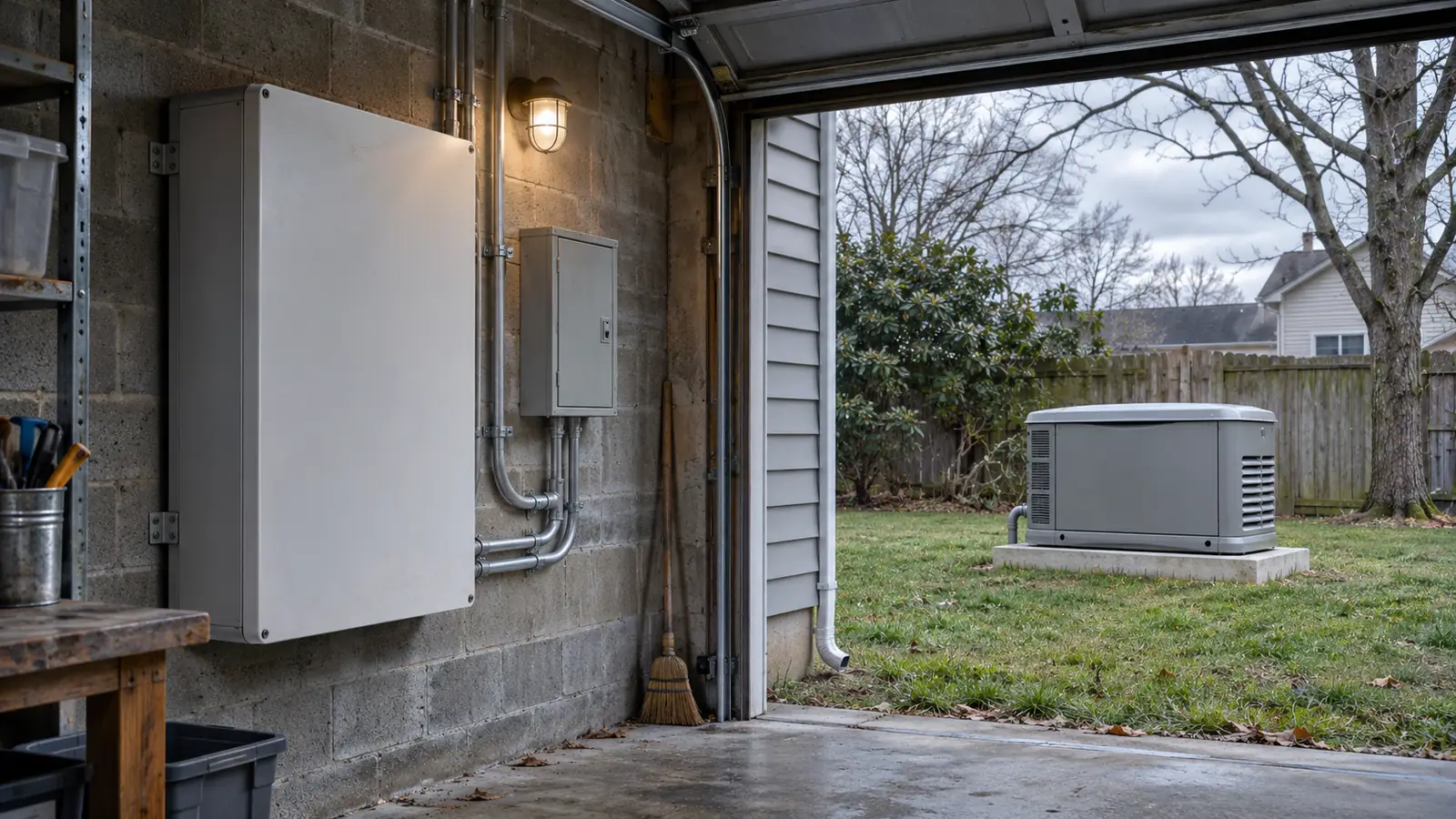

The choice between home battery backup vs generator is not a question of which technology is better. It is a question of which failure you are buying insurance against, because the two fail in opposite directions: a battery runs out and a generator runs on.
Everything else — the quiet, the fuel, the maintenance, the paperwork — follows from that one difference. Here it is laid out side by side, with no product to sell you either way.
The One Difference That Decides It
A battery holds a fixed amount of energy and gives it back. When it is empty, it is empty until something recharges it — the grid, which is what failed, or panels, which only work in daylight and only if you have them. A fuelled engine makes power continuously and stops only when the fuel stops, which for a piped-gas standby unit may be a very long time.
So the useful first question is not which to buy. It is: how long do your outages last? Two hours, four times a winter, is a completely different problem from four days after an ice storm. If you do not know, your utility's reliability reporting and your own memory of the last three years are better evidence than any brochure.
Side by Side
Where the whole house battery vs generator comparison actually lands, on the things people notice after a year of ownership:
- Runtime. Battery: hours, set by what you run. Generator: as long as the fuel lasts.
- Transfer. Battery: instant and seamless, nothing blinks. Generator: a pause of seconds while it starts.
- Noise. Battery: silent. Generator: audible from inside, and from next door.
- Fuel. Battery: none. Generator: piped gas, propane or petrol, each with its own failure mode — a propane tank empties, a petrol can ages, a gas main is itself a utility.
- Maintenance. Battery: essentially none, with gradual capacity loss over years. Generator: scheduled servicing, oil, filters, and a weekly self-exercise.
- Big loads. Battery: limited by the inverter rating, and expensive to scale. Generator: the stronger option for electric heat, well pumps and air conditioning.
- Everyday value. Battery: can shift your consumption and pair with solar. Generator: does nothing at all until the lights go out.
- Safety. Battery: electrical and fire risk, managed by siting rules. Generator: carbon monoxide, which is the hazard that actually kills people during outages.
- Cold. Battery: usable capacity falls in the cold, and cold is when you need it. Generator: starts harder but is less affected overall.
Which One Fits Which House
Choose the battery if your outages are short and frequent, you want silence, you have or plan solar, your heating is not electric, and nobody in the house will reliably go outside to start something at three in the morning.
Choose the generator if outages run long, you have a well pump or electric heat, you are on a piped gas supply, and you can accept the noise, the servicing and the siting constraints. The whole house generator vs battery backup question almost always resolves to the generator once multi-day outages and heavy loads are both on the table — see standby generator installation cost for what that project involves.
Choose both if you can. The battery covers the common case silently and instantly; the generator covers the rare long one and recharges the battery while it runs. It is the most expensive answer and the most robust, and the reason people who have lived through a long outage often end up there. Framed as whole home battery backup vs generator, this is the configuration that stops the argument.
And there is a fourth answer that gets dismissed too quickly. For a short outage, a portable power station that keeps the phones, a lamp and a router alive may be all you actually need. The portable power station vs generator comparison is the same logic at a tenth of the scale: silent and finite against noisy and refuellable.
What Neither One Fixes
Backup power keeps appliances running. It does not keep the house warm if the heating is electric and the battery is small, it does not make the water safe if the supply is affected, and it does not help if nobody has thought about which circuits matter before the outage starts. Deciding that list in advance is free, and it is the step most often skipped — see power outage preparedness.
Both options involve a licensed electrician, a permit and an inspection, and both have siting rules set by local code. Neither is a weekend project.
FAQ: Home Battery Backup vs Generator
Is a home battery better than a generator?
Neither is better in general. A battery is better for short, frequent outages and for silence; a generator is better for long outages and heavy loads. The home battery vs generator answer follows from how long your outages actually last.
How long will a battery run my house?
Hours, and the number depends on the circuits rather than the battery alone. A fridge, a furnace fan and some lights is a load a single unit can often hold overnight; electric heat or air conditioning will empty the same unit in a fraction of that.
Can a generator charge a battery?
In a properly designed system, yes, and that pairing is a large part of why people install both. It needs to be designed that way rather than improvised.
Which is cheaper?
It varies too much with the house to state, and the comparison is not like for like anyway: a battery that covers six circuits for four hours and a generator that carries the whole panel for four days are different products. Compare three itemised quotes for each on the same named circuits.
Which is safer?
They carry different risks rather than different amounts of risk. The generator's is carbon monoxide, which is why clearances and CO alarms matter. The battery's is electrical and thermal, which is why code limits where and how much storage can be installed.
What about a generator vs battery backup for home with a well pump?
A well pump is a large intermittent load with a hard starting surge, and that pushes the answer toward the generator unless the inverter is sized generously. Ask for the starting current to be considered explicitly in any sizing.
Does the comparison change if I already have solar?
Yes, and in the battery's favour: panels can recharge it during a multi-day outage, which removes its main weakness. The home battery backup vs generator balance shifts most when there is daytime generation to refill the battery.
Sources
- U.S. Department of Energy — residential backup power, energy storage and sizing considerations
- U.S. Consumer Product Safety Commission — carbon monoxide hazards from engine-driven generators
- National Fire Protection Association — National Electrical Code, the articles covering energy storage systems and optional standby systems
- National Renewable Energy Laboratory — battery capacity retention and temperature effects on usable capacity
- U.S. Energy Information Administration — reported frequency and duration of electricity interruptions
Outage duration varies widely by region and by year, and code requirements and permit practice are set locally; use your own utility's reliability reporting and your local building department rather than a national figure. This page is general information, not an electrical design, and we recommend no contractors and receive no referral fees. See our Editorial Policy, Sources & Fact-Checking and Affiliate Disclosure.