
Tornado shelter cost is the question everyone starts with, and the honest answer is that the price range published online is wide enough to be useless — because it depends on the type, the ground you're building into, and whether it's going into a new house or an existing one.
What can be pinned down is the standard it has to meet. That part is not a matter of opinion, and it's the thing to get right before discussing money.
How We Chose
We haven't installed shelters and we don't rank manufacturers here. What this page uses is the published federal and model-code criteria — FEMA P-320 for homes, FEMA P-361 for larger and community shelters, and ICC-500, the standard the building codes point to.
Prices are deliberately described as ranges reported by owners and installers rather than as figures we can verify, because they are genuinely local. Anyone quoting a single national number is guessing.
The Four Types, and Who Each Suits
The choice is usually settled by the ground and the building rather than by preference.
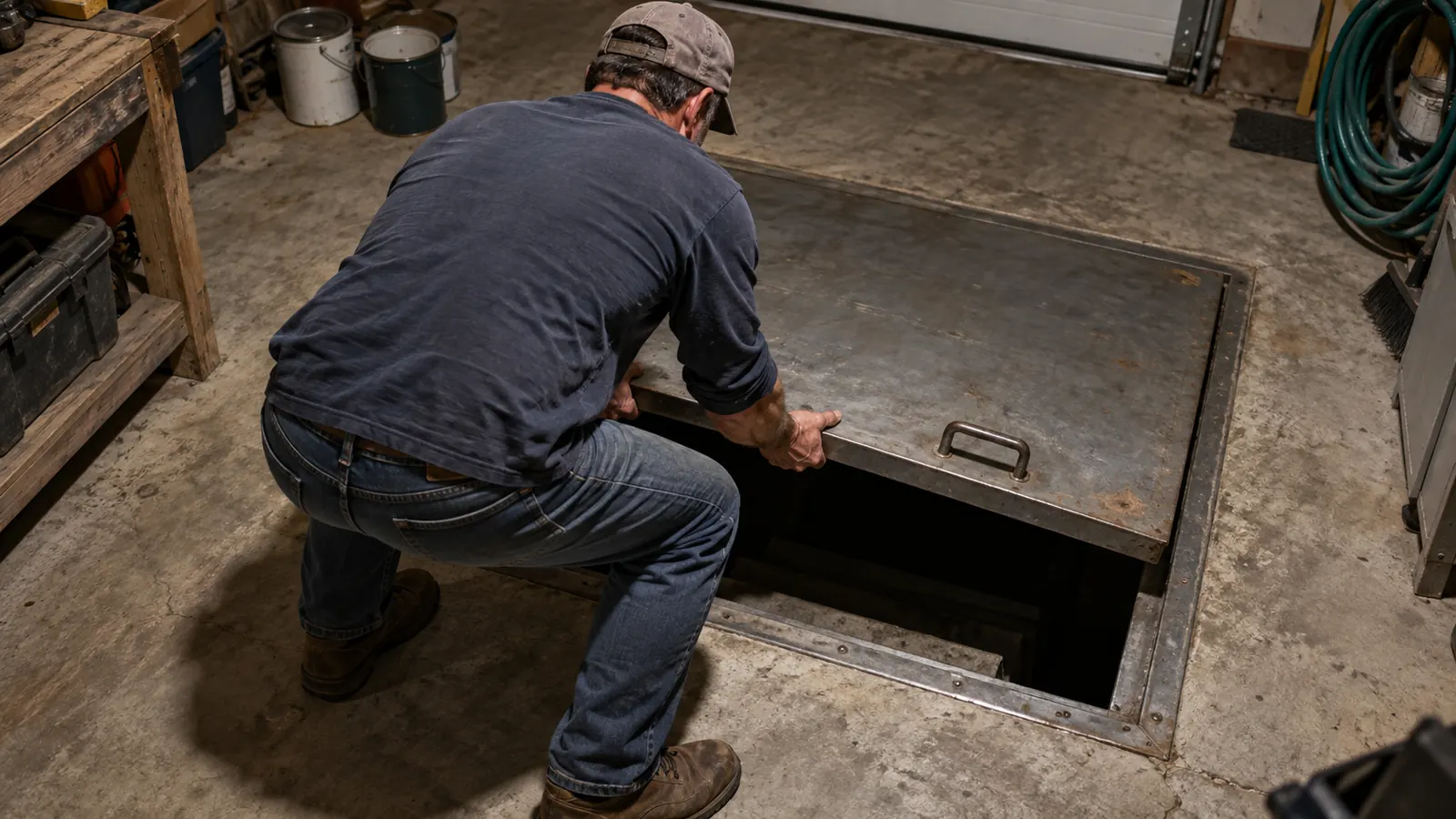
In-ground, in the garage floor. A steel or concrete box set into the slab with a hatch flush to the floor. The common retrofit: it needs no extra footprint, and the vehicle parks over it. Steps are the limitation, and so is anything that can be parked on the hatch.
In-ground, outside. The traditional storm cellar. Cheaper to dig outside than to cut a slab, and it requires walking outside to reach it — which is a real disadvantage in the minutes before arrival, and a serious one at night.
Above-ground, inside the house. A reinforced room, often replacing a closet, anchored to the slab. This is the option where the water table forbids digging, and the one that works for anyone who can't manage steps. It's also the easiest to reach in a hurry, which matters more than people expect.
Community shelter. Free, maintained by someone else, and only useful if you can get there during the watch rather than the warning. Ask your county emergency management office whether one exists and when it opens — many open only when a watch is issued.
What Drives the Price
A storm shelter cost quote varies mostly on things that have nothing to do with the shelter itself.
| Factor | Why it matters |
|---|---|
| Retrofit or new build | Cutting and repouring an existing slab costs far more than forming one during construction |
| Capacity | Priced per occupant. Standards specify floor area per person, so bigger is genuinely dearer |
| Ground conditions | Rock, clay or a high water table can rule out digging entirely |
| Access for machinery | A back garden a digger can't reach changes the method and the bill |
| Certification | Documented compliance and inspection cost money and are the entire point |
| Grant programmes | Some states have run rebate schemes. Availability changes — ask your state emergency management agency |
Choosing an Installer
This is where most of the risk sits, because the market includes both engineers and people welding boxes in a yard.
Whether you're searching for safe room builders or storm shelter installers near me, the questions are the same and they're short. Which standard is this built and installed to, and will you put that in the quote? Vague compliance language is the single biggest warning sign. Who anchors it, and how? Anchoring is what stops an above-ground room being pushed off the slab. Can the door be opened from inside with debris on top of it? Ask for the specific mechanism.
Then the ordinary contractor questions: licence and insurance, whether a building permit is required in your jurisdiction, who handles inspection, and what the warranty covers. Ask for local references and actually call one.
A storm shelter installation that isn't inspected and documented is worth considerably less than the same box with paperwork — including to an insurer, and to whoever buys the house from you.
Once it's in, what goes inside it is a separate and much cheaper problem: Tornado Shelter Supplies. And if a shelter isn't in the budget, the free version — picking the best room you already have — is in Tornado Preparedness.
Get two quotes, both naming the standard in writing. That one requirement filters the market faster than any other question.
FAQ: Tornado Shelters
How much does a tornado shelter cost?
It varies too much for a national figure to be honest — type, capacity, ground conditions and retrofit versus new build all move it substantially. Get two local quotes, both naming the standard they build to.
What standard should it meet?
FEMA P-320 for residential safe rooms, FEMA P-361 for larger and community shelters, and ICC-500, which the building codes reference. Ask for compliance in writing.
In-ground or above-ground?
Ground conditions usually decide. Above-ground suits high water tables and anyone who can't manage steps, and it's faster to reach. In-ground in a garage floor is often the cheapest retrofit.
Can I build a safe room myself?
We don't publish plans or specifications, because debris impact, anchoring and door hardware are engineered life-safety details. Get the FEMA documents and work with a builder who follows them.
What if debris blocks the hatch?
Ask the installer that question directly and get a specific answer about the mechanism. A shelter you can't get out of is a serious problem, and good designs address it.
Are there grants to help pay for one?
Some states have run rebate or grant programmes, and availability changes. Ask your state emergency management agency before assuming either way.
Sources
- FEMA P-320 — Taking Shelter From the Storm, residential safe rooms
- FEMA P-361 — Safe Rooms for Tornadoes and Hurricanes, design criteria
- ICC-500 — ICC/NSSA Standard for the Design and Construction of Storm Shelters
- National Weather Service — sheltering guidance
This page describes standards and buying considerations. It is not engineering advice and contains no construction specifications. Verify requirements with your local building authority. See our Editorial Policy and Sources & Fact-Checking.