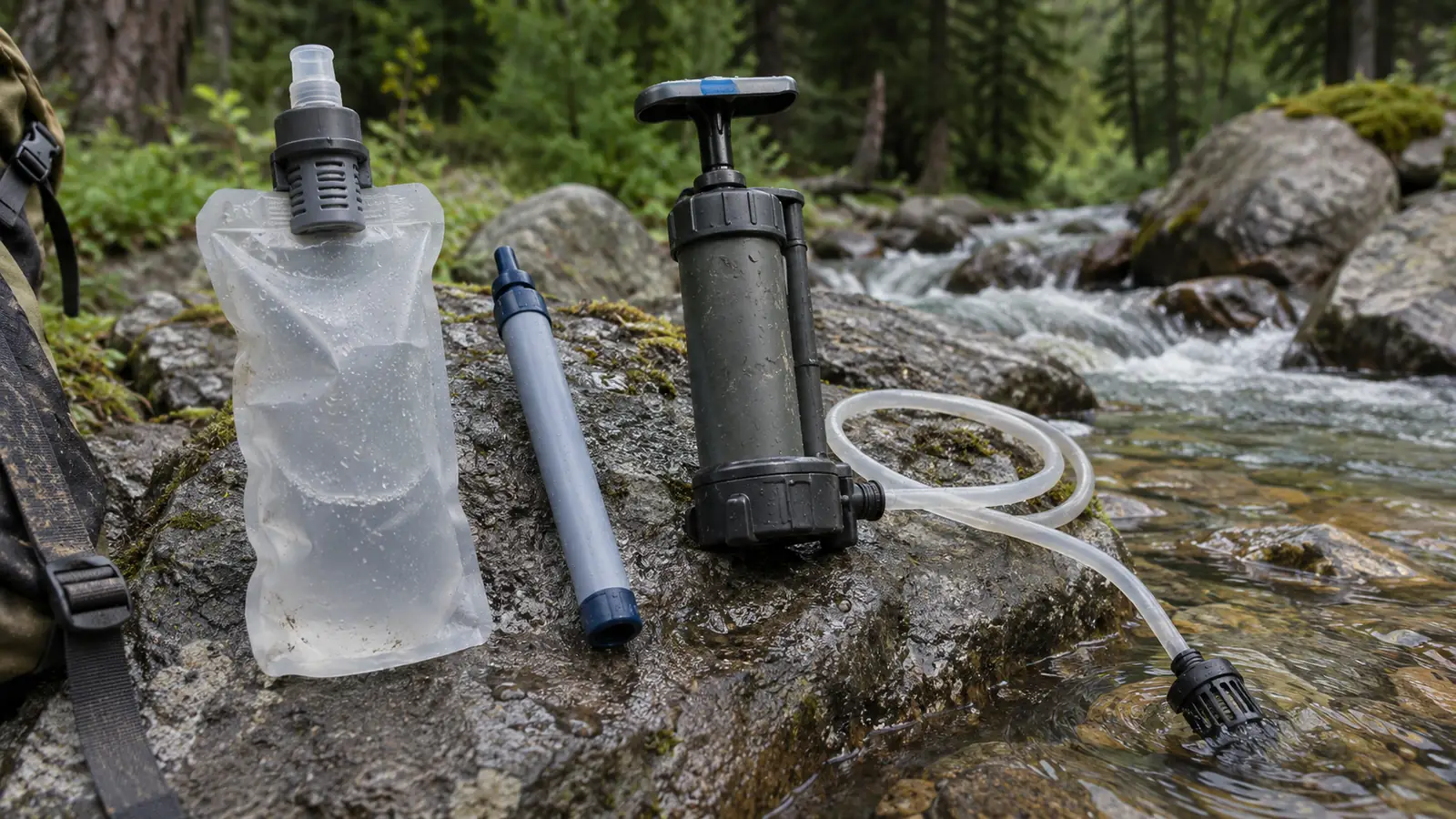

Choosing a portable water filter for travel comes down to one question most buying guides skip: are you worried about organisms, or about chemicals? Nearly every portable filter on the market handles the first and almost none handle the second, and knowing which problem you have narrows the choice from hundreds of products to about four types.
The second question is how you want to move water — suck it, squeeze it, pump it, or let gravity do the work. That decides the format, and the format is what you will either use every day or leave at home.
Four Formats, and Who Each One Suits
Inside, portable water filter systems mostly share the same hollow-fibre or ceramic element. What differs is how water is persuaded through it, and that changes the experience completely.
- Straw. A portable water filter straw is used at the source. Lightest, cheapest, nothing to break — and you cannot carry treated water, cook with it, or share it.
- Squeeze / bottle. A soft flask or bottle with the element in the lid or neck. Fill, squeeze, drink. The best balance for most portable water filter for hiking use.
- Pump. A hand pump draws from the source through a hose. Heavier and slower to use, but it works from shallow or awkward water, and it keeps producing in cold conditions where squeezing gets unpleasant.
- Gravity. A hanging bag that filters unattended into a container below. The right answer for groups and camps: see gravity water filter system.
For a portable water filter for camping with more than two people, gravity wins on effort alone. Solo and moving fast, a squeeze filter is hard to beat. The straw is a backup that lives in a bag and weighs nothing.
Filter or Purifier: The Distinction That Matters
A filter physically strains water. Its pores stop bacteria, protozoa and cysts — giardia, cryptosporidium, E. coli — which covers the realistic risk in most wilderness water in North America and Europe.
A purifier also deals with viruses, which are small enough to pass most filter membranes. Viruses in water generally indicate human sewage, which makes purification the right choice for travel in regions where sanitation is unreliable, and for any urban or agricultural source. Purification is usually achieved chemically or with UV rather than by a finer membrane.
So portable water filters survival thinking should start with the source, not the product. The same filter is entirely adequate on a mountain stream and inadequate downstream of a village.
What No Portable Filter Will Do
This is the limit worth being blunt about. Portable filters do not remove dissolved chemicals, heavy metals, nitrate, salt or fuel. Many include a small carbon stage that improves taste and adsorbs some organics, and that is a genuine benefit — but it is not treatment for chemical contamination.
The practical consequences are specific. Floodwater is not filterable: assume sewage, fuel and agricultural chemicals together, and do not drink it whatever you own. Water near industry, mine drainage, or a road spill is the same problem. Saltwater cannot be filtered at all — desalination is a different process entirely.
And after a disaster at home, a portable filter is not the first tool. Stored water is, because it needs no decisions. See flood preparedness and 72-hour kits for where water sits in the wider plan.
Using One Without Ruining It
Four failure modes account for most disappointed owners, and all four are avoidable.
Freezing. Water left inside a hollow-fibre element expands and cracks the fibres. The filter looks and feels fine afterwards and no longer filters. Below freezing, carry it close to your body and blow it through after use; if it may have frozen wet, retire it.
Sediment. Cloudy water clogs elements quickly. Let it settle, or pre-filter through a cloth or bandana. The flow rate you get on day one is not the flow rate you keep if you draw from silty water.
Cross-contamination. The clean outlet must never touch the dirty source, a dirty bottle, or dirty hands. In practice this is how people get ill with a working filter — keep the two ends mentally separate and store them apart.
Backflushing — or not. Most hollow-fibre filters restore flow when flushed backwards, and most owners never do it. Follow the instructions, flush before the flow gets bad rather than after, and dry it properly before storage so it does not grow anything in the pack.
A small portable water filter that lives in a bag for three years also deserves a check before it is relied on: run water through it at home, confirm the flow, and look for a cracked housing.
Common Questions
Can I use a portable filter on tap water?
You can, and for taste it works, but it is solving a problem you do not have. Municipal water is already disinfected; if you are filtering it for lead or chemicals, a portable filter is the wrong tool — see water filter types.
Is boiling better than filtering?
For organisms, boiling is more certain — nothing biological survives a rolling boil. It needs fuel, time and a pot, and it does nothing about chemicals or sediment. Filtering is faster and portable. Each covers the other's weakness, which is why many people carry both options.
How long does a portable filter last?
Rated lives range from a few hundred litres for small straws to several thousand for larger elements, assuming reasonably clear water. Flow rate dropping despite backflushing is the real end-of-life signal, and freezing ends it instantly regardless of volume used.
Do I need a filter for a hotel in another country?
If the concern is tap water, a purifier rather than a filter is the appropriate choice, because viruses are the relevant risk where sanitation is unreliable. Sealed bottled water is often simpler. A filter alone gives false confidence in exactly the situation where viruses matter most.
Can two people share one filter?
Yes, and it is normal. The practical constraint is format rather than hygiene: a straw means everyone drinks at the source, whereas a squeeze or gravity system fills containers that can be carried and shared. For three or more, gravity saves a lot of effort.
Sources
- Centers for Disease Control and Prevention — drinking water treatment methods for backcountry and travel, and pore-size effectiveness by organism
- Centers for Disease Control and Prevention — Yellow Book travel health guidance on water disinfection abroad
- U.S. Environmental Protection Agency — emergency disinfection of drinking water, and chemically contaminated water after flooding
- World Health Organization — household water treatment and safe storage, including recontamination of treated water
- NSF/ANSI standards for drinking water treatment units, and the regulatory basis for microbiological purifier claims
Filter performance depends on the specific product and its certification, not on its format, and no portable filter is a treatment for chemical contamination. This page is general information; we test no products, recommend none, and receive no referral fees. After flooding or in a declared emergency, follow the guidance issued by your local authority. See our Editorial Policy, Sources & Fact-Checking and Affiliate Disclosure.