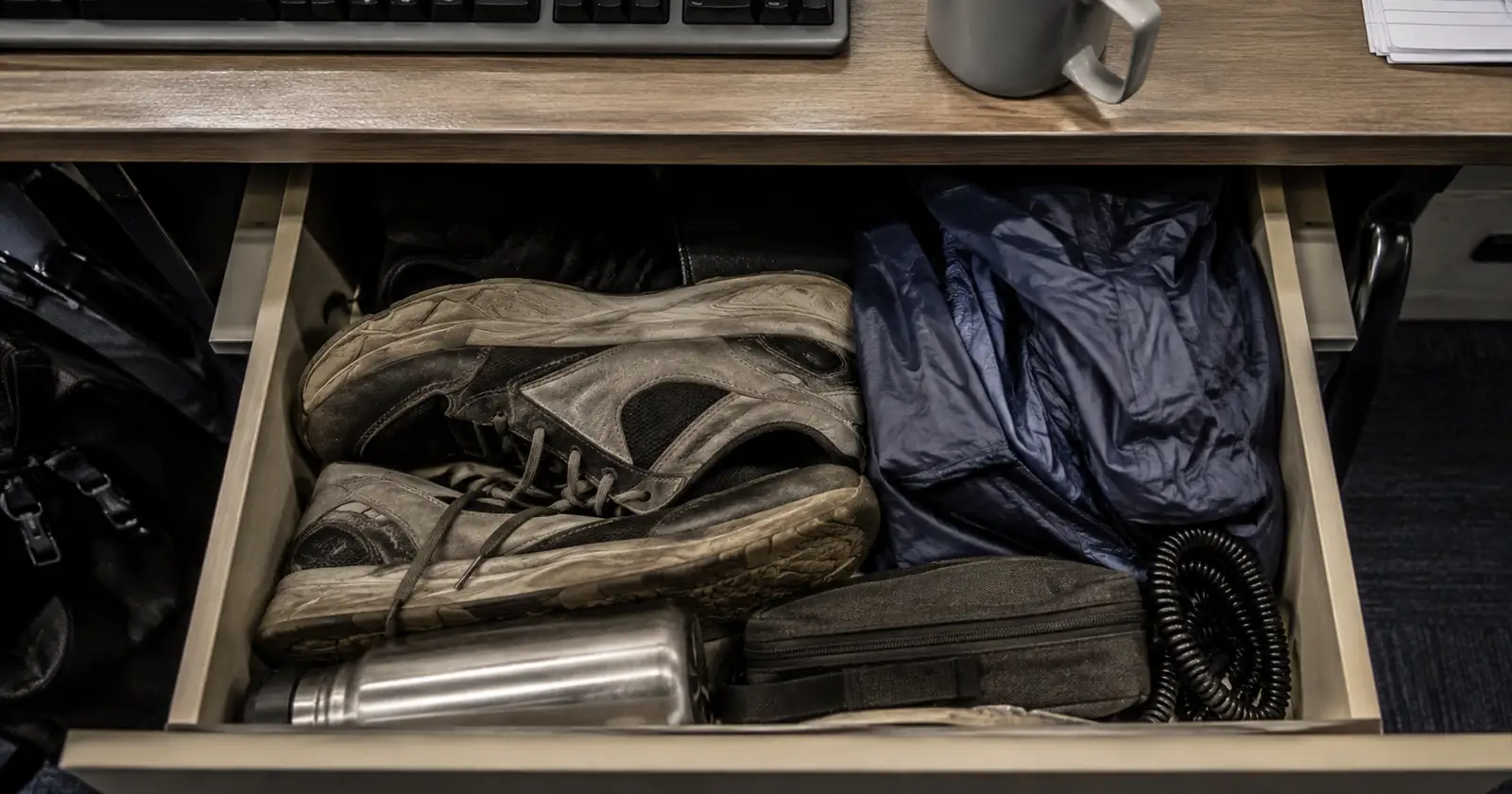

A lot of what's sold as a work emergency kit is a first aid pouch for a desk drawer. Useful for a paper cut, not much help on the day the trains stop and you're eleven miles from your kids.
The question that shapes this kit isn't what to keep at your desk. It's how far you'd have to travel to get home, and whether you could do it on foot in the shoes you're wearing right now.
How We Chose
We haven't tested workplace kits, and there's no dominant tested product in this category — it's mostly generic pouches sold under a dozen labels. So this page recommends categories of item rather than naming models we haven't examined, and the framework comes from a question you can answer yourself in five minutes.
The Walking-Distance Reality Check
Open a map, put in your workplace and your home, and switch the mode to walking. Look at the time, not the distance.
Under an hour, and your kit is genuinely small — shoes, a layer, water. Two to four hours changes things: you'll need food, more water, a light if it gets dark, and something for blisters, which are the thing that actually stops people. Beyond four hours on foot, walking home isn't a plan at all, and the kit's job becomes staying put comfortably overnight or getting to someone nearer.
Do the same for a partner or an adult child if their commute is longer than yours. It's a ten-minute exercise and it tends to surprise people.
The Desk Drawer Kit
Small, permanent, and boring enough that you'll leave it there.
- Trainers or walking shoes, plus a pair of socks.
- A packable rain jacket and a warm layer that folds small.
- A refillable water bottle.
- A power bank and the cable your phone actually uses.
- Snacks with a long shelf life — nuts, bars, something you'd eat.
- A small torch. Building lighting fails before the street lighting does.
- Plasters, blister pads, painkillers, and any personal medication you'd miss in a day.
- Cash in small notes, and a printed contact card.
- Glasses, contact solution, hygiene items — whatever a day away from home makes awkward.
Add a printed walking route home if the map showed more than an hour. A phone with no signal and 4% battery isn't navigation.
If you carry a handbag or a small bag
The commute kit can live in it rather than at the desk, which is better if you're often away from your building. The compromise is space, so prioritise ruthlessly: power bank, cash, medication, a folded rain layer. Shoes stay at the desk — they're the one item that doesn't compress.
If you work somewhere with its own plan
Ask what it says. Many workplaces hold emergency supplies, an evacuation procedure and an assembly point, and most employees have never seen any of it. Your personal kit fills the gaps rather than duplicating the fire extinguisher.
The Gift Version
A work emergency kit is a genuinely good present, and it's easy to get wrong.
What works: a small, well-made pouch with a power bank, a torch, blister pads and a foil blanket, in something the recipient would be happy to keep on a desk. It reads as thoughtful rather than alarming.
What doesn't: the 200-piece first aid box. It's bulky, most of it is plasters, and it ends up in a cupboard. Neither does anything survival-branded — camouflage on a desk is a strange gift for someone who works in an office.
What to Buy, and Where It Overlaps
Almost everything here doubles as something else, which is the argument for buying decent versions once.
- Emergency & Survival Kits — the home and grab-and-go categories this borrows from.
- Emergency Lighting & Lanterns — the torch that's worth owning.
- Emergency Blankets & Sleeping Bags — the foil blanket, and what it does and doesn't do.
Do the walking-distance check today. It takes five minutes on a phone and it decides whether this kit is three items or nine.
FAQ: Work Emergency Kit
What should be in a work emergency kit?
Walking shoes and socks, a rain and a warm layer, water, a power bank and cable, snacks, a torch, blister pads and painkillers, cash, and a printed contact card. Add a paper route home if your commute is long.
Where should I keep it?
A desk drawer for the bulk of it, especially the shoes. If you move around during the day, keep the small essentials in the bag you carry.
Is a work emergency kit a good gift?
Yes, if it's compact and usable — power bank, torch, blister pads, foil blanket. Skip the oversized first aid boxes and anything with survival branding.
What if I can't walk home?
Then the kit's job changes: staying overnight comfortably, or reaching someone closer. Identify that person or place now and tell them.
Does my employer's kit cover me?
Ask. Many workplaces hold supplies and have a written plan. Yours should fill the gaps rather than repeat what's already there.
Sources
- Ready.gov — Workplace preparedness
- FEMA — business and workplace emergency planning
- American Red Cross — workplace preparedness guidance
- OSHA — emergency action plan requirements
When a warning is active, follow local authorities and official emergency instructions before any general guidance. See our Editorial Policy and Sources & Fact-Checking.