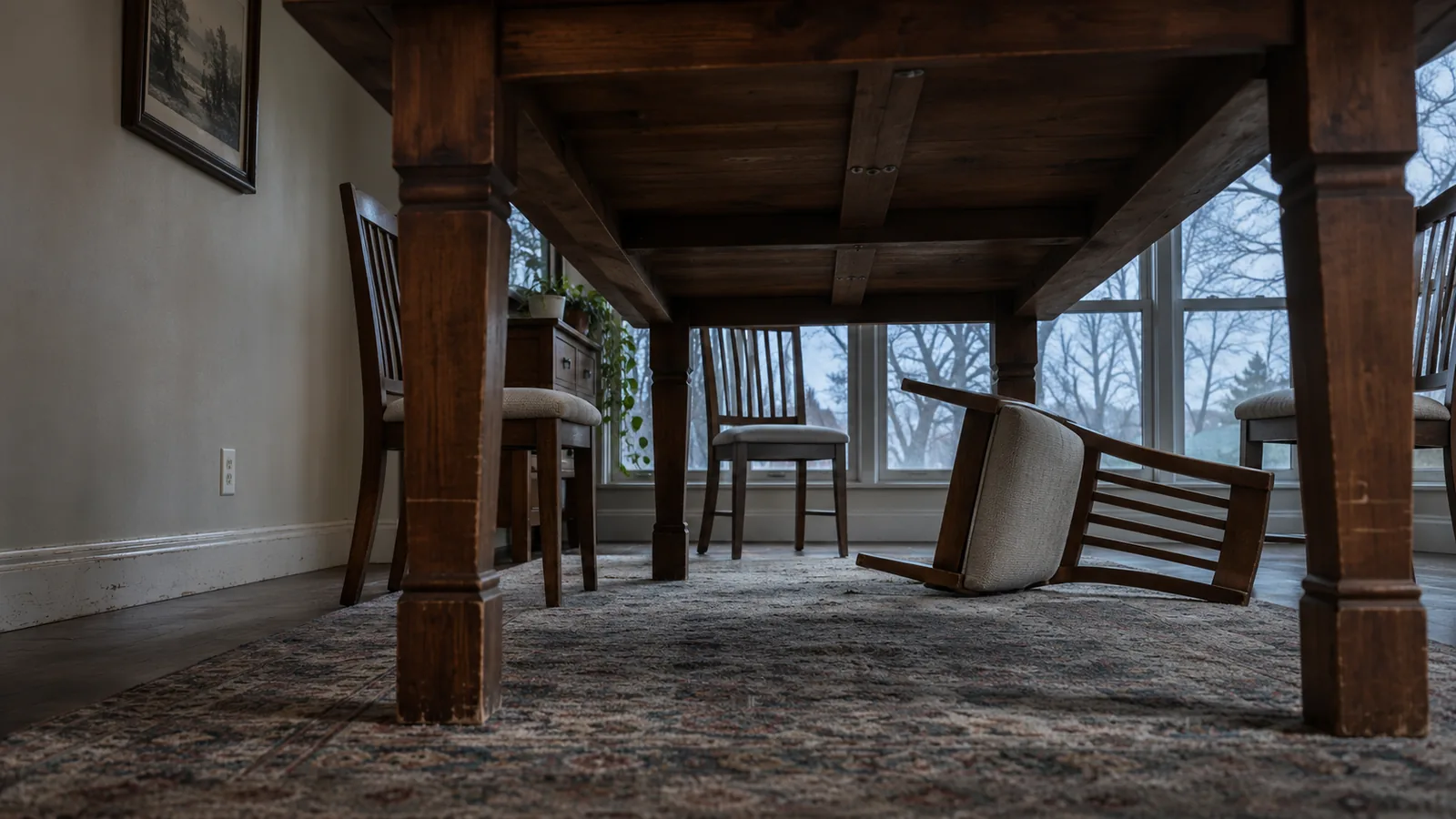

You get no decision time. By the time you have registered that the shaking is an earthquake rather than a lorry or a dream, you have used most of the window in which your choices still matter. Whatever you do next is whatever you already rehearsed.
That is why earthquake safety is taught as a short phrase rather than a decision tree. Drop, Cover and Hold On is not the cleverest response to every room in the world. It is the one that is good enough almost everywhere and can be executed without thinking.
Drop, Cover and Hold On, and Why the Alternatives Are Wrong
Three movements. Drop to hands and knees, which lowers your centre of gravity and stops you being thrown. Cover head and neck with one arm, and get under a sturdy table if one is within a step or two; if not, move against an interior wall away from windows. Hold on to the furniture you are under, because it will move, and stay there until the shaking stops.
The instinct to get outside is strong and wrong. The space immediately outside a building is where glass, cladding, parapets and roof tiles land. Most injuries in moderate earthquakes come from falling objects and from people moving while the floor still is. The earthquake safety rules taught by every major agency come down to one instruction: stay inside, get low, cover your head.
Two pieces of bad advice are worth naming. The doorway dates from unreinforced adobe, where the frame was sometimes the last thing standing; in a framed building it offers no protection. The "triangle of life", which says to lie beside furniture rather than under it, is rejected by the USGS, FEMA and the Red Cross alike.
Where You Are Changes the Last Step, Not the First
- In bed: stay there. Turn face down and cover your head and neck with a pillow. Getting up means walking on broken glass in the dark.
- In a wheelchair or walker: lock the wheels, stay seated, and bend forward to protect your head and neck with your arms. Protecting the head is the goal, not reaching the floor.
- Driving: pull over clear of bridges, signs and power lines, set the brake, and stay in the vehicle until the shaking stops.
- Outdoors: move away from buildings, streetlights and overhead wires, then drop and cover. Open ground is genuinely safer; the few steps to reach it are not.
- In a high-rise: the same three movements, and never the lift. Tall buildings sway for longer than the floors below.
- Near the coast: if the shaking was strong or long, move inland and uphill once it stops, without waiting for an alert. Local tsunami waves arrive in minutes.
The First Hour After It Stops
This is where good earthquake safety instructions stop being about your body and start being about the building. Reliable earthquake safety information on the next few minutes is thinner than it should be, so the order matters.
Check people first. Serious bleeding before anything else (First Aid Basics). If someone is trapped, do not move rubble you do not understand; mark it and call it in. Then put shoes on, and expect glass everywhere.
Smell before you switch. If there is a smell of gas, hissing, or a visibly broken line, get everyone out, then shut the gas off at the meter if you can do it safely and leave it off. With no sign of a leak, leave it alone — and do not light a match or flick a switch in a space that smells of gas.
Look at the structure without becoming an inspector. Cracks through foundations, a floor shifted relative to the walls, a leaning chimney, a door frame out of square: all reasons to get out and stay out until someone qualified has looked. Plaster cracks alone are not a verdict.
Then communication. Text rather than call, and use the out-of-area contact. Who meets where should already be settled (Earthquake Preparedness, Emergency Communication Plans).
Aftershocks, and What to Tell Children
Aftershocks follow every significant earthquake, most frequently in the first hours and days, and occasionally one is large enough to be an earthquake in its own right. Each can bring down something the first shock loosened. So every aftershock gets the same response as the first, including the ones that turn out to be small.
Children handle this better than adults expect, provided somebody explained it beforehand. Useful earthquake safety tips for kids are short and physical: practise the three movements as a game, let them find the safe spot in each room, and name the loud noises in advance — alarms, car alarms, the helicopter. Saying aftershocks are expected turns a terrifying surprise into a predicted event. Then agree who collects them from school.
FAQ: Earthquake Safety
What should you do during an earthquake?
Drop to your hands and knees, cover your head and neck and get under a sturdy table if one is within reach, and hold on until the shaking stops. Stay inside. Do not run for the door.
Is standing in a doorway safe during an earthquake?
No. It is advice left over from unreinforced masonry and adobe. In a modern framed building a doorway offers no structural protection, keeps you upright while the floor moves, and puts you beside a heavy swinging door.
What are the main earthquake safety guidelines after the shaking stops?
Check for injuries, put shoes on, check for gas by smell and sound before touching a switch, look for obvious structural damage and leave if you find it, text rather than call, and treat every aftershock as the real thing.
Should I turn off the gas after an earthquake?
Only if you smell gas, hear hissing, or can see a damaged line. Shutting it off as a precaution leaves you without heat or cooking and needs a utility visit to relight, which can take days. Never relight it yourself.
How long do aftershocks last?
Days to weeks after a moderate quake and months after a large one, decaying in frequency rather than stopping on a date. Larger ones stay possible throughout, which is why the response is identical.
Sources
- USGS — earthquake safety, Drop Cover and Hold On, and the "triangle of life"
- FEMA and Ready.gov — during and after an earthquake
- American Red Cross — earthquake safety, including wheelchair users
- Great ShakeOut — protective actions by setting
- CPSC and CDC — carbon monoxide and generator safety
- NOAA National Tsunami Warning Center — natural warnings after strong shaking
This page is general information and not medical advice, and nothing here authorises a structural assessment of your own building — have visible damage inspected by a qualified professional or your building department. For current conditions see the Live Emergency Map. See our Editorial Policy, Sources & Fact-Checking and Emergency Medical Disclaimer.