
Every other hazard on this site gives you something: a watch, a cone, a few hours. An earthquake gives you nothing. The first thing you know about it is that it has already started, and whatever you did beforehand is what you have.
That one fact reorganises the subject. Earthquake preparedness is not a response plan you activate when the alert arrives. It is a handful of decisions made on an ordinary afternoon, mostly with a drill and a few brackets, then mostly forgotten.
Why Earthquakes Break the Usual Preparedness Rules
Hurricane preparation has a clock. Tornado preparation has a warning, measured in minutes but real. Earthquake preparedness has neither, and that gap changes what a plan can even be.
A written earthquake preparedness plan that begins with "when an earthquake is forecast" is worthless, because that sentence will never apply. What works instead assumes you are asleep, or driving, or at your desk three towns from your children, and answers one question: where do we end up, and how do we learn that everyone else is alive?
What happens during the shaking, and in the first confused hour afterwards, has its own rules: Earthquake Safety covers it. This page is the part you can still act on today.
The Work That Pays Off: Securing What Falls
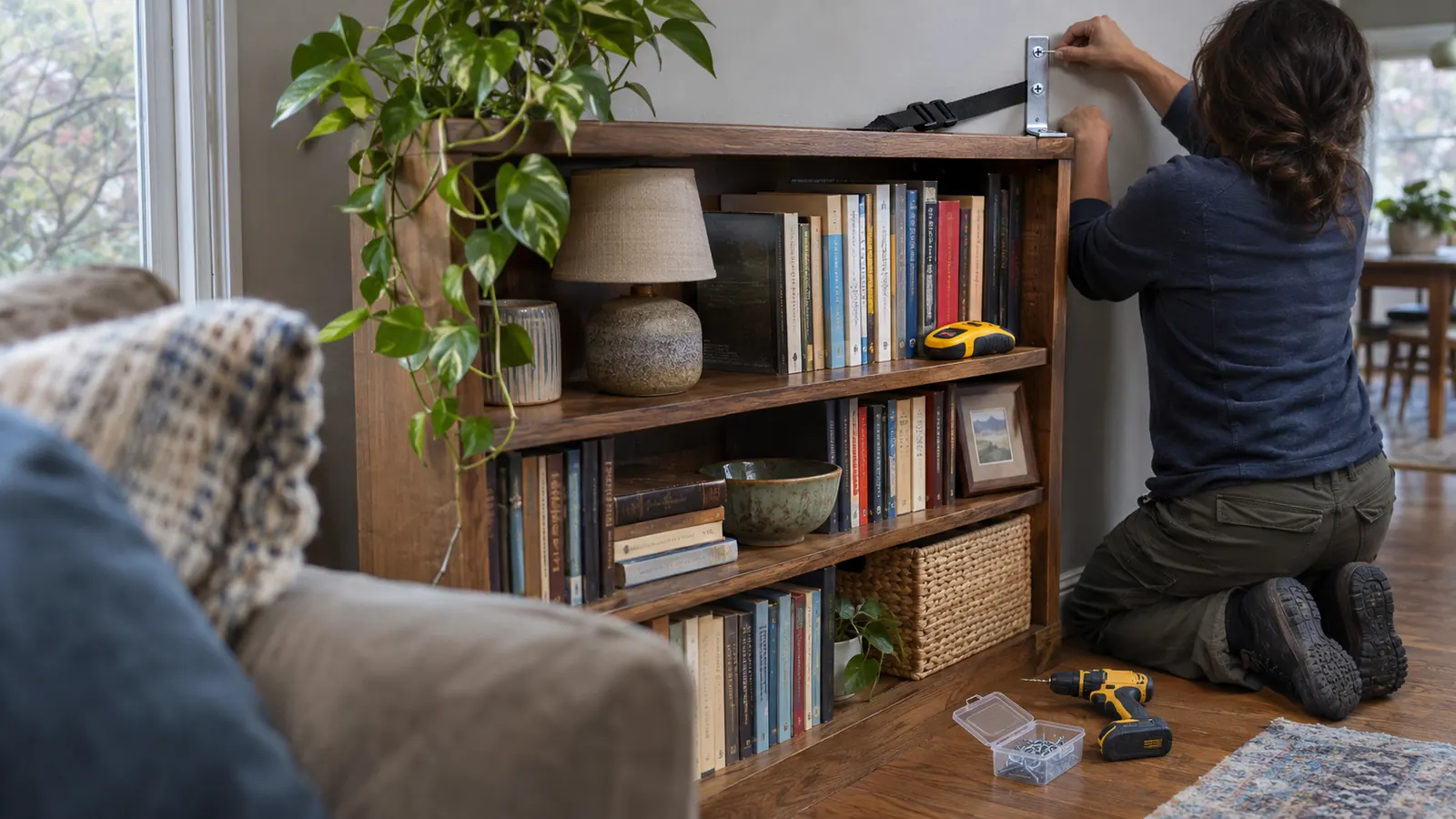
If you read one section, read this one. In a moderate quake in a modern building, the building is usually fine and the contents are not. Injuries come from bookcases, televisions, water heaters, hanging mirrors and the contents of upper kitchen cabinets, arriving at speed.
The fixes are unglamorous and take a weekend:
- Strap tall furniture to studs — bookcases, wardrobes, filing cabinets, anything taller than it is wide. Nylon straps into a stud, never a drywall anchor.
- Strap the water heater at the upper and lower third. A toppled heater tears its gas line, and in many jurisdictions this is already required.
- Latch upper cabinets, especially where glass and heavy crockery sit above a worktop.
- Move the heavy things down. Nothing over a bed, nothing stored high you would not want to catch.
- Secure the television and anything on a wheeled stand.
Beyond the contents sits the structure: older houses on raised foundations may not be bolted down, and an unbraced crawl space can let a house slide off its footings. That is permit-and-contractor work, covered at Seismic Retrofit.
Fault Lines, Shaking Maps and Where You Actually Live
People go looking for a map of fault lines near their address, and the fault map is the less useful of the two maps available. Proximity to a mapped fault matters, but so does what the house stands on: soft sediment and filled ground amplify shaking, rock does not. Two streets the same distance from the same fault can behave very differently.
Two things not to take from that exercise. Do not conclude you are safe because no fault is drawn nearby: damaging earthquakes happen on faults nobody had mapped, and large parts of the central and eastern United States carry real hazard with very few visible faults. And do not wait for a prediction. Earthquakes cannot be predicted at any useful timescale — probabilities over decades exist, forecasts of next Tuesday do not.
Your Plan, Your Kit and the Place You Work
A workable plan fits on an index card. One out-of-area contact everyone texts, because local circuits fail first. One meeting place outside the building, and one further away for when the neighbourhood is closed. Who collects the children, and the written authorisation at the school that lets them. Where the documents are. Who checks on the neighbour who cannot get downstairs.
A good earthquake preparedness checklist is two lists: the fixing-things list above, and the supplies. What an earthquake preparedness kit needs that a generic one does not — footwear and a torch reachable from the pillow, water stored well past three days, supplies split between house, car and desk — is set out in Earthquake Kits, and the baseline household contents at Emergency & Survival Kits.
Then the building you spend your days in. Earthquake preparedness in the workplace is mostly whether anyone has looked up from the desk: does that bookcase have a strap, do you know two ways off the floor, is there water on site, has the office practised anything. The ShakeOut drill, on the third Thursday of October, exists to make that practice happen at scale, and registering is free. Workplace Emergency Kits covers what a desk kit holds.
FAQ: Earthquake Preparedness
How do I prepare for an earthquake?
Secure the furniture and the water heater, store water and supplies past three days, keep shoes and a light where you sleep, agree one out-of-area contact and two meeting places, and practise Drop, Cover and Hold On until it needs no thought.
Is there an earthquake preparedness month?
No single national one. The widely observed fixed date is the ShakeOut drill on the third Thursday of October, and FEMA runs National Preparedness Month in September. Several states proclaim their own awareness periods, so the answer depends on where you live.
What should an earthquake preparedness guide tell me that most don't?
That the highest-value work is mechanical rather than logistical. Strapping a bookcase to a stud prevents more injuries than any amount of stockpiling, and it is the step most guides mention once and then bury under supply lists.
How much water should I store for an earthquake?
One gallon per person per day, and well past the usual three days — mains and treatment plants can be out for a week while nobody has evacuated. Store water for animals too.
Can earthquakes be predicted or forecast?
No. Scientists estimate the probability of a damaging quake in a region over years or decades, and issue aftershock forecasts once a sequence has begun, but nobody can say when or where the next one will strike. Treat any specific date-and-place prediction as false.
Sources
- USGS — earthquake hazards, seismic hazard maps, and earthquake prediction
- Ready.gov — earthquakes, and securing household items
- FEMA — reducing the risks of nonstructural earthquake damage
- Great ShakeOut Earthquake Drills — drill date and registration
- American Red Cross — earthquake safety and household planning
Hazard maps and local ordinances vary by state and city; check your own state geological survey and building department rather than assuming national figures apply. For current conditions see the Live Emergency Map. When a warning is active, follow local authorities before any general guidance. See our Editorial Policy and Sources & Fact-Checking.