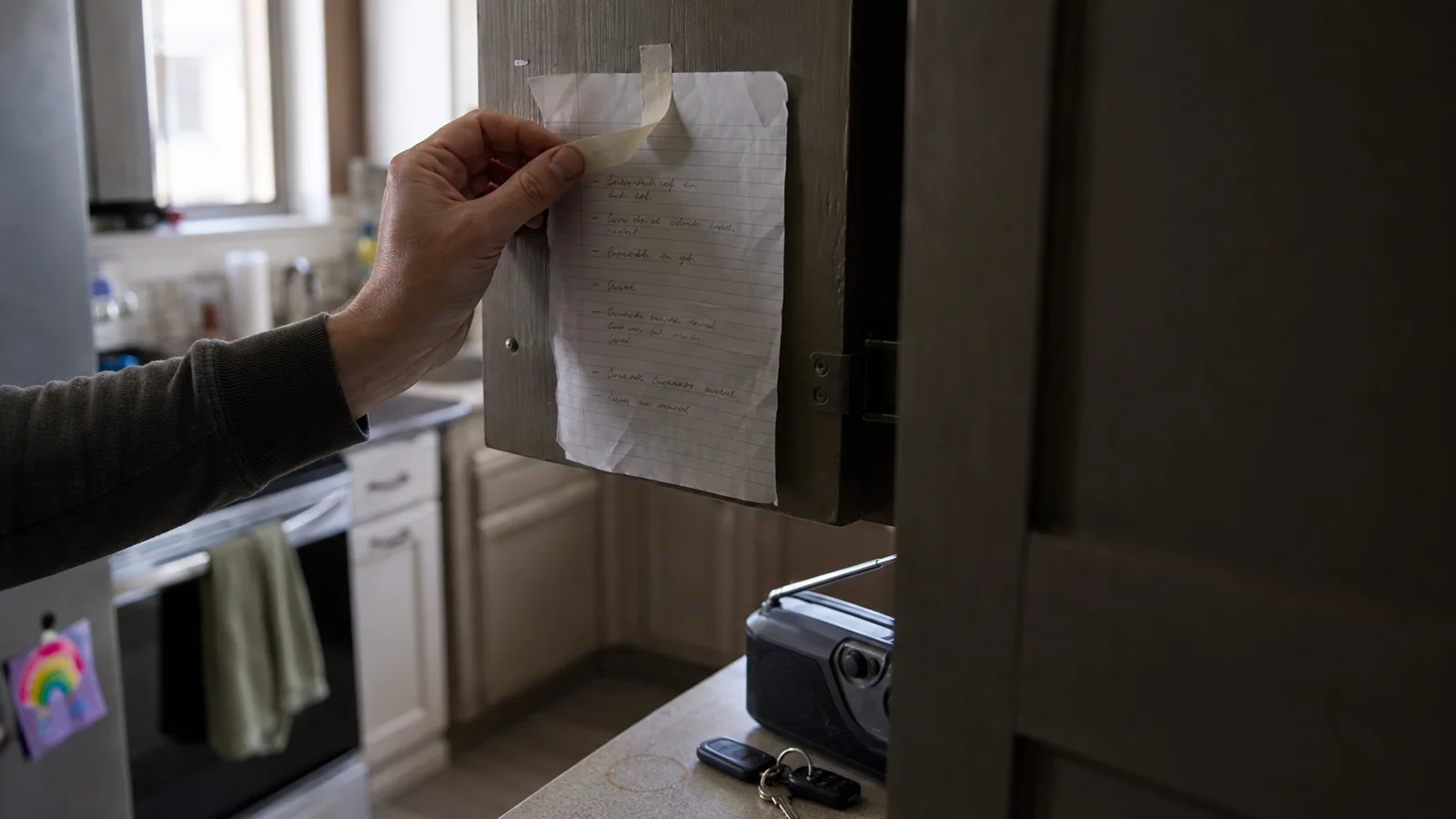

A home emergency plan doesn't need to be impressive. It needs to work when the power is out, one person is stuck at work, and nobody has time to hunt through a twenty-page binder for a phone number.
One sheet of paper everyone in the house understands beats the most thorough plan on the block. Start with four things: the hazards that actually apply to your address, who does what, where everyone meets, and how you reach each other if the phones stop cooperating. Get those four down and the rest is detail.
Start With the Risk at Your Address
Ready.gov and FEMA publish the master list of hazards, and that's the right place to check the facts. What they can't do is tell you which three matter where you live — and that's the part that decides what your plan looks like.
Which hazards apply where you live
Check your county, not the country. Flood exposure, tornado frequency, wildfire risk, earthquake potential and grid reliability change over short distances. Your state or county emergency management office publishes local hazard and evacuation information; FEMA's Flood Map Service Center covers flood zones. Once you know which three apply to you, read what each one actually does to a household — the first action for a tornado is nothing like the first action for a week without power.
Pick three and stop. A plan that tries to cover nine hazards is a plan nobody reviews.
Who the emergency plan for home has to cover
Count everyone, then write down what limits their options: someone who can't drive, a medication that needs refrigeration, limited mobility, kids at school, pets. Those constraints belong on the paper, next to the names — not in one person's head. Someone who can't self-evacuate rewrites the entire evacuation section, and that's not a detail you want to discover on the day.
What a Home Emergency Plan Contains
Six sections. One or two pages. If your emergency plan needs a table of contents, it's too long.
- Local hazards — your three, with the first action for each.
- Roles — who does what, by name.
- Meeting points — near the home, and outside the neighborhood.
- Communication — contacts, out-of-area number, backup methods.
- Utility shutoff — where the valves and breakers are, and who touches them.
- Documents — what leaves the house with you.
Roles, meeting points and evacuation routes
Assign by name, not by description. One person grabs the kit. One handles pets. One is responsible for a relative who needs help. Everyone else gets to the meeting point.
Map two evacuation routes out of your area, because the obvious one is the one that closes. Drive both once — a route that looks fine on a map can dead-end at a single bridge. The paper copy belongs in the glove box too, not only on the fridge.
Communication when the network fails
A plan that runs entirely on phones has one point of failure. Congestion hits first, then power, and the plan quietly stops working. So:
- Everyone carries the same short contact list on paper, not only in a phone.
- Text before calling. Texts often get through when voice calls don't.
- Agree on a check-in time, so nobody burns battery hunting for a signal.
- Keep one battery or hand-crank NOAA Weather Radio in the house. It receives NWS alerts with no network and no power.
While you still have a connection, the Live Emergency Map shows which NWS warnings and watches are active right now. It is situational awareness, not a warning system — the radio is what keeps working after the network doesn't.
Utility shutoff and documents
Locate the main breaker, the main water shutoff and the gas shutoff now, and make sure two adults know where they are. If your gas valve needs a wrench, keep one at the meter.
For documents, a scanned set on an encrypted drive plus a slim folder of originals covers most households. Emergency Documents covers what belongs in it.
Now the Part People Skip
Almost nobody fails at writing the plan. They fail at keeping it true. Phone numbers change, a kid changes schools, someone buys a different car, and the document quietly goes stale while everyone assumes it's current.
Review it once a year, and after any change to a phone number, school, workplace, vehicle or who lives in the home. Ten minutes.
| Problem | Cause | Fix |
|---|---|---|
| Nobody remembers the plan | Written once, never practiced | One 15-minute walkthrough a year, plus one meeting-point drill |
| Contacts are wrong | Numbers changed, list lives only in a phone | Paper copy, checked at the annual review |
| Plan is unreachable | Single copy, kept in the house you may have to leave | Copies in vehicles, with the out-of-area contact, on phones |
| Route is blocked | Only one route ever mapped | Second route, driven at least once |
What to Buy First, and What Can Wait
The plan comes first. Equipment supports it, not the reverse — and a lot of preparedness money gets spent in the wrong order.
If there's one purchase to make right after writing the plan, it's the radio. It's the only item here that still works with no network and no power. The fireproof document safe can wait — a safe with nothing in it yet is furniture.
Write the out-of-area contact and the two meeting points today. Ten minutes, and it covers the most common failure. The rest can wait until Saturday.
When you get to the rest, start here — eleven planning guides, sorted so you can see which three or four your household actually needs and skip the others.
FAQ: Home Emergency Plan
What should a home emergency plan include?
Your three most likely local hazards with a first action for each, named roles, two meeting points, a contact list with one out-of-area number, utility shutoff locations, and a document list. One to two pages.
How long does it take to write an emergency plan for home use?
About an hour for a first version. Locating the shutoffs and driving the second evacuation route takes another hour, and can wait for the weekend.
What makes the best home emergency plan different from an average one?
It's short, it exists in more than one place, and somebody has walked through it at least once. Length isn't the variable that matters.
Is a home emergency preparedness plan different from a family emergency plan template?
Same purpose, different format. One is the reasoning, the other is the form you fill in. Use both — start here, then take the template from Family Emergency Plans.
Do I need a plan if I live in an apartment?
Yes, and the content changes. Shelter location, stairwell evacuation, water storage and utility access all work differently. Apartment Preparedness covers the differences.
How often should I update it?
Once a year, and after any change to a phone number, school, workplace, vehicle or who lives in the home.
Sources
- Ready.gov — Make a Plan
- FEMA — Flood Map Service Center
- NOAA / NWS — Weather Radio All Hazards
- American Red Cross — household preparedness
- State and county emergency management offices
When a warning is active, follow local authorities and official emergency instructions before any general guidance. See our Editorial Policy and Sources & Fact-Checking.