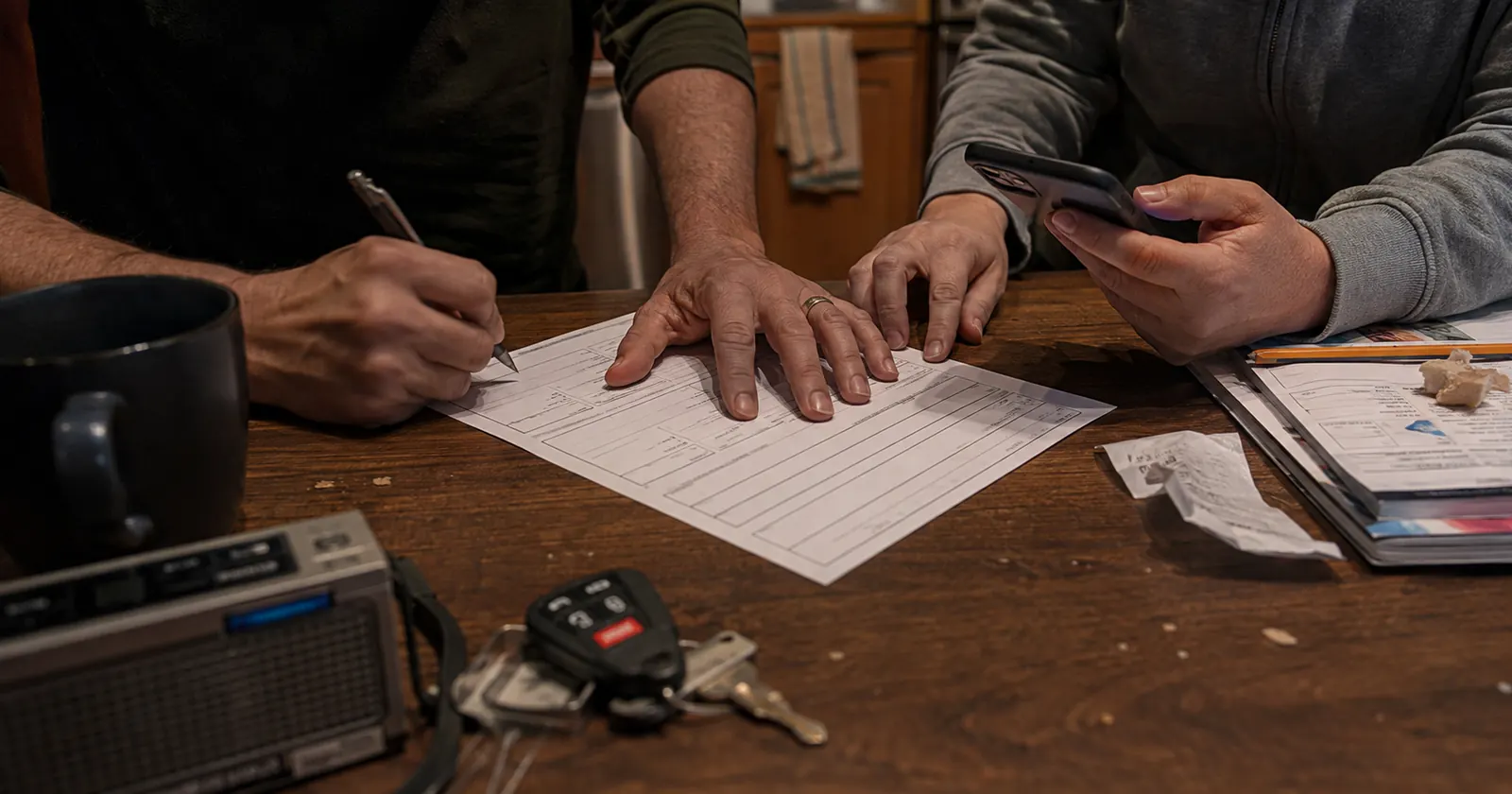

Print it, fill it in, stick it on the fridge. That's the entire job, and it takes about twenty minutes at the kitchen table.
The template below is one page. Not a workbook, not a binder — one page, because a plan nobody can read at a glance is a plan nobody uses. It's the piece most households never get around to writing down.
What's on the Page
Ready.gov publishes an official family emergency communication plan form, and it's a solid document. This one is shorter on purpose, and it adds a worked example, because a blank form is the reason most of these never get finished.
Six blocks:
- Everyone in the household — name, phone, school or workplace, one line each.
- Out-of-area contact — one person, outside your region.
- Two meeting points — one near the house, one outside the neighborhood.
- Who does what — kit, pets, the person who needs help.
- Shutoff locations — water, electrical panel, gas.
- Medical and pets — medications, allergies, vet.
That's it. If you want the reasoning behind each block rather than the form, that's covered in Home Emergency Plans.
Plenty of templates add insurance policy numbers, bank details, a full inventory of the house. I'd leave all of that off this sheet. It's sensitive information on a page meant to live on a fridge and ride around in a glove box, and it makes the form long enough that people stop filling it in halfway. Documents belong in their own place — scanned, encrypted, listed separately.
Fill It In for the Household You Actually Have
The blank form assumes two adults, one car and a house. Plenty of households aren't that, and the form should bend rather than be abandoned.
If somebody can't evacuate on their own
Write the name, then write who is responsible for them, then write the backup if that person is at work. Two names, not one. This is one of the first gaps I'd look for on a finished plan — the responsibility gets assigned to whoever happens to be home, which is the same as assigning it to nobody.
If you're in an apartment
The near-home meeting point isn't the driveway, it's a specific spot outside the building — name the corner, not "outside". Add the stairwell you'd use, because the elevator won't be an option. More on that in Apartment Preparedness.
If you have kids in school
Add one line: does the school release children to a named adult, and who is on that list? Schools have their own reunification procedure, and it usually doesn't match what parents assume. Call the office once and write the answer on the form.
If money is tight
Completing the form costs nothing. Paper, a pen, one phone call to confirm the school policy. I'd finish all of that before buying a single piece of gear, because the plan is what tells you which gear you actually need. It's easy to spend two hundred dollars solving a problem you don't have.
The Four Lines That Matter Most
If you only get partway through, get these four right. Everything else on the form is useful; these four are the ones that fail people.
| Line on the form | What people write | Write this instead |
|---|---|---|
| Out-of-area contact | A local friend two streets away | Someone in another region, who knows they're on the form |
| Meeting point | "The park" | A named, specific spot two people could find in the dark |
| Who does what | "Mom handles the pets" | A name, plus a backup name for when that person is at work |
| Gas shutoff | "Outside somewhere" | The exact location, and whether it needs a wrench |
When to Update It
Once a year, and any time a phone number, school, workplace, vehicle or household member changes. Tie the review to your annual smoke-alarm test or another household safety check, and you'll never have to remember it separately.
The failure mode here is quiet. Nothing announces that a plan has gone stale — the paper looks exactly the same with a disconnected number on it as it did the day it was written. A kid changes schools, someone starts a new job across town, and the form keeps sitting on the fridge looking finished.
Then two things worth doing once the form is done:
Print it tonight and fill in the top half. The out-of-area contact and the two meeting points take five minutes, and they're the two lines that do the most work.
Once it's filled in, the next question is whether you also need an evacuation plan, a shelter-in-place room, or neither yet. Emergency Planning & Evacuation works that out in a couple of minutes.
FAQ: Family Emergency Plan Template
Is there a free family emergency plan template PDF?
Yes — the one above, and Ready.gov publishes an official family emergency communication plan form. Ours is shorter and comes with a worked example; theirs is the government-issued version. Either is fine. Finishing one is what matters.
How do I create a family emergency plan from scratch?
Start with the out-of-area contact and two meeting points, then add roles, shutoff locations and medical notes. Twenty minutes at a table. The template just saves you deciding what the sections should be.
What should a family emergency plan example actually look like?
One page, handwriting allowed, no full sentences. Names, numbers, places. If it reads like a document, it's too long to be useful during an event.
Where should we keep the completed plan?
At least three places: the fridge, one vehicle, and a photo on every phone. A single copy kept in the house you might have to leave isn't much of a plan.
Do we need to practice it?
Once a year, fifteen minutes. Walk to the near-home meeting point and confirm everyone knows the out-of-area number without looking it up. That's enough to find the gaps.
Does this replace a home emergency plan?
No. This is the form. The reasoning behind it — which hazards apply where you live, what belongs in each section — is in Home Emergency Plans.
Sources
- Ready.gov — Family Emergency Communication Plan
- FEMA — household preparedness guidance
- American Red Cross — family disaster planning
- State and county emergency management offices
When a warning is active, follow local authorities and official emergency instructions before any general guidance. See our Editorial Policy and Sources & Fact-Checking.