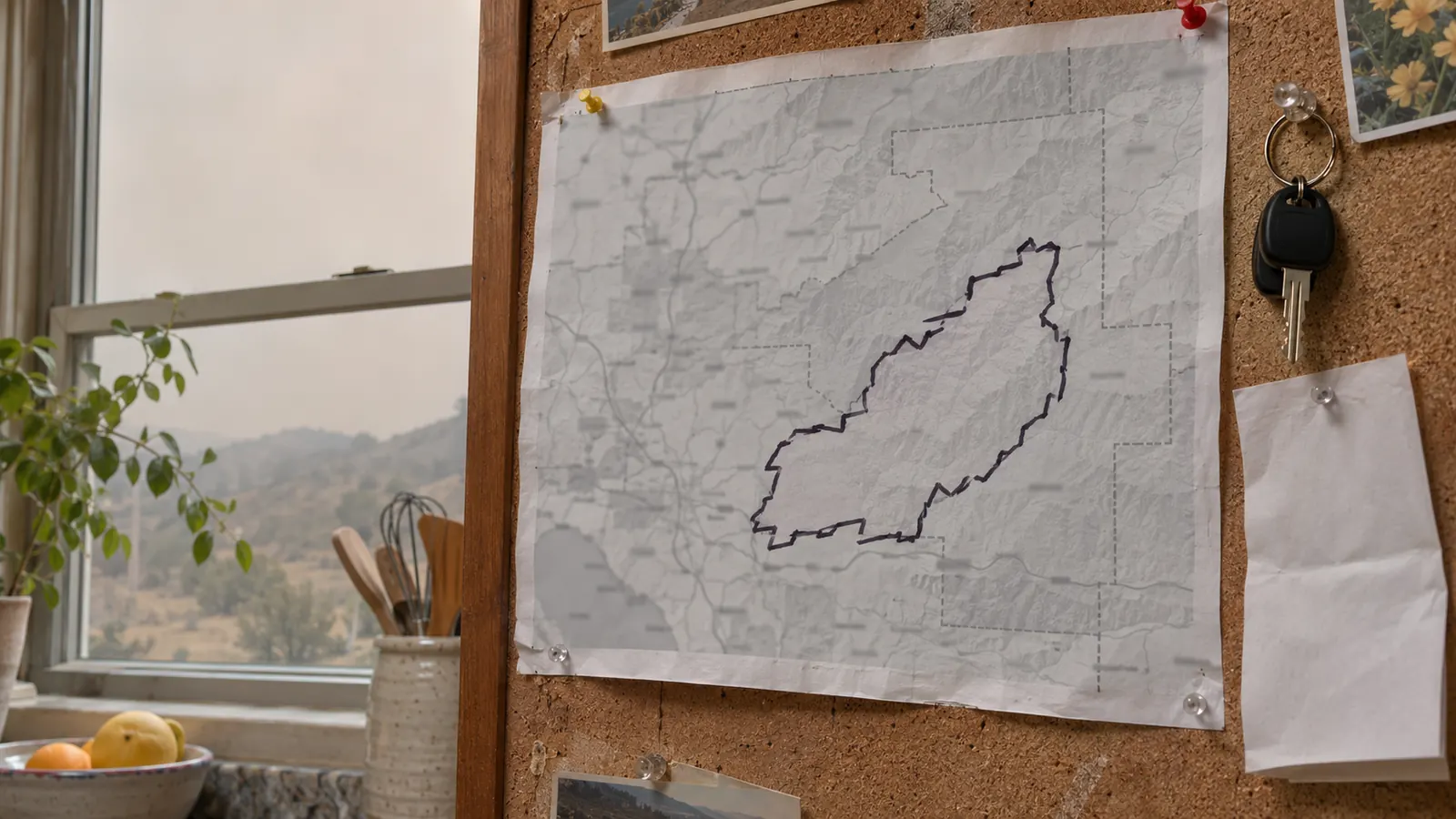

Two different things get called the same thing, and the confusion costs people time they do not have. Wildfire evacuation levels tell you what to do. Wildfire evacuation zones tell you where that instruction applies.
They move independently. Your zone does not change during a fire; your level can change three times in a day. Knowing one without the other leaves you watching an alert feed unable to work out whether it is addressed to you.
Level and Zone Are Not the Same Thing
A zone is a polygon on a map, drawn months or years in advance by a county or a state emergency management agency. It follows roads, ridges and population clusters so that officials can order part of a county out without ordering all of it. It has a short code, it does not move, and it is yours permanently unless the maps are redrawn.
A level is a status attached to that polygon at a moment in time. Three zones in one county can sit at three different levels simultaneously, and the one next to yours going to Go does not mean yours has.
This matters because the two systems answer different questions. If you ask what is my wildfire evacuation zone, the answer is a code you write on the fridge. If you ask what level you are at, the answer is only good for the next few hours.
Ready, Set, Go — and the Counties That Use Numbers
Most of the country expresses wildfire evacuation levels in three words, a system standardised by fire agencies and widely adopted.
Ready means a fire is a credible threat to the area, though not yet to your street. Fuel clearing should already be done; this is when the bag goes in the car and the animals stop being left alone in the house.
Set means you should be prepared to leave at a moment's notice. In practice it means the vehicle is loaded and facing out, the windows are shut, and anyone who would slow the departure — children, elderly relatives, animals, anyone needing medical equipment — has already gone. People read Set as permission to wait. It is not; it is the last comfortable moment.
Go means leave immediately by the route you are given. Not pack, not hose the roof, not wait for a second confirmation.
Much of Oregon and Washington, and some counties elsewhere, use Level 1, Level 2 and Level 3 for the same three states. The mapping is direct: 1 is Ready, 2 is Set, 3 is Go. The numbers cause their own problem, because a Level 1 sounds minor and a Level 3 sounds like the middle of a five-point scale. There is no Level 4.
How to Find Which Zone You Live In
Zone lookup is a county function, and there is no single national site that does it reliably.
Start with your county's emergency management or sheriff's office page and look for a wildfire evacuation zone map or an address lookup tool. Many Western counties use a shared platform that returns a zone code from an address in one step. Where no tool exists, the zone map is usually published as a PDF and you find yourself on it.
Three things to do once you have the code. Write it down somewhere that does not need a charged phone. Sign up for the county's alert system, which is separate from the federal alerts that arrive on their own — see Wireless Emergency Alerts and Emergency Alerts in My Area. And check the code for anywhere else that matters: a school, a workplace, a parent's house.
We do not publish zone levels here, and no general site should. The only correct source for a live level is the county issuing it. What we can point you at for the wider picture is the Live Emergency Map.
What Changes at Each Level
| Ready / Level 1 | Set / Level 2 | Go / Level 3 | |
|---|---|---|---|
| Means | Threat in the area | Leave at short notice | Leave now |
| Vehicle | Fuelled, bag inside | Loaded, facing out | Moving |
| Animals | Carriers out, not left alone | In the vehicle | With you |
| Household | Everyone briefed on the route | Anyone slow has already left | All out together |
| Typical duration | Days | Hours | Minutes |
The practical lesson of the table is that almost everything moves one column earlier than instinct suggests, whichever naming the wildfire evacuation levels in your county use. What to put in the vehicle is in Wildfire Evacuation Kits & Checklists; the standing plan it belongs to is in Evacuation Plans.
FAQ: Evacuation Levels and Zones
What are wildfire evacuation levels?
Three graded instructions attached to an area: Ready, Set, Go — or Level 1, 2, 3 where counties use numbers. They say what to do, not where.
What is my wildfire evacuation zone?
A fixed code assigned to your address by your county, usually findable through the county emergency management or sheriff's site. Look it up before fire season, not during.
What is the difference between Level 1, 2 and 3?
Level 1 is Ready: be prepared. Level 2 is Set: be ready to leave at short notice. Level 3 is Go: leave immediately. There is no level above three.
Does "Set" mean I should already be gone?
If anything would slow you down — animals, mobility, medical equipment, children — then yes. Set is the stage at which the people who cannot leave fast should already have left.
Where do I check the current level for my zone?
The county issuing it: its emergency management page, its alert system and its social accounts. Treat anything secondhand as delayed.
Sources
- Ready, Set, Go! — the national wildland fire public education framework
- Oregon and Washington state emergency management agencies — Level 1, 2 and 3 definitions
- CAL FIRE and county emergency management offices — evacuation zone mapping
- Ready.gov — evacuation
Zone codes, level names and lookup tools are set locally and differ between counties. This page explains the systems; it does not report live levels. For current conditions see the Live Emergency Map. When an order is active, follow local authorities and emergency services before any general guidance. See our Editorial Policy and Sources & Fact-Checking.