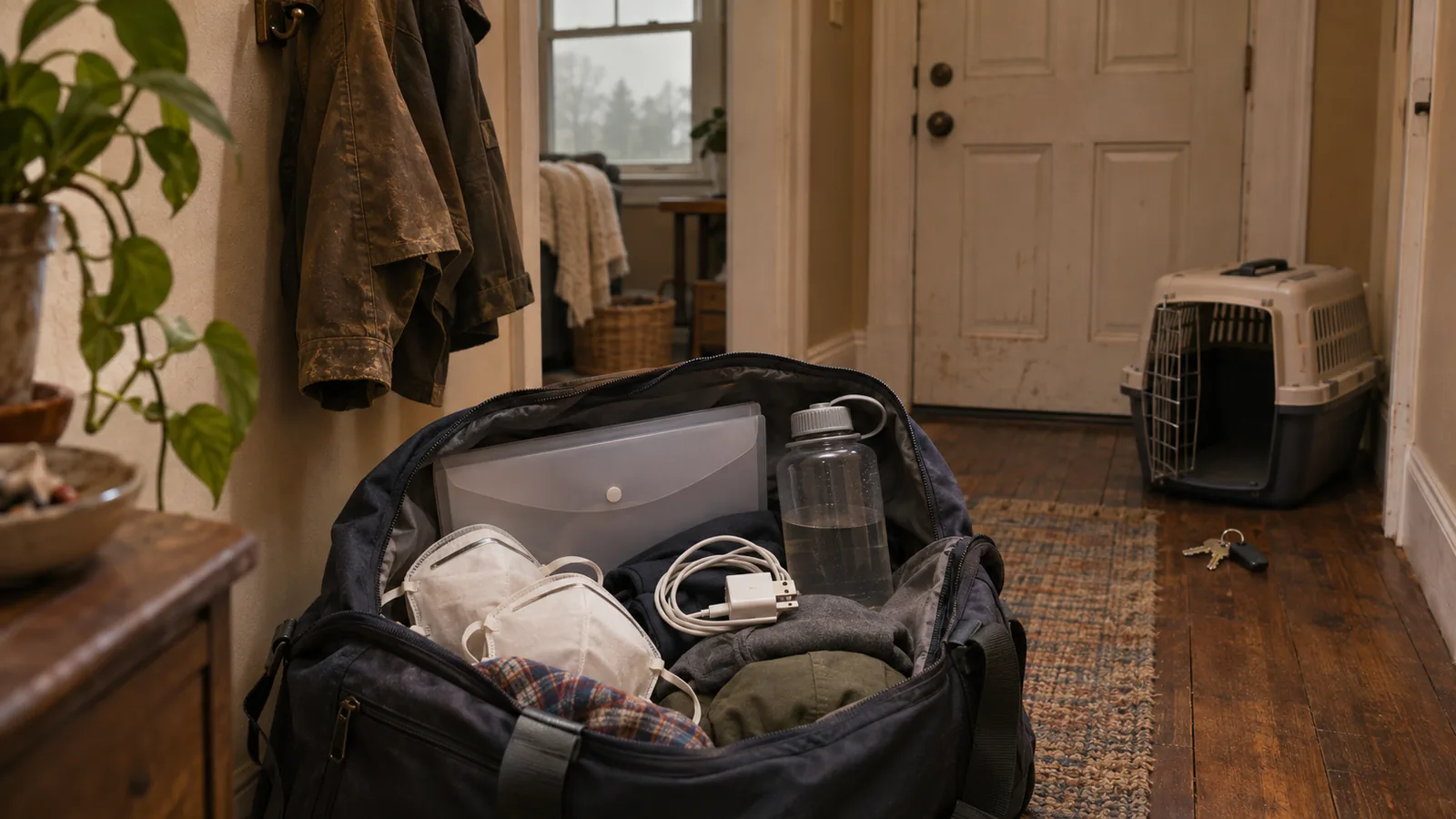

A wildfire evacuation kit is not a general go bag with a mask thrown in. Two things make fire different from almost every other reason to leave a house: the air is dangerous for days in every direction, and you may not be allowed back for weeks.
That changes what belongs in the bag, and it changes the question people actually ask. Nobody wants a list of ninety items. They want to know what to grab when there are fifteen minutes left.
What a Wildfire Kit Has That a Go Bag Doesn't
Start from a standard go bag and add four categories.
Respiratory protection. Smoke is the part of a wildfire that reaches people who are nowhere near the flames, and the particles that matter are far too small for a cloth or surgical mask to catch. A properly fitted N95 or P100 respirator is the only item in this category worth packing. One per person, and more than one each, because they do not last indefinitely in heavy smoke. What they do and do not achieve is covered in Wildfire Smoke.
Eye protection and a long-sleeved layer. Smoke irritates eyes badly, and ash falls. Sealed glasses or goggles and cotton rather than synthetic, which melts.
The irreplaceable. Insurance documents, deeds, prescriptions, the external drive with the photographs, the one box nobody else can reconstruct. This is the category that distinguishes fire from a flood or a storm, because the house may not be there afterwards.
A longer horizon of supplies. The standard three-day framing assumes you go home. After a fire, re-entry is controlled by the authorities and can be weeks away. Clothes for a fortnight, not a weekend, and the chargers for everything.
Fifteen Minutes: The Non-Negotiables
This is the real scenario, and the list is short because it has to be.
People and animals first, counted out loud. Then medication — the actual bottles, not a note about them. Then the document pouch, if it already exists as a pouch; if it does not, this is the stage you skip it and accept the consequences later. Assembling one is a job for a quiet evening — Emergency Documents. Then phones and chargers. Then keys and a wallet. Then the respirators.
Carriers are the bottleneck with animals, every time. A cat that will not go into a carrier under normal conditions will certainly not go into one with sirens outside. Carriers live where you can reach them in the dark, and Pet Emergency Kits covers the rest.
One Hour: Documents, Medication, Pets
With an hour, the fifteen-minute list stops being the whole list and starts being the first ten minutes of it.
Add the medical layer properly: a written list of prescriptions and doses, any equipment that needs power, spare glasses, hearing aid batteries. Add a change of clothes per person and something warm, because a night in a car or a shelter is cold whatever the daytime temperature was. Add the pet food, the leads and the vaccination records that some shelters ask for. Add a paper copy of the addresses and numbers you would otherwise look up on a dead phone — Emergency Contacts.
Then the valuables, in a deliberate order you decided in advance rather than one chosen while standing in a hallway. A wildfire evacuation checklist earns its place here, because at this stage the limiting factor is memory rather than time.
A note on FEMA. People search for a fema wildfire evacuation checklist expecting a single authoritative document; what exists is Ready.gov's wildfire guidance and the general evacuation checklists, which are good and are not fire-specific. The fire-specific parts — respirators, re-entry timelines, the irreplaceables — you assemble yourself.
The Night Before, and the Printable Checklist
Everything above works much better if the staging happened before the order.
On a red flag warning day, or at Ready in your zone, do the cheap things: park facing out, fill the tank, charge everything, put the carriers by the door, move the document pouch to the vehicle, bring in the cushions and the doormat. None of it takes an hour and all of it removes decisions from the moment when decisions go badly. Which level you are at is in Wildfire Evacuation Levels and Zones.
The printable version exists because this is the one checklist that should not live on a phone. The phone is the thing you are charging, the thing with no signal in a canyon, and the thing someone else is using to call a relative.
FAQ: Wildfire Evacuation Kit
What goes in a wildfire evacuation kit?
A standard go bag plus four fire-specific additions: fitted N95 or P100 respirators, eye protection, the documents and media you cannot replace, and supplies for a fortnight rather than three days.
Is there a FEMA wildfire evacuation checklist?
Not as a single fire-specific document. Ready.gov publishes wildfire guidance and general evacuation checklists; the fire-specific items are left to you.
Where can I get a wildfire evacuation checklist PDF?
Yes — ours is one page, free, no form. County fire districts often publish a local version worth having alongside it.
Do I need a respirator, or will a dust mask do?
A dust mask or cloth mask does not filter the fine particles in wildfire smoke. An N95 or P100 that seals against the face does, and the seal is the part that matters — facial hair or a child's face defeats it.
What do people most often forget?
Chargers, spare glasses, pet carriers, and the external drive or photo albums. All four are obvious in hindsight and all four are invisible at speed, which is the argument for a written list.
Sources
- Ready.gov — wildfires and evacuation
- CDC and EPA — respirator effectiveness against wildfire smoke particles
- NIOSH — N95 and P100 filtering facepiece respirators, fit and limitations
- CAL FIRE — Ready, Set, Go! evacuation guidance
Re-entry rules, shelter requirements and animal intake policies are set locally. For current conditions see the Live Emergency Map. When an evacuation order is active, follow local authorities and emergency services before any general guidance. See our Editorial Policy and Sources & Fact-Checking.