
Almost everyone arrives here wanting one number: the standby generator installation cost. Nobody can give it honestly without standing in your side yard, looking at your gas meter and opening your panel. What anyone can give you is the list of things that move the number, which beats a range you would have to throw away.
So: what the machine is, what the installation involves, which variables swing a quote hardest, and how to compare three without being an electrician. No prices, no contractors.
What a Standby Generator Actually Is
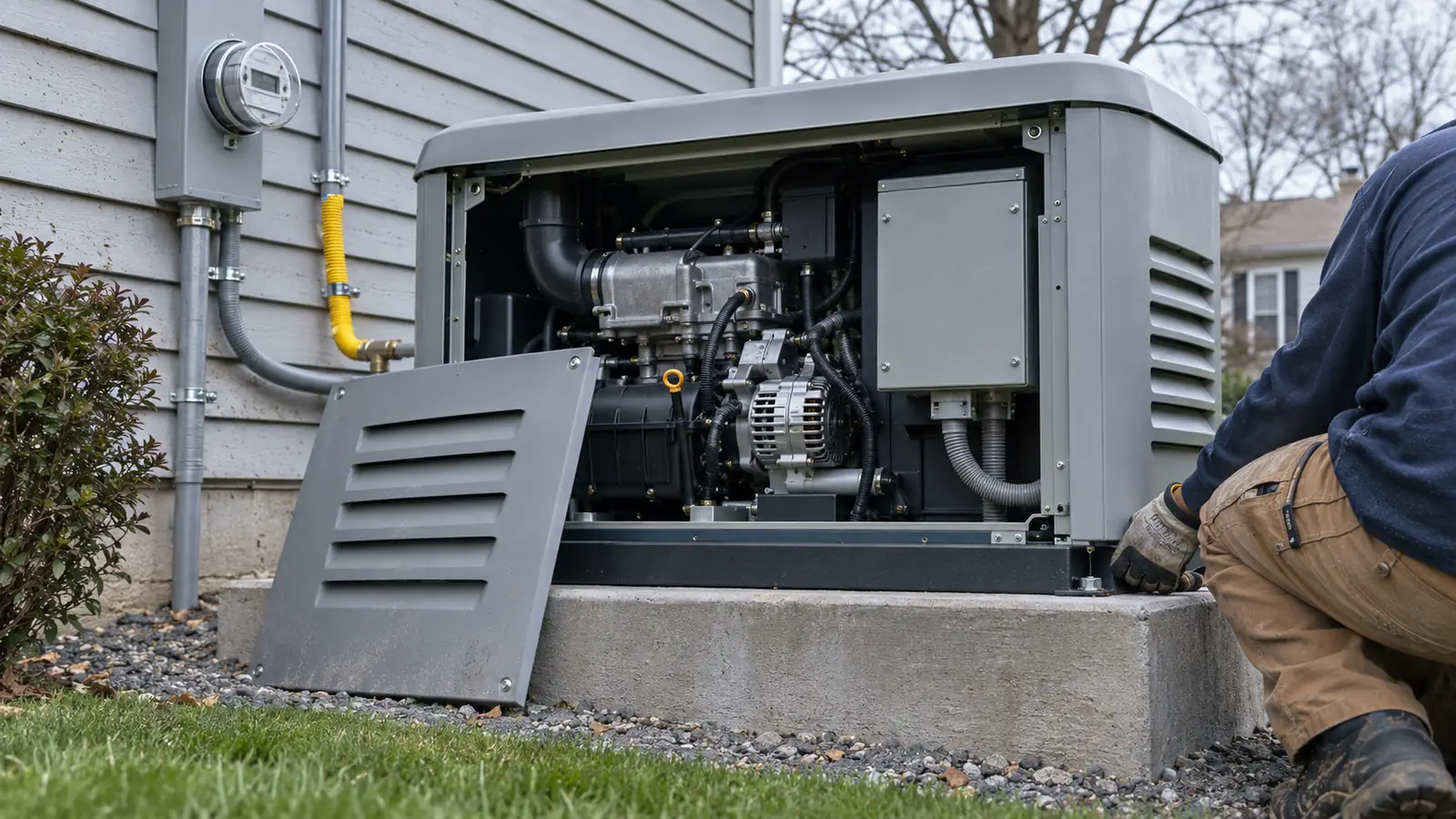
Ask what is a standby generator and the short answer is: a permanently installed engine that starts itself. It sits outside on a pad, wired in through an automatic transfer switch, fed by a gas line rather than a jerry can. When the utility drops, the switch senses it, the engine starts, and the covered circuits come back in under a minute. When the utility returns, it hands the load back and shuts down.
That self-starting behaviour is the whole point, and it separates this from a portable generator you drag out and refuel by hand. It is also why the installation is a real project: you are adding a fuel appliance and a service-rated switching device at the same time.
A whole house generator is the same machine sized to carry everything, and people asking about the whole house generator cost are usually pricing that larger machine without realising it. Most installations are not that: most carry a chosen set of circuits — heating, well pump, refrigeration, a few outlets — because sizing for every circuit at once is where budgets go to die.
What the Installation Actually Involves
Four trades' worth of work, usually inside two or three days on site.
The pad and the siting. A level base, concrete or moulded composite, set at a clearance distance from windows, doors, vents and the property line. Those clearances come from the manufacturer's instructions and from local code, and they are the commonest reason a planned location has to move.
The fuel connection. A gas fitter runs and sizes the pipe. Sizing matters more than people expect: an undersized run starves the engine under load even though the pipe is technically connected. On propane, the tank capacity and its own clearances enter the picture.
The electrical work. A licensed electrician sets the transfer switch beside the service panel, runs the control and power conductors, and sorts out grounding and bonding. On an older panel this is where the surprise usually lives — no room, or a service that needs attention first.
The permit and the inspection. Both the gas and the electrical work are normally permitted and inspected. This is routine, and a quote that omits the fees and the inspection time is not cheaper, just less complete.
What Moves the Number on a Quote
The standby generator installation cost is driven less by the generator than by the house it is going into. In rough order of how much they swing a quote:
- Sizing. What you ask it to carry decides the machine, and the machine decides the gas pipe and the switch. Doubling the covered load does not double the price, but it moves everything.
- Fuel supply. An existing natural gas service near the proposed pad is the easy case. A long run, a meter upgrade or a new propane tank is not.
- Distance and terrain. Trenching through lawn is one thing; through a paved driveway, mature roots or rock is another.
- Panel condition. An old or full panel can turn a clean install into a service upgrade.
- Switch type. A whole-panel switch and a smaller essential-circuits switch are different devices, wired differently.
- Local permit and inspection practice. Varies by jurisdiction, sometimes by a lot.
Which is why a generator installation cost calculator can only produce a starting guess: the inputs that matter most — pipe run, panel condition, ground conditions — are the ones a form cannot see. Treat any generator installation cost estimate made without a site visit as a conversation starter.
Reading a Quote Without Being an Electrician
Ask for the quote itemised, and check that these appear as separate lines rather than hidden in a single figure:
- the generator model and rated output, and the load it was sized for;
- the transfer switch type, and which circuits it covers;
- gas pipe length and size, and who does the gas work;
- conductor run, the pad, and any panel work;
- permit fees and inspection attendance;
- commissioning, the first load test, and what the warranty covers;
- maintenance — these machines exercise themselves weekly and want servicing on a schedule.
Three quotes covering the same scope are comparable. Three where one sizes for the whole panel and another for six circuits are not, and the cheap one is not cheap. The commonest reason a residential generator installation cost comes in far below the others is that it quietly covers far less — which is also why an average cost for generator installation is a number without a referent, and why a whole house generator cost installed figure means nothing detached from a stated scope.
Two more things to ask, because they are often fudged: the standby generator installation code requirements your installer is working to, and whether the sizing was calculated or guessed from square footage. A sizing from floor area is a guess wearing a number. And when you contact standby generator installers, ask all three the same scope question in the same words.
Safety, and the Limits of This Page
This is an engine burning fuel next to a house, so carbon monoxide is the hazard that actually kills people during outages — that is what the clearances from windows, doors and vents are for, along with a working CO alarm on every floor. See also power outage preparedness and generator safety. Nothing here is a wiring procedure: transfer switches and service panels are work for a licensed electrician under permit, and the details come from your local code, not from an article.
FAQ: Standby Generator Installation
How much does a generator installation cost?
The standby generator installation cost depends almost entirely on the fuel run, the panel condition and the load you size for, so any published figure would mislead you. Three itemised quotes covering the same scope, compared line by line rather than on the total, is the useful move.
What is a standby generator, and how is it different from a portable one?
It is permanently installed, fed by a gas line, and starts itself through an automatic transfer switch when the utility fails. A portable generator is moved into place, refuelled by hand and connected manually.
Do I need a permit?
Almost always, for both the gas and the electrical work, with an inspection at the end. Treat a quote that leaves out the fees and the inspection time as incomplete rather than competitive.
Does it have to power the whole house?
No, and most do not. Sizing for a chosen set of circuits — heat, water, refrigeration, a few outlets — is the normal approach. Covering every circuit at once drives the machine, the pipe and the switch upward together.
How do I find a good installer?
We keep no directory and recommend no contractors. Ask for the licence and permit history, ask how the sizing was calculated, ask for references on work of similar scope — then compare three itemised quotes.
Is a battery system an alternative?
Sometimes, and the trade-offs differ rather than one being better. See home battery backup vs generator.
Sources
- National Fire Protection Association — National Electrical Code, including the articles covering optional standby systems and transfer equipment
- National Fire Protection Association — National Fuel Gas Code, pipe sizing and appliance connection
- U.S. Consumer Product Safety Commission — carbon monoxide hazards from engine-driven generators
- U.S. Department of Energy — residential standby power and electrical panel considerations
- Occupational Safety and Health Administration — generator siting, grounding and backfeed guidance
Code editions, permit requirements, clearance distances and inspection practice are set locally and are revised; verify with your local building department and with the manufacturer's installation instructions. This page is general information, not an electrical or gas design. We recommend no contractors and receive no referral fees. See our Editorial Policy, Sources & Fact-Checking and Affiliate Disclosure.