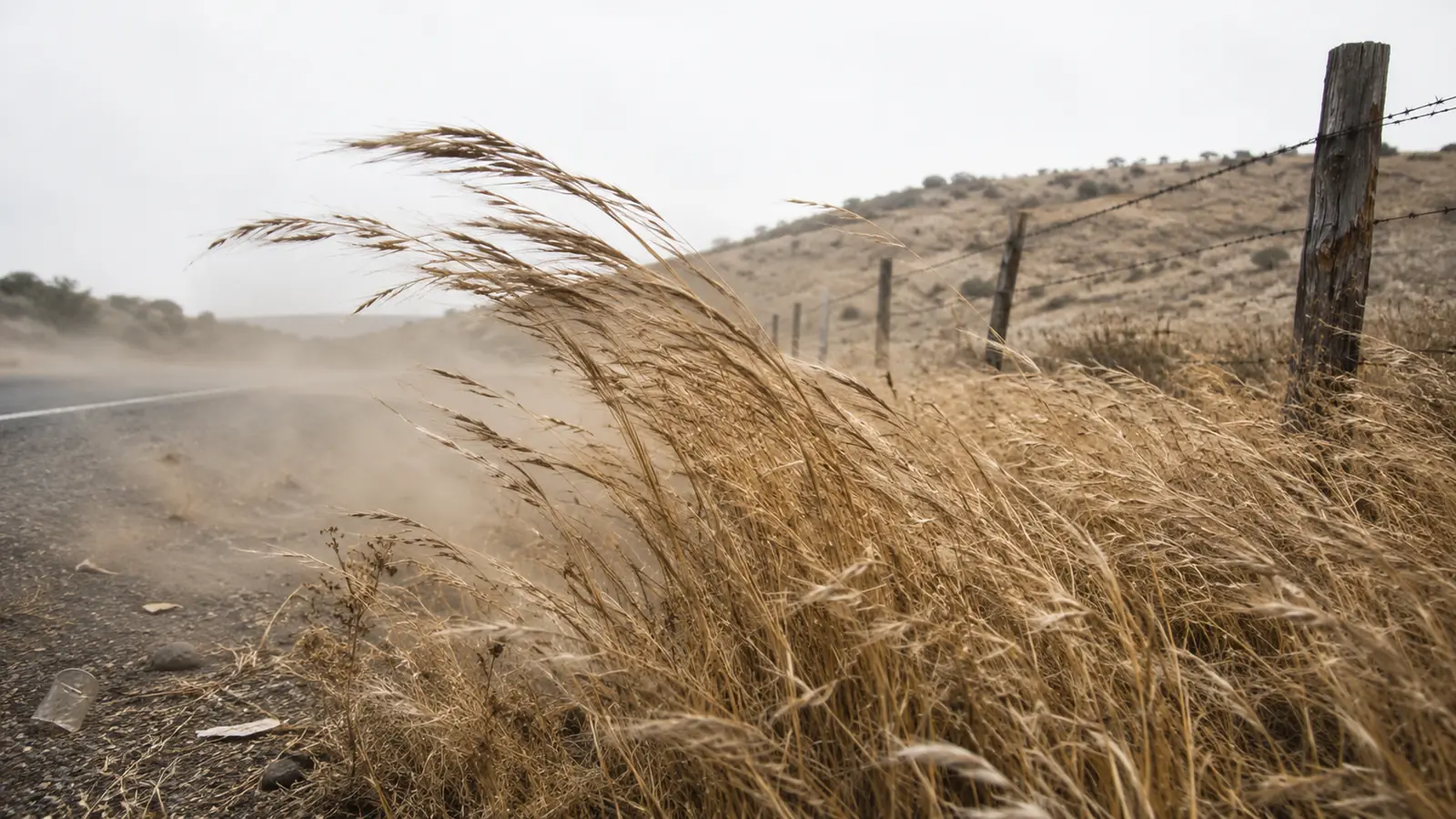

A red flag warning does not mean a fire is burning. It means the weather has arranged itself so that if one starts, it will spread faster than anyone can contain it.
That distinction decides what you are supposed to do. The instruction is not "evacuate". It is "produce no sparks" — and it is aimed at the entire population of an area, because most wildfires start with people.
A Red Flag Warning Is About Conditions, Not a Fire
The clearest way to understand the red flag warning meaning is by analogy with a severe thunderstorm watch: nothing has happened, and the atmosphere is loaded.
Three things have to line up. Wind carries flame into new fuel and throws embers ahead of the fire front, which is how fires cross roads and rivers. Low relative humidity dries vegetation to the point where it ignites from a spark rather than needing sustained heat. Dry fuel — cured grass, dead brush, drought-stressed timber — is the part that accumulated over weeks and cannot change overnight.
Add warm temperatures and you have a day on which a dragging trailer chain, a mower blade on a stone, a cigarette or a spark from a power line becomes a fire nobody catches in the first hour. Most wildfires are human-caused, which is the entire reason this warning is addressed to the public rather than to agencies.
What it is not: a prediction that a fire will occur, a statement about any particular fire, or an evacuation instruction. Evacuation runs on a separate system — Wildfire Evacuation Levels and Zones.
What Triggers One, and Why the Threshold Moves
People reasonably expect national numbers. They do not exist, and the reason is sound.
The red flag warning criteria are set by each NWS Weather Forecast Office with the land management and fire agencies it serves, because what counts as dangerous depends on the vegetation. Relative humidity in the teens with sustained winds in the twenties is a common shape, but a figure that is routine in the Great Basin would be extraordinary in the Southeast.
Fuel condition is usually part of the test as well. The same wind and humidity will not produce a warning if recent rain has left the vegetation damp — the weather alone is not sufficient.
So the useful thing to know about red flag warning conditions is not a number but where to find yours: your local office publishes its fire weather criteria on its own site, and the forecast that precedes the warning is explained in Fire Weather Forecasts.
Watch, Warning, and Whether There Are Levels
There is no scale. People search for red flag warning levels expecting something like the hurricane categories, and the honest answer is that the product is binary. What varies is timing and emphasis.
| Fire Weather Watch | Red Flag Warning | |
|---|---|---|
| Means | Critical conditions are possible | Critical conditions are happening or imminent |
| Lead time | Up to 72 hours ahead | Within the next 24 hours, or now |
| Your move | Plan the week around it | Change today's behaviour |
| Issued by | Local NWS office | Local NWS office |
Some offices do add emphasis within a warning when the setup is exceptional — the phrasing varies by region and, in parts of the West, a particularly dangerous situation is called out explicitly in the text. Treat that wording as the signal it is meant to be, and read the actual product rather than the colour of an icon.
One more distinction worth keeping straight: the warning is not a burn ban. Bans and fire restrictions are legal instruments issued by counties, fire districts and land agencies. They frequently follow a warning, and they outlast it.
What to Stop Doing for the Next Twelve Hours
This is the part that is actually actionable, and almost all of it is about ignition.
No outdoor burning of any kind. No brush piles, no burn barrels, no campfires, no fireworks. The grill is the common argument: a gas grill on a concrete patio away from vegetation is a different proposition from charcoal on a wooden deck, but on a red flag day local restrictions may remove the choice.
No spark-producing equipment on dry vegetation. Mowers, strimmers, chainsaws, grinders and welding all qualify. If the clearing work has to happen, it happens early in the morning on a different day.
Park off dry grass. A hot exhaust or catalytic converter over cured grass ignites it. The same goes for dragging trailer safety chains, which throw sparks along miles of roadside.
Nothing lit out of a window. Obvious, and still one of the recurring causes.
Then the preparation side, which costs nothing on a day you were already paying attention: park facing out, keep the tank above half, make sure the bag and the carriers are where you can reach them — Wildfire Evacuation Kits & Checklists — and check that someone in the household is monitoring alerts. Because these warnings do not usually arrive as a phone alert, the reliable channels are your NWS office, a NOAA weather radio, and an alert app configured for fire weather.
FAQ: Red Flag Warning
What does a red flag warning mean?
That wind, humidity and dry fuel have combined so that a new fire would spread rapidly and be hard to control. It is a statement about conditions, not about an existing fire.
What are the criteria for one?
Each NWS office sets its own thresholds for wind, relative humidity and fuel dryness, in consultation with fire agencies. There is no national number, because the same weather means different things in different vegetation.
Are there levels or categories?
No. It is issued or it is not. The Fire Weather Watch is the earlier, lower-confidence stage, and some offices add explicit wording when a setup is unusually dangerous.
Is it the same as a fire ban?
No. The warning is a weather forecast product. Burn bans and fire restrictions are legal orders from counties, fire districts or land agencies — often issued alongside, and often lasting longer.
Can I still use a grill?
Check local restrictions first, because they may say no. Where it is permitted, gas on a hard surface well clear of vegetation is far lower risk than charcoal, embers or anything on a wooden deck.
How do I find out if one is active near me?
Your local NWS office page on weather.gov is the authoritative source, and a NOAA weather radio or an alert app set to fire weather will tell you without being asked. These warnings are not normally pushed to phones automatically.
Sources
- NOAA National Weather Service — fire weather products, Red Flag Warning and Fire Weather Watch definitions
- National Interagency Fire Center — human-caused ignition statistics
- CAL FIRE and Ready.gov — wildfire prevention and red flag day guidance
- NWS Weather Forecast Offices — locally published fire weather criteria
Criteria, wording and local fire restrictions vary by NWS office and by jurisdiction. This page explains the product; it does not report active warnings. For current conditions see the Live Emergency Map. When a warning is active, follow local authorities and emergency services before any general guidance. See our Editorial Policy and Sources & Fact-Checking.