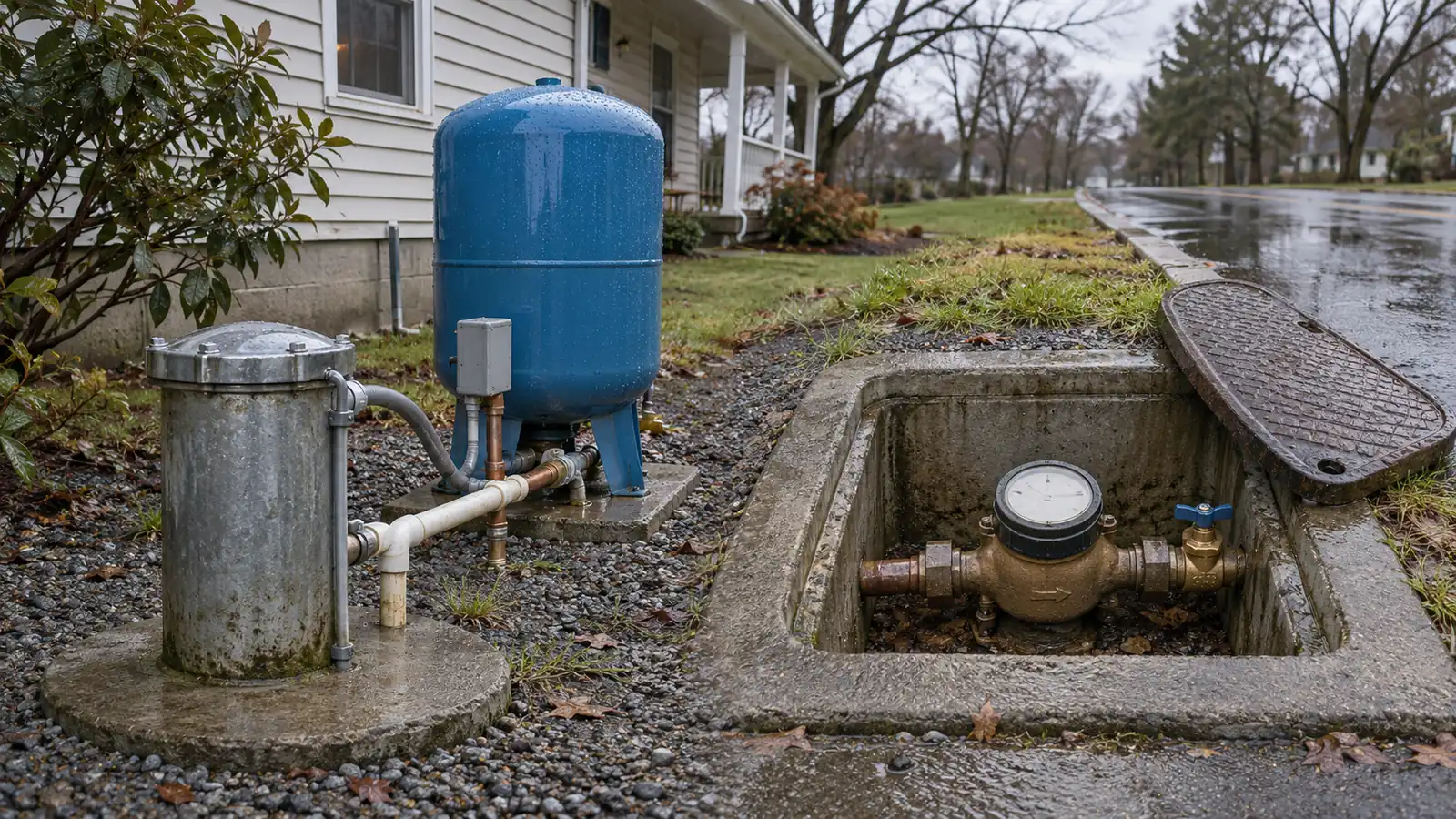

The difference between well water and city water is not really about water quality. It is about who is responsible. On a municipal supply, a utility treats, tests and monitors continuously, and sends you a bill and an annual report. On a well, all of that is yours — the testing, the treatment, the pump, the repair bill, and the decision about when something is wrong.
Everything else follows from that transfer. People usually frame it as the benefits of well water vs. city water, but benefits run both ways and the honest list has costs on both sides. Here it is laid out properly, including the part nobody mentions: switching from one to the other is a project in itself.
WELL
No water bill, independent of the municipal system, and yours to control. Also yours to test, treat, power and repair — and it stops when the electricity does.
CITY
Treated, disinfected and tested by someone else, with pressure during outages. Metered, chlorinated, and entirely outside your control.
Side by Side
Whether you frame it as municipal water vs well water or well water vs city water, the comparison lands on the same handful of things — the ones people notice after a few years rather than in the first week:
- Testing. City: done continuously by the utility, reported annually. Well: your responsibility, and nobody reminds you.
- Treatment. City: disinfected before it reaches you, usually with chlorine. Well: untreated unless you install treatment yourself.
- Cost shape. City: a predictable monthly bill. Well: no bill, but electricity to pump, periodic testing, treatment consumables, and occasional large repairs.
- Power cuts. City: usually keeps flowing on stored pressure. Well: stops immediately, because the pump is an electrical appliance.
- Taste. City: often chlorine. Well: often minerals, iron or sulphur. Both are addressable and neither indicates safety.
- Hardness. City: varies by source, and the utility tells you. Well: commonly harder, and often needs a softener.
- Control. City: none over source or treatment. Well: complete, including the right to get it wrong.
- Risk profile. City: infrastructure failures, main breaks, boil-water notices. Well: contamination from the surface, a failing seal, a dry season, a dead pump.
Is Well Water Cheaper?
The honest answer to is well water cheaper than city water is: the monthly cost is lower and the lifetime cost is less predictable. There is no volumetric charge for water you pump yourself, which is a real and permanent saving. Against that sit costs a municipal customer never sees.
Electricity to run the pump, which is a continuous cost that rises with depth and usage. Testing, which should be annual and is not free. Treatment equipment and its consumables, where needed. And the capital items: pumps fail, pressure tanks fail, and a well itself has a finite working life. None of those arrive on a schedule, which is the real difference — a water bill is small and certain, well ownership is cheaper on average and occasionally expensive all at once.
So the comparison is less about the total and more about whether an unpredictable four-figure repair is something you can absorb. For many households it comfortably is, and the independence is worth it.
Which Is Safer?
Neither, as a category. A municipal supply is treated and monitored against enforceable standards, which makes it reliably adequate. It is also vulnerable to failures in distribution — this is what a boil-water notice is — and the treatment is designed for the source rather than for your pipes.
A well can be better than anything a utility delivers, or genuinely unsafe, and the difference is invisible. The contaminants that matter most on a well — bacteria, nitrate, arsenic — have no taste, colour or smell at the concentrations that affect health. Nobody is testing for them unless you arrange it, which is why private wells are typically tested annually for bacteria and nitrate, and less often for the rest.
The practical conclusion is uncomfortable but simple: on city water, read the report. On a well, you do not have an opinion about your water quality until you have a laboratory result. That is covered on well water test kits and professional testing, and treatment options on water treatment systems for home.
Switching From One to the Other
A surprising share of the questions here are not city water vs well water comparisons at all but logistics — people facing a well water to city water conversion because a main has reached their road, or because a well has failed.
Connecting to a municipal main typically involves a connection fee, a service line, a meter, a backflow preventer, and plumbing work to disconnect the well from the household system. That last step is neither optional nor cosmetic: a cross-connection between a private well and a public main is a contamination route into everyone else's water, and the rules are strict. Many jurisdictions also set requirements for the old well — capped, kept for irrigation under conditions, or properly decommissioned.
Going the other way means siting, drilling, a pump and pressure system, electrical work, testing and almost certainly treatment. Both directions are permitted projects, and the sequence and fees are set where you live rather than nationally.
On a well, one planning point outranks the rest: no power means no water. Stored water and a way to run the pump turn the biggest weakness of a private well into an inconvenience — see water storage tank sizes and backup power and energy.
Common Questions
Does well water taste better than city water?
Often, because it has no chlorine. That is a preference rather than a quality judgement — chlorine is there precisely because it keeps water safe through miles of pipework, and a well without it has no residual protection.
How often should well water be tested?
Annually for bacteria and nitrate as a baseline, and again after any flooding, work on the well, a change in taste or colour, or a new baby or pregnancy in the house. Broader panels — arsenic, lead, radon, pesticides — are usually run less often but at least once, since they depend on local geology.
Is a house with a well worth less?
It varies by market, and the question at a sale is usually practical rather than financial: buyers and lenders frequently require a recent water test and a satisfactory flow rate. Current test results in hand remove most of the friction.
Can I keep my well after connecting to city water?
Sometimes, for irrigation or livestock, but only if it is fully disconnected from the household plumbing in a way the local authority accepts. The requirement exists to prevent backflow into the public main, and it is enforced.
Does city water ever stop during a power cut?
It can, though later than a well does. Distribution systems hold pressure through elevated storage, so taps often keep running for a while; extended outages can bring pressure loss or a precautionary boil-water notice.
Sources
- U.S. Environmental Protection Agency — private drinking water wells, testing frequency and owner responsibilities
- U.S. Environmental Protection Agency — National Primary Drinking Water Regulations and Consumer Confidence Reports for public water systems
- Centers for Disease Control and Prevention — well water testing, contamination routes and comparison with public supplies
- National Ground Water Association — well construction, pump and well service life, and well decommissioning
- U.S. Geological Survey — groundwater quality and regional variation in well water chemistry
Connection fees, permit requirements, cross-connection rules and well decommissioning standards are set locally and vary widely; so does groundwater chemistry. This page is general information rather than guidance for a specific property — consult your local health or building authority and an accredited laboratory. See our Editorial Policy, Sources & Fact-Checking and Affiliate Disclosure.