
Searches for an earthquake kit almost always come back with the same answer: a three-day box of water, food, a radio and a first aid kit. That list is correct, and it is also the list for every other hazard. It tells you nothing about what shaking specifically does to a household.
So this page skips the generic contents, which are set out properly at Emergency & Survival Kits, and deals only with what changes when the hazard arrives without warning, breaks glass at floor level, and knocks out the water supply for a neighbourhood that nobody evacuated.
The Five Things a Generic Kit Leaves Out
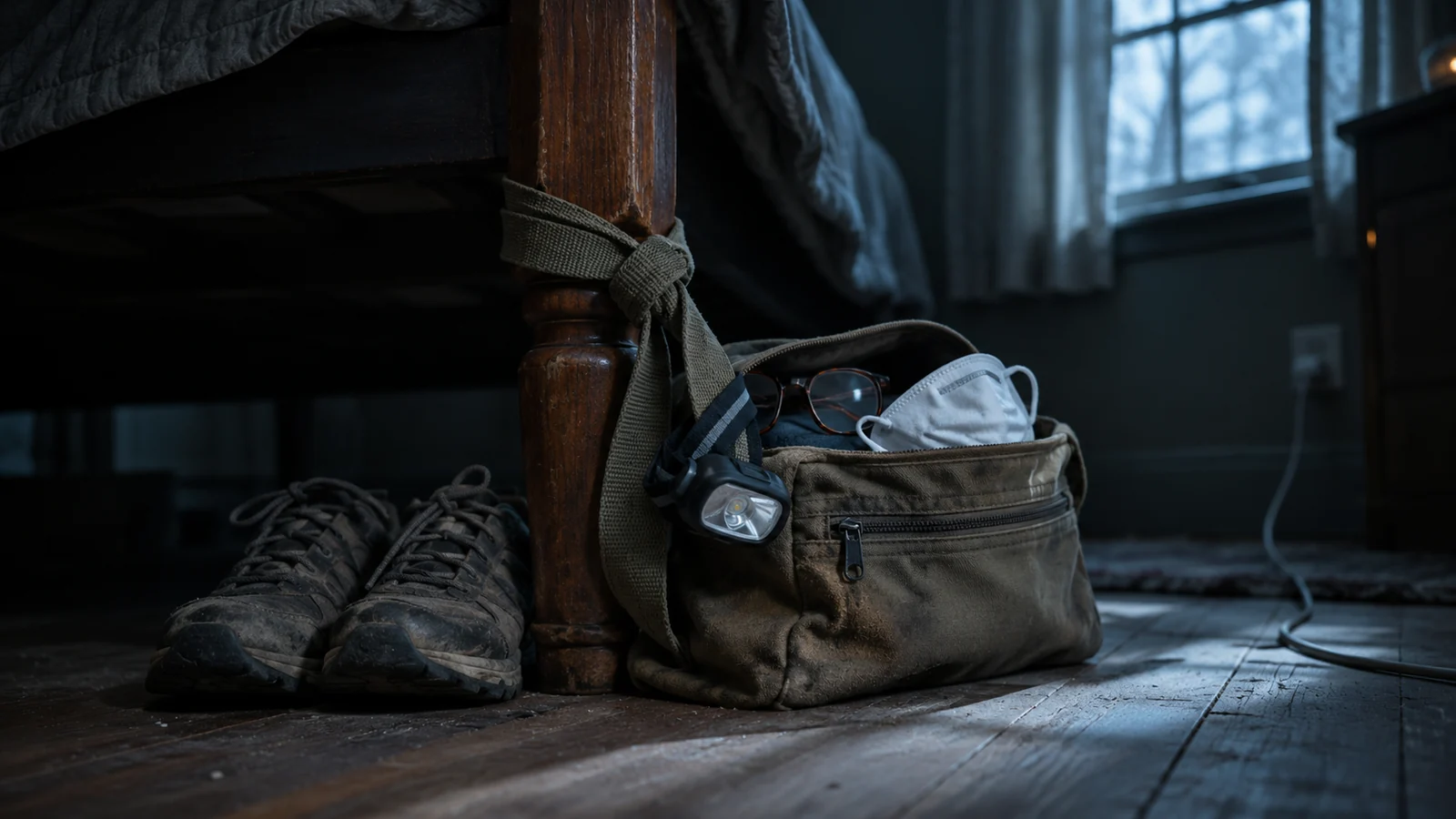
Start with the floor. A quake at three in the morning puts window glass, crockery and picture frames across every floor in the house, and takes the lights out at the same moment. People are cut walking to the hallway in bare feet, in the dark, in their own homes. Closed-toe shoes and a headlamp, in a bag tied to a bed leg, solve that for the price of a takeaway. Nothing else on any list has that ratio.
Then the four that follow from it:
- Heavy work gloves. Clearing a doorway, lifting a fallen shelf, shifting glass. Garden gloves are not enough.
- N95 respirators. Collapsed plaster, insulation and masonry dust are the standard air quality after shaking, indoors and out.
- A gas shutoff wrench, kept at the meter rather than in the kit, where you will actually find it.
- A whistle per person. Trivial, weightless, and the only thing that works once someone is trapped and shouting has stopped working.
Water, and Why Three Days Is the Wrong Target
A gallon per person per day is the right unit. Three days is the wrong multiplier here, and the reason is structural rather than cautious.
In a hurricane or a wildfire the population leaves and the utilities repair an empty area. After a damaging earthquake nobody leaves. Mains and treatment plants break under the same shaking that broke the houses, and the repair happens where every tap is still in demand. Boil-water notices run for days. The Red Cross now frames the home supply as a two-week stay-at-home kit rather than a three-day one, and two weeks of water is a different conversation from seventy-two hours.
Two weeks per person is bulky, so layer it: a small supply in the grab bag, bottles in a cupboard, the bulk in food-grade containers. Add water for animals (Pet Emergency Kits), and remember an undamaged water heater already holds thirty to fifty gallons.
One Kit Is Not Enough: Car, Desk and Home
Every other hazard lets you be somewhere specific. This one catches you wherever you happen to be, which is the argument for splitting rather than perfecting.
The earthquake kit in the car does the heaviest lifting, because it covers the case where roads close and you are on the far side of the closure from your own front door. Shoes you can walk miles in, water, a light, a charged power bank, a paper map of the metro area, cash in small notes, and any medication you cannot skip for forty-eight hours. Our Car Emergency Kits page covers the vehicle-specific items; the earthquake addition is simply the assumption that you may be walking home.
At work, a small bag in the desk drawer with shoes, a light, water and a whistle. Workplace Emergency Kits goes further. And at home, the full supply — this is where an earthquake kit list of items, and a check of the dates on it, actually belongs. Earthquake kits for home carry the bulk water and the tools; the other two carry what gets you back to them.
Review twice a year. Water and batteries age, children outgrow the shoes in the bag, prescriptions change, and a kit packed four years ago and never opened is a box of expired items in sizes nobody wears.
Aftershocks, and the Long Tail of the Shopping List
First, the kit has to survive being used repeatedly rather than once. Tools and gloves stay accessible, not packed at the bottom of a sealed tub. Second, you may be sleeping somewhere else — a porch, a car, a shelter — while the sequence calms down, which puts warm layers, a sleeping bag and a tarp into the list for reasons that have nothing to do with camping. Emergency Blankets & Sleeping Bags and Emergency Tents & Tarps cover the options.
Finally, a note on where the earthquake kit supplies question goes wrong. Most of what is sold as an earthquake-specific bundle is a generic kit with a different label on the lid. The genuinely earthquake-specific items are the cheapest ones on this page: shoes, a light, gloves, masks, a whistle, a wrench. Buy a bundle if the convenience is worth it, but do not expect the bundle to contain the parts that matter most, and check what is actually in it against the list above.
FAQ: Earthquake Kits
What should be in an earthquake kit?
The generic household contents — water, food, light, radio, first aid, medication, documents, cash — plus six specific additions: closed-toe shoes and a headlamp by the bed, heavy gloves, N95 masks, a gas shutoff wrench at the meter, and a whistle each.
Is there an earthquake kit checklist I can work from?
Use the generic household checklist as the base and add the six items above. Any earthquake kit checklist that does not mention shoes beside the bed has skipped the one item that is specific to shaking.
How much water for an earthquake kit?
One gallon per person per day, well past three days. Two weeks is the Red Cross figure for a stay-at-home kit, and it suits shaking particularly well, because mains break while the whole population is still at home and still demanding water.
Do I need one for the car as well as the house?
Yes, and the car kit may be the more useful of the two. A quake can easily catch you at work or on the road with closures between you and home, so pack it on the assumption that you walk.
Is a pre-made kit worth buying?
It is a reasonable shortcut to the generic contents, but check the earthquake kit contents against this page. Most bundles are a standard three-day kit relabelled, and the genuinely shaking-specific items are usually the ones left out.
Sources
- Ready.gov — build a kit, water storage, and earthquake guidance
- USGS — earthquake hazards and aftershock forecasting
- American Red Cross — earthquake safety and survival kit supplies
- CDC — respiratory protection and dust exposure after structural damage
Storage recommendations differ between agencies and regions; the two-week figure used here is the Red Cross stay-at-home kit, not a three-day go-bag. For current conditions see the Live Emergency Map. See our Editorial Policy and Sources & Fact-Checking.