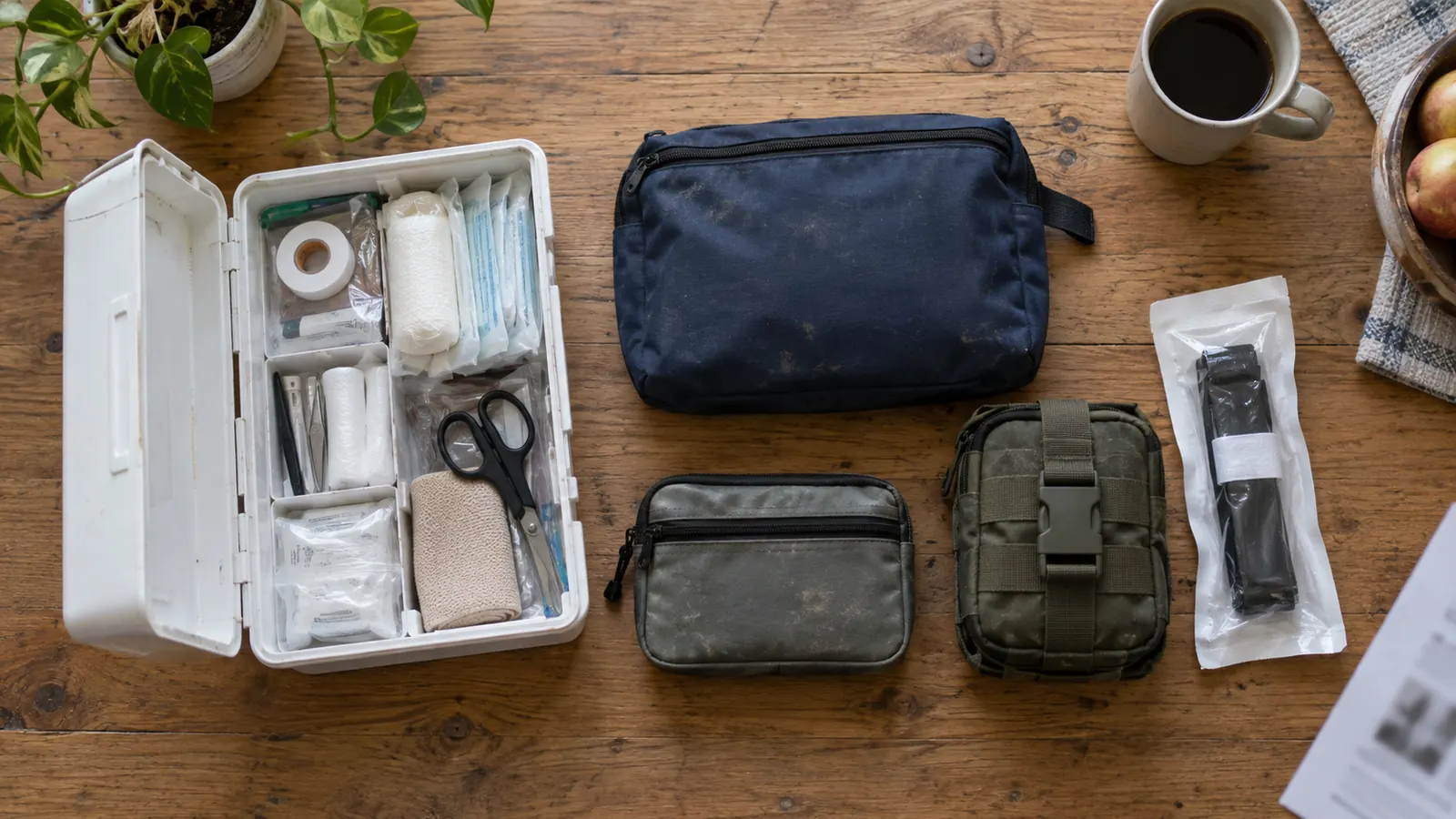

Ten guides live here, and they answer two different questions. What do I do with my hands right now, and what should I own when it happens again?
Most people arrive looking for the second and need the first. A kit makes a capable person faster; it does not make an incapable one capable. That ordering runs through every page below.
Training First, Equipment Second
Three things change whether someone survives the next ten minutes: severe bleeding, cardiac arrest and choking. None of them is solved by owning something. All three are teachable in an afternoon.
First Aid Basics is the free version — what a bystander can safely do before professionals arrive, and the handful of confident pieces of advice that are actually wrong. First Aid Training covers what a certificate involves and which formats employers accept. BLS vs CPR settles the one question people get wrong before booking.
Which Kit, and Where It Lives
Where the kit lives decides more than what it cost. A good kit two floors away loses to a mediocre one in the kitchen drawer, every time — so the location comes before the comparison.
First Aid Kits is the general buying guide, built on independent testing of fifteen purchased kits rather than on piece counts. Home and vehicle get their own pages because the constraints genuinely differ: a domestic kit is judged on depth of basics, a vehicle kit on surviving heat and neglect.
When a First Aid Kit Isn't Enough
A trauma kit answers one question an ordinary kit cannot: what to do when someone is losing blood faster than their body can spare it. It is a narrow tool with an obligation attached, and that obligation is training.
Most households need the ordinary kit and have never needed the other one. If you're unsure which describes you, the comparison page settles it faster than either buying guide.
FIRST AID KIT
Cuts, burns, sprains and blisters. You have hours and a car. Every household needs one.
TRAUMA KIT
Life-threatening bleeding. Minutes, not hours. Power tools, remoteness, or training already done.
Print It, Then Restock It
The kit that gets restocked is the kit with a list taped inside the lid. Both printables here are free, need no email address, and are sized to one page because a stapled document is a document nobody turns over one-handed.
The checklist is sized by where the kit lives — pouch, household, vehicle — and carries the restock intervals. The emergency guide is the sheet for the cupboard door, read by someone who isn't you.
If you only do one thing after reading this page: book a course. The equipment decision gets much easier once you have held the gear.
Sources
- American Red Cross — first aid steps, kit contents and training guidance
- American Heart Association — CPR, BLS and choking guidelines
- Stop the Bleed / American College of Surgeons — bleeding control
- OutdoorGearLab — first aid kit testing, 15 kits purchased and field tested
This page is general information, not medical advice, and does not replace training. When an emergency is underway, follow 911 dispatchers and emergency services before any general guidance. See our Editorial Policy and Sources & Fact-Checking.