
Most wildfire preparedness advice arrives as a list. Lists are fine, but they hide the thing that decides the outcome: the order you do them in.
Clearing fuel protects the house whether or not anyone is home. Hardening the building protects it against embers, which arrive before the flame front and travel much further than people expect. Packing a bag only matters in the last hour. Work the list backwards and you spend fire season with a beautifully organised bag beside a house still ringed by dry juniper.
First: The Thirty Feet Around the House
Defensible space is the space fire has to cross to reach you, and it is organised in bands.
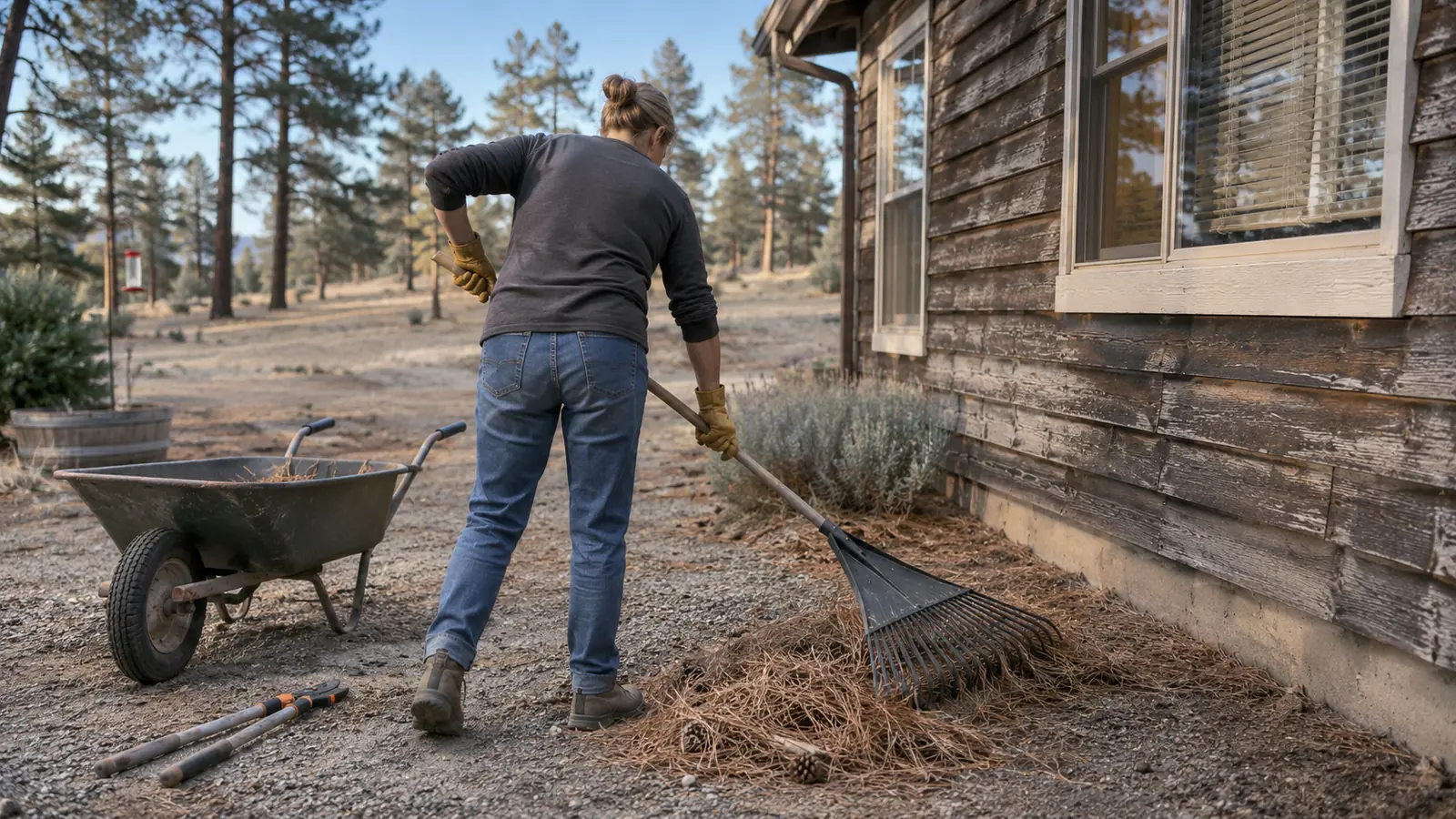
The first five feet — what CAL FIRE calls Zone 0 — should contain nothing that burns. No bark mulch against the siding, no firewood stacked on the porch, no plastic storage bins, no dead leaves collecting in the corner where the wall meets the deck. Gravel, bare soil, concrete. This band is small, cheap and unglamorous, and it is where most of the saved houses were saved.
Five to thirty feet is the lean, clean and green band. Mow before the grass cures brown. Prune the lower branches off trees so a grass fire cannot climb them. Break up continuous runs of shrub so there is no uninterrupted path of fuel. Move the woodpile out here instead of against the house.
Thirty to a hundred feet is thinning rather than clearing. Dead material out, tree crowns spaced, ladder fuels removed.
A wildfire preparedness checklist worth printing starts in this band rather than with supplies, because this is the part that cannot be done in a hurry. Green waste disposal has limits, saws need dry days, and a hundred feet of thinning is a season of weekends. If you rent, or the land is not yours, the realistic version is narrower — Apartment Preparedness covers what you can still control.
Then: The Parts of the House That Catch
Embers land on a house for an hour or more before any fire is visible, and they find the same handful of weaknesses every time. Any honest wildfire preparedness guide puts this second rather than first, because a hardened house inside an unmanaged yard is still a house inside a fuel bed.
Vents are the usual way in. Attic, crawlspace and soffit vents let embers into a space full of dry timber and stored cardboard. Metal mesh with openings no larger than one-eighth of an inch is the standard retrofit, and it costs very little.
Gutters, valleys and the roof edge collect needles and leaves that act as kindling at roof height. Clear them late in the season, not in spring.
Under the deck is a chimney. Sweep it out, screen the gap at the perimeter, and stop storing paint, cushions and spare lumber there.
A wooden fence touching the siding is a fuse laid up to the wall. Replace the last section in metal or masonry, or leave a gap.
Last: The Bag, and the Decision to Leave
Only now does packing make sense. The general version is a go bag plus copies of the documents you cannot replace quickly and a carrier per animal — see Pet Emergency Kits. The fire-specific version, including respiratory protection and the things people reliably forget, is in Wildfire Evacuation Kits & Checklists.
The decision matters more than the bag. Write down, in advance, the condition that makes you leave rather than wait — a specific alert level, a closed road, a smoke column in a particular direction. Know which evacuation zone you live in and what each level requires, which is Wildfire Evacuation Levels and Zones. Pick a second route out, because the obvious one may be the one that closes. And pay attention to red flag warnings, which tell you when conditions have turned, days before anything is burning.
What "Preparedness Level" Means on a Federal Map
If you follow fire news you will see a national wildfire preparedness level quoted on a scale of one to five. It is set by the National Multi-Agency Coordinating Group from fire activity, weather, fuel conditions and how much of the country's firefighting capacity — crews, aircraft, incident management teams — is already committed.
Level five is the highest, and it means those resources are stretched nationally. It is not a grade on your household and it carries no instruction for you. What it does imply, indirectly, is worth knowing: when the national system is at its busiest, a new fire near you may get a smaller initial response than it would in a quiet week. That is an argument for self-sufficiency, not for alarm.
FAQ: Wildfire Preparedness
What is wildfire preparedness?
Three things in sequence: reducing the fuel around the building, closing the openings where embers get in, and arranging to leave quickly. The first two protect the house when nobody is there, which is why they come first.
Is there a wildfire preparedness checklist I can print?
Ready.gov, CAL FIRE and NFPA's Firewise USA programme all publish free checklists, and county fire districts often publish one adapted to local vegetation. Ours for the evacuation stage is on Wildfire Evacuation Kits & Checklists.
When is National Wildfire Preparedness Day?
NFPA runs it as Wildfire Community Preparedness Day, on the first Saturday in May. It exists mainly as a prompt for community clearing projects, and the timing is deliberate — before the vegetation cures.
What does wildfire preparedness level 5 mean?
The highest of the five, set when fire activity and committed resources are at their peak nationally. It is an allocation figure for agencies, not a warning for a specific area and not a measure of your own readiness.
How often does defensible space need redoing?
Every year, and the inner five feet more often than that. Vegetation grows back, needles keep falling, and the band closest to the house is the one that fills up fastest.
Sources
- CAL FIRE — defensible space zones and the ember-resistant zone
- NFPA — Firewise USA, home hardening and Wildfire Community Preparedness Day
- Ready.gov — wildfires
- National Interagency Fire Center — national preparedness levels
Vegetation rules, clearance requirements and defensible space law vary by state and county, and some are enforceable. Check your local fire district before cutting. For current conditions see the Live Emergency Map. When a fire is active, follow local authorities and emergency services before any general guidance. See our Editorial Policy and Sources & Fact-Checking.